Agriculture, Energy Transition, Refined Products, Chemicals, Biofuels, Renewables, Jet Fuel
April 27, 2026
Global Biofuels Alliance targets SAF corridors, advances methanol for marine sector

Editor:
HIGHLIGHTS
GBA negotiates SAF corridors for standardization
Methanol emerges as near-term marine fuel solution
2G ethanol shifts focus from road to SAF feedstock
The Global Biofuels Alliance is in active negotiations with the governments across the world to establish a sustainable aviation fuel corridor linking global airports, a framework designed to drive SAF policy harmonization and standardization across jurisdictions and position India as a global aviation bunkering geography, GBA Director Joshua Wycliffe said at an industry event in New Delhi.
"GBA is in very active talks with the governments of the Netherlands and Singapore to work on a SAF corridor between airports — between let's say Amsterdam-Delhi, Amsterdam-Mumbai, Singapore-Mumbai, Singapore-Delhi," Wycliffe said at the Indian Federation of Green Energy's Green Transport Conclave in New Delhi from April 23-24.
"What it does is it not just promotes SAF, it promotes standardization, brings governments together, brings policy mandates together, and also helps defragment policy differences and standards differences," he said.
Standardization at core
Wycliffe framed the corridor initiative as a response to a structural problem in the global SAF market, a widening mismatch between carrier-level SAF commitments and the absence of binding national policy mandates in many jurisdictions.
He cited an instance of flying on an international flag carrier whose crew announced the flight was operating on SAF, only to discover on landing that the carrier's home country had no SAF mandate in place.
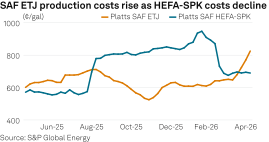
"Everybody is looking at SAF with or without the mandate. But one of the key things we would need to emphasize if leapfrogging is being able to regularize the policy mandate and have frameworks that will then have the uptake. Why would someone invest in technology? Why would they invest in SAF or for that matter in biofuel unless there's a policy mandate that would create an uptake?" he said, drawing a parallel to India's solar power trajectory where a combination of mandates and incentives drove the price from Rupees 18/unit to Rupees 2/unit ($0.2-$0.02).
The corridor model is designed specifically to address the policy fragmentation problem by creating a bilateral or multilateral framework that anchors SAF volumes, blending standards, and certification requirements across participating country pairs, creating a replicable template for other routes.
Wycliffe said it would also help position India as a "global bunkering geography" — a strategically significant designation given India's refining capacity, ethanol surplus, and geographic location on major international aviation corridors.
Methanol outlook
On the technical side, GBA Technical Director Dr. Santanu Gupta identified methanol as the most commercially near-term solution for the marine sector among hard-to-abate fuel applications, citing direct engagement with the International Maritime Organization last month and confirmation from engine manufacturers that commercial methanol marine engines have been developed and are moving into production.
"We had interactions where the engine manufacturers have already developed methanol-based engines and almost 200-plus ships are also coming out, so it's going to take a very good commercial shape in the marine sector," Gupta said.
He flagged the CO2-to-methanol pathway as particularly attractive in a marine context given the availability of carbon price mechanisms to absorb the cost differential.
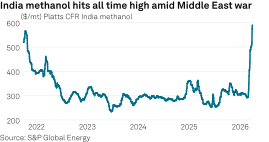
"That's a sector which is hard to abate and because CO2 to methanol is going to be a very good go — at least some delta price absorptions with the carbon market in place, it is going to be a good go," he said.
For SAF, however, Gupta drew a clear distinction: while the methanol-to-SAF pathway is conceptually analogous to ethanol-to-SAF, it has not yet achieved a single commercial-scale success globally.
"Not a single such technology has got commercial success. That's a problem. So we are fanatically looking for these areas," he said, adding that GBA remains open to methanol-to-SAF as a future pathway but cautioned the industry to "wait for some more time."
2G ethanol
Gupta gave a assessment of India's second-generation ethanol program noting that while all Indian oil marketing companies have each built a 2G ethanol plant, a record globally, the technology faces an unresolved feedstock pre-treatment challenge specific to Indian paddy straw due to its unusually high silica content.
"The issue is not technology conversion is no challenge. We have already got 99.9% pure ethanol from our 2G plant at Panipat but the solid content and lignin breaking is affecting wear and tear of the pre-treatment machinery," he said, adding that both Praj Industries and OMC research teams are actively working on solutions.
At a current price of approximately Rupees 130-140/litre, 2G ethanol is not competitive with first-generation ethanol for road transport blending, and Gupta said this gap is unlikely to close sufficiently to justify transport use.
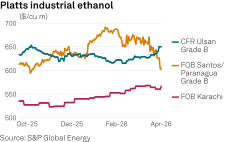
Instead, GBA's global positioning for 2G ethanol is now explicitly as an SAF feedstock via the alcohol-to-jet pathway.
"We are globally positioning 2G as a SAF conversion by the time alcohol-to-jet technology will be stabilized," he said, noting that two liters of ethanol yield one liter of SAF, with renewable diesel emerging as a significant and commercially valuable coproduct.
"A combination of renewable diesel coming out from the SAF plant and a SAF product produced — 2.5x is fine of jet fuel rate — and that is going to crack these things," Gupta said.
Platts, part of S&P Global Energy, assessed CFR Southeast Asia methanol unchanged from April 24 at $649/mt on April 27.
Platts assessed Sustainable Aviation Fuel HEFA-SPK FOB Straits at $2,305/mt on April 27, up $10/mt day over day.
