Agriculture, Chemicals, Energy Transition, Biofuels, Solvents & Intermediates, Renewables
April 27, 2026
EU ethanol market eyes Mercosur inflows as quotas near; E20 push adds upside

Editor:
HIGHLIGHTS
EU ethanol quotas open May 1 for Mercosur
E20 blend push could boost demand 58% by 2030
Market watches import flows vs. policy shifts
European ethanol markets are bracing for the start of Mercosur import flows from May 1, with participants watching early quota uptake closely as policy momentum builds for higher blending rates within the EU.
Under the EU's interim trade agreement with Mercosur countries, tariff-rate quotas for ethanol will come into effect at the border from May 1, opening preferential access to shipments into the bloc for the first time.
The initial focus will be on how quickly volumes are drawn down, particularly given the prorated quota for 2026 and ongoing uncertainty around arbitrage economics.
Across most of the EU, the current maximum ethanol blend in petrol is E10, with up to 10% renewable ethanol produced from multipurpose crops, waste and residues. Production and use of European renewable ethanol reduces GHG emissions by 79% on average compared with fossil petrol, renewable ethanol lobby ePURE said in a release April 24.
Demand-side signals strengthen
At the same time, industry groups are pointing to a potentially stronger demand outlook if the EU moves ahead with higher ethanol blending.
Increasing ethanol content in petrol to 20% could significantly cut emissions while reducing reliance on imported fossil fuels, ePURE said late last week.
European Commission President Ursula von der Leyen has confirmed that Brussels will consider allowing higher ethanol blends, including E20, under a review of fuel legislation.
Market participants said any move toward E20 would materially increase ethanol demand in the medium term, potentially tightening the regional balance even as new import channels open.
Balancing imports with policy shift
The EU-Mercosur deal provides for a gradual ramp-up in ethanol import quotas, reaching 650,000 mt annually from 2031, with volumes split between duty-free chemical use and reduced-duty fuel and other applications.
While the framework improves supply optionality, traders said the interaction between rising imports and potential policy-driven demand growth will be key to price direction.
"If E20 gains traction, it could absorb a significant share of incremental supply," another trader said.
Near-term focus on flows, pricing
In the near term, attention remains on arbitrage viability and the pace of customs clearance once quotas open.
The European Commission's formal consideration of E20 a petrol blend with up to 20% renewable ethanol could generate an additional 3.2 billion liters of ethanol demand in Europe under a conservative adoption scenario by 2030, rising to a trebling of current supply volumes if the full petrol pool moves to E20, according to a supply and demand study commissioned by European renewable ethanol association ePURE from consultancy E4tech.
The E20 across the EU petrol pool would require an additional 3.2 billion liters of ethanol, representing a 58% increase from baseline volumes.
A maximum demand scenario, in which all EU petrol sold moves to E20, would require an additional 11.1 billion liters, effectively tripling the industry's output, but crucially, the study found both scenarios were achievable without breaching the existing RED II crop-based biofuels cap.
A move to E20 would double the ethanol content threshold, directly expanding addressable demand for grain- and sugar-based ethanol as well as advanced biofuels used in blending.
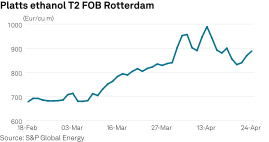
In the spot market, Platts, part of S&P Global Energy, last assessed Beverage 96 ethanol at Eur80/hectoliter FOB ARA, while Industrial 99 ethanol was assessed at Eur83/hl FOB ARA. In the fuel market, Platts assessed T2 ethanol at Eur869/cubic meter FOB ARA April 23.
