Agriculture, Meat, Food
April 16, 2026
Middle East poultry trade slows as buyers balk at higher costs

By Karan Dadure
Editor:
HIGHLIGHTS
Middle East poultry trade slows on costs
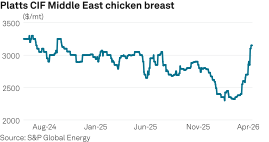
Chicken breast prices hold at $3,150/mt
High freight pushes values beyond buy levels
Middle East poultry trading activity has slowed in recent days as buyers resisted higher replacement costs amid firm price indications across the market, participants said April 15.
Platts, part of S&P Global Energy, assessed chicken breast CIF Middle East, basis Jebel Ali, at $3,150/metric ton April 15, unchanged day over day, after rising by $50/mt April 13 and extending a broader rally from $2,850/mt April 9.
Market participants said supplier activity in the region has become limited, with fewer fresh offers into Persian Gulf destinations.
"We didn't receive offers this week," a trader based in the UAE said, adding that market engagement has slowed.
Indicative values have been elevated, particularly into alternative entry points such as Jeddah, where cargo continues to move before being redistributed across the region.
"For new orders, Jeddah and the west coast is the way to go," a trader said.
Cargoes already at sea are being rerouted through intermediate ports, participants said.
"But first port of discharge is Salalah or Khor Fakkan, then transshipment to Dammam. This was the way to go for containers that were stuck at sea," a participant said.
However, the rise in logistics and inland costs has made it increasingly difficult to translate these indications into workable trades, they added.
"There is no market to pay higher levels with freight on top," one said, highlighting the widening gap between indicative pricing and executable business.
Additional freight and inland transport costs -- at about $6,000-$8,000 per container into the Persian Gulf -- have pushed delivered values beyond levels most buyers are willing to accept, traders said.
"Everything is still moving to Jeddah and Aqaba, but not clear offering to Oman or the UAE at this point," another participant said.
Higher indications were heard for the Saudi Food and Drug Authority-approved product in Saudi Arabia, though these were not seen as representative of the wider Persian Gulf market.
The market was firm on paper but constrained in practice, with pricing supported, while liquidity remains thin, participants said.