Agriculture, Grains, Rice
April 10, 2026
Myanmar 5% WR prices hit nine-month high on Philippine demand
By Muskan Agarwal and Ayushi Baloni
Editor:
HIGHLIGHTS
Philippine demand, high costs drive rice prices higher
Milled rice production for MY 2025-26 at 12 million mt: USDA
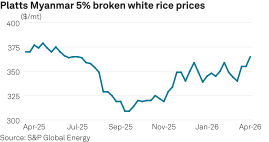
Myanmar's 5% broken white rice prices reached their highest level in over nine months on April 10, supported by strong demand from the Philippines and sustained high local production costs linked to the ongoing Middle East conflict, according to market sources.
Platts, part of S&P Global Energy, assessed Burmese 5% WR at $365/metric ton FOB on April 10, a $10/mt increase week over week, marking the first time the market has returned to this level since July 4, 2025.
The Philippines fuels demand surges
Myanmar-based sellers attributed this price rise to strong demand from the Philippines.
"This week, we are seeing a lot of demand from the Philippines for both 5% and 25% white rice. Some demand from Europe is also active," a Yangon-based exporter said.
The exporter added that local rice prices in the Philippines were significantly higher than import prices, which is leading to increased demand. Additionally, since prices in Thailand remain elevated compared to Myanmar, many importers are choosing to source rice from Myanmar rather than Thailand, the exporter said.
Thailand and Myanmar rank among the Philippines' leading rice suppliers after Vietnam.
Another trader from Yangon echoed similar sentiments, saying, "The market is firm, due to sudden demand from the Philippines. 10 days back, [Burmese] 5% white rice, double polish STX was priced at $355/mt FOB levels, today it's risen to $380-$385/mt FOB levels."
In response to the increased demand, multiple trades were reported to the Philippines during the week.
Multiple trades for Myanmar 5% broken WR, double-polish STX, were concluded to the Philippines for May shipment, with reported volumes ranging from 2,000 mt to 10,000 mt and prices spanning $370-$380/mt FOB.
Rising local costs support prices
Local sellers observed that, beyond strong demand, persistently high costs for fuel, fertilizer, and packaging have further contributed to the upward movement in Myanmar rice prices. The impact of these elevated expenses is being felt across the supply chain.
The first exporter pointed to fuel as the primary driver behind the price increase, saying, "Fuel costs have almost doubled since the war, and other costs, mainly fertilizers, have also increased."
Market volatility has intensified because of war-driven uncertainty. "Our local market price is increasing and not stable at the moment," a third Yangon-based exporter said, noting that this instability is leading to volatile FOB offers.
Looking ahead, the first exporter further warned that next season's harvest is likely to be impacted as farmers continue to struggle with fertilizer shortages and high prices. However, the exporter emphasized that it remains difficult to predict how the situation will evolve in the coming months, given the rapidly changing circumstances.
Myanmar's revised estimate for milled rice production in the 2025-26 marketing year (January–December) remained unchanged at 12 million mt from the previous estimate, representing a year-over-year increase of 100,000 mt, according to the latest US Department of Agriculture report dated April 9.
