Agriculture, Livestock, Meat
April 10, 2026
Diseases, demand shift reshape pork trade as EU exporters look beyond China: FAS

Editor:
HIGHLIGHTS
China's pork imports to drop 16% in 2026
ASF outbreak in Spain disrupts EU exports
Global pork trade in 2026 is being reshaped by animal disease outbreaks and shifting demand patterns, with the EU emerging as a key player in a rapidly evolving export landscape, the US Foreign Agricultural Service said in its April 9 report.
A sharp decline in Chinese import demand -- forecast to fall 16% this year -- has forced major exporters, including the EU, to diversify into alternative markets. The downturn follows China's recovery from African swine fever, which previously drove a surge in imports between 2019 and 2021. As domestic production rebounds, China's pork imports are now expected to fall below pre-ASF levels, disrupting long-established trade flows, according to the FAS, which is a branch of the US Department of Agriculture.
For the EU, the shift has been particularly pronounced. The bloc's share of pork exports to China has dropped steeply -- from 54% in 2020 to just 18% in 2025. In response, European exporters have intensified their focus on other Asian markets, including the Philippines, South Korea, Taiwan and Vietnam, many of which continue to grapple with ASF-related supply constraints, the report added.
EU pork exports edged up 1% in 2025, supported by stronger demand across these alternative destinations and improved price competitiveness. However, the sector faces mounting headwinds in 2026. Exports are forecast to decline by 8% amid lower production, tightening margins and renewed disease pressure, the FAS said.
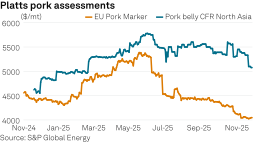
The detection of ASF in Spain in late 2025 has added fresh uncertainty, triggering trade restrictions that are expected to weigh on export volumes. The outbreak also contributed to falling EU pork prices, compounding the impact of already weak domestic demand and abundant supply, the report added.
Production trends further underscore the challenges. EU pork output is projected to fall 1% to 21.7 million mt in 2026, as declining hog prices and disease-related risks prompt producers to scale back herd sizes, according to the report.
Despite these pressures, Europe remains a critical supplier to global markets. Its strategic pivot toward Asian countries other than China mirrors a broader realignment among exporters. Brazil and the US have similarly reduced reliance on China, redirecting shipments to Southeast Asia, Mexico and Central America, it said.
Globally, pork production is expected to rise modestly by 1% in 2026, while exports are forecast to remain broadly stable at 10.4 million mt. Gains from Brazil, the US and Canada are likely to offset declining shipments from the EU, the FAS said.
Still, the trajectory of the market will hinge on disease dynamics. ASF and other livestock illnesses continue to disrupt production, influence prices and redirect trade flows, ensuring that animal health remains one of the most powerful forces shaping the global pork industry, the FAS added.
Platts, part of S&P Global Energy, assessed Frozen Boneless Pork Loin EXW-US Midwest at $1.39/lb or $3,064.43/mt on April 9, delivered Midwest for 15-30 days forward.