Agriculture, Energy Transition, Refined Products, Biofuels, Renewables, Jet Fuel
April 10, 2026
Cathay Pacific SAF volumes surge in 2025 but remain below 1% of total fuel use

Editor:
HIGHLIGHTS
SAF volumes surge 430%, remain under 1% of fuel
Cathay commits $220 mil to SAF investments
Corporate SAF Programme grows 180% YOY
Cathay Pacific Airways used 36,242 metric tons of sustainable aviation fuel in 2025, a near-fivefold increase from the prior year, but the Hong Kong-based carrier said SAF still accounts for less than 1% of global commercial jet fuel consumption, underscoring the pace of supply build-up needed to meet the aviation industry's net-zero 2050 target, according to its Sustainability Report 2025 released April 9.
The carrier's gross Scope 1 emissions rose to 16.76 million mt of CO2-equivalent in 2025, with SAF use delivering a net abatement of 101,446 mtCO2 on a lifecycle basis. Carbon intensity across the Cathay Group stood at 751 grams of CO2 per revenue tonne-kilometer (RTK) excluding SAF reductions, narrowing to 746 gCO2/RTK when both mandatory and voluntary SAF-derived abatement were included.
$220 mil in SAF investments
In 2025, Cathay committed a combined $220 million in SAF investment across two landmark partnerships. In September, the airline joined as a launch investor in the $150 million oneworld Breakthrough Energy Ventures Fund, co-founded with airline peers including American Airlines, Alaska Airlines, IAG, Japan Airlines, and Singapore Airlines, and backed by climate investment firm Breakthrough Energy to advance and commercialize next-generation SAF technologies.
Complementing this, in October 2025, Cathay committed up to $70 million in a co-investment agreement with Airbus, targeting more mature SAF production opportunities with a 2030-and-beyond horizon, primarily in Asia. The Airbus partnership will assess individual projects for commercial viability, technological maturity, and long-term offtake potential, alongside joint advocacy for enabling SAF policies across the Asia-Pacific region.
Corporate SAF programme nearly triples
Cathay's Corporate SAF Programme, now in its fourth year, recorded commitments of approximately 17,400 mt of SAF from 17 global partners in 2025, representing an increase of nearly 180% year over year. Partners including DHL, Microsoft, and Kuehne+Nagel drove the growth, collectively enabling an equivalent lifecycle emissions reduction of approximately 54,600 mtCO2e -- equal to roughly 61,800 economy class round trips between Hong Kong and London.
In July 2025, Cathay also launched an individual customer SAF program, allowing passengers to voluntarily purchase SAF attributes aligned with their specific flight emissions. In its first year, the program recorded 1.6 mt of SAF use, delivering approximately 5 mt of CO2 reductions.
Supply chain, expanding footprint
To broaden its SAF sourcing geography, Cathay entered into an agreement with Sinopec for the delivery of domestically produced Chinese SAF to Hong Kong International Airport -- marking the first such export by Sinopec to Hong Kong. Additionally, the carrier secured a multiyear supply deal with South Korea's SK Energy for 20,000 mt of SAF between 2025 and 2027.
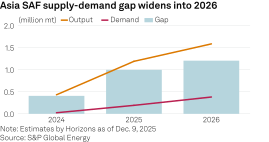
Cathay uplifts approximately half of its total fuel in Hong Kong, making the city's SAF policy environment critical to its decarbonization trajectory. The carrier welcomed the Hong Kong SAR government's announcement of a 1%-2% SAF usage target at HKIA by 2030, along with plans for local SAF blending facilities and production plants in the Greater Bay Area, but stressed that "stronger partnerships and additional policy support will be essential to close this gap."
CORSIA, EU ETS compliance costs flagged
Cathay highlighted compliance obligations under CORSIA's first phase (2024-2026), the EU Emissions Trading System, and the UK ETS. The ICAO issued its 2024 annual sectoral growth factor in October 2025 -- the first time it has been above zero -- triggering net carbon offsetting obligations for participating international carriers. Cathay said it continues to monitor and prepare for developments across all mandatory market-based measures.
Total Scope 3 emissions for the group stood at 10.59 million mtCO2e in 2025, with the largest contributors being Scope 3 Category 15 (investments) at 4.93 million mtCO2e and Category 3 (fuel- and energy-related upstream activities) at 3.65 million mtCO2e.
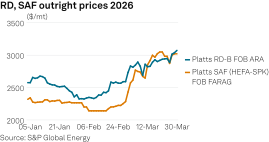
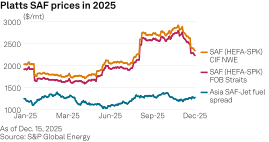
Platts, part of S&P Global Energy, assessed FOB Straits SAF prices at $2,295/mt on April 9, down $125/mt from the week before.
