Agriculture, Meat, Livestock
April 06, 2026
US beef trimming imports surge on strong demand, tight supplies

Editor:
HIGHLIGHTS
US beef trimming imports surge 31.9% yearly
Australia leads suppliers at 29.4% share
Tight domestic supplies push prices up 26%
US beef trimming imports remain above year-ago levels amid strong domestic demand and a slow pace of slaughter of bulls and cows, the main source of lean beef trimmings.
The US Department of Agriculture said in its latest Imported Meat Passed for Entry in the US report, released April 3, that total US imports of beef trimmings for the week ended March 28 were 22,142 mt, up 13.2% week over week, and up 31.9% from the week ending March 29, 2025.
Of the total US imports of beef trimmings during the week ending March 28, 29.4% were from Australia, 28.2% from Brazil, 17.2% from New Zealand, and 9.5% from Uruguay, USDA data showed.
US imports of Australian beef trimmings rose 101.6% to 6,519 mt during the week; imports from Brazil rose 10.9% to 6,238 mt, but from New Zealand, dropped 17.4% to 3,815 mt.
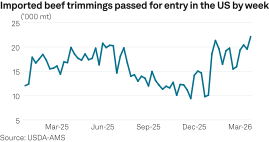
The USDA reported that about 238,061 mt of beef trimmings have been imported through March 28, up 10.4% from the same period in 2025.
The USDA report showed that the US imported around 238,061 mt of beef trimmings during 2026. Of the total, 27.4% was imported from Australia, 21.8% from Brazil, 19.6% from New Zealand, and 12.3% from Uruguay.
US imports expected to remain elevated
"Import levels remain above year-ago levels. For February, numbers came in about 30 million pounds above year-ago levels, mostly led by Brazil," Caleb Hurst, principal analyst for Cattle and beef at S&P Global Energy Cera, said. "I do think that we will continue to push higher here as we get the March numbers out."
"We did see some front-loading from tariffs in the second quarter of 2025. Obviously, we're not expecting to see that again, so we may start to see some year-over-year declines as we get into that second quarter," Hurst added. "However, imports are still going to remain elevated, especially if you look at it from a year-over-year increase — particularly in the back half of the year, once we see some extra product come from Brazil and Australia."
According to Hurst, "The US did not import much from Brazil in the second half of 2025, so any increase would show up as a notable gain. We're also hitting tariffs with China in the next few months, so I do expect some record-high imports again in 2026."
Regarding the recent foot and mouth disease outbreak in China, Hurst said he is not expecting that the outbreak could change the quota and tariff program in China, although we should keep tracking the development of the FMD outbreak in China.
High prices amid limited domestic supplies
Limited US and New Zealand supplies, amid strong US demand, continued to support CIF lean beef values.
In the slaughter of non-fed cattle, the differential has narrowed year over year, largely due to an increase in dairy cattle slaughter, yet levels remained below previous years, an analyst said.
On the supply side, "we had federal slaughters at the dairy cattle remains elevated, about 6.3% year over year," Katherin Mera, US dairy analyst with CERA, said. "Confirming that culling activity is still running at a structurally higher pace."
As of March 28, 1.325 million heads of bulls and cows, the main source of lean trims, had been slaughtered, down 6.2% from the same period in 2025 and 18% from 2024, according to the latest US Department of Agriculture's Daily Livestock and Poultry Slaughter report.
The last weekly slaughter figure was at 103,000 head, up 8.4% from the previous week and 0.5% from the previous six-week average but down 3.3% from the corresponding week of 2025 and 9.6% from 2024.
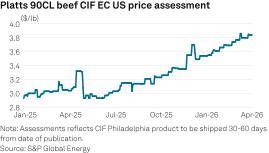
Platts assessed 90CL beef CIF East Coast US for 30- to 60-day shipment at $8,466/metric tons, or $3.84/lb, on April 2, unchanged from the previous business day, with last trades heard at those levels for New Zealand origin. The assessment remained unchanged week over week but was up 26.3% year over year.
Platts assessed 90CL beef FCA US at $3.50/lb for a 15- to 60-day loading period on April 2, up 7 cents/lb from the previous business day, with FOB port of entry value indications heard at those levels for South American origins.
