Maritime & Shipping, Agriculture, Containers, Rice
March 25, 2026
Freight surge, container shortage disrupt global rice trade
Editor:
HIGHLIGHTS
India to West African breabulk freights up $14-$19/mt in weeks
Thailand sellers shift preference to FOB deals
EU demand likely to shift to South America amid high freight to Asia
Surging freight rates and tightening container availability are disrupting global rice trade flows, with higher costs and logistical constraints slowing deal-making across key export routes, sources told Platts, part of S&P Global Energy.
Breakbulk freight to West African destinations such as Abidjan has risen to $74-$79/mt over the past two weeks, and that no further bookings have been made at $60/mt, according to a Kakinada-based exporter.
The exporter also said they were unable to close deals amid freight volatility despite strong demand, and future trades now depend entirely on whether freight will continue to rise for April/May shipments.
While breakbulk freight rose over the course of the week, major carriers are continuously updating their emergency fuel surcharges on containers.
One shipping line has increased its emergency surcharge to West Africa to $230/twenty-foot equivalent unit, a Delhi-based trader said, adding that these sudden changes are leading to volatility in trade and potential risk.
Exporters who chartered vessels are stuck, since vessels currently at Kandla/Kakinada port were booked at February freight rates. Now that freight rates have risen, suppliers are potentially bargaining, the Delhi-based trader said.
Another Delhi-based trader said the situation depends on bunker availability, and they don't expect freight to soften soon, while it could take a minimum of three to six months to return original levels prior to the war in the Middle East.
A Bangkok-based seller said shipments to Iraq have ground to a halt due to disruptions in the Persian Gulf, making the route currently unviable. However, exports to other destinations remain largely unaffected. "Shipments to South Africa are continuing via conventional vessels, while container flows to North America are ongoing despite significantly higher freight costs," the seller said. "Freight to West Africa and Europe has also increased significantly. Most buyers are unable to absorb the cost. Market participants are still adjusting to the sharp rise in freight rates, driven by war-related fuel surcharges."
Another Bangkok-based seller said rising freight rates had prompted sellers to avoid CFR deals and instead opt for FOB contracts amid ongoing uncertainty. Although freight costs have increased, many market participants remain unclear about the extent of the rise.
Container shortages
A Pakistani exporter said that in the Middle East, there is an increasing preference for bulk shipments. Freight rates from Karachi for both containers and vessels have risen, resulting in subdued trade agreements.
"African shipments have been less impacted compared to those to the Middle East," another Pakistan-based exporter said. "However, freight rates to East Africa have risen by more than 50% from levels before the escalation of the Middle Eastern conflict, while increases to West Africa are around 10%."
A third exporter who primarily deals with China said: "From China, freight rates have nearly doubled under the pretext of fuel surcharges -- Shekou and Huangpu, for example, have jumped from $20 and $50 to $50 and $100 per container, respectively."
Pakistani exporters have also noted a shortage of container availability, further exacerbating freight costs.
"Despite elevated freight rates, there's no assurance of container availability, as shipping lines are prompting an artificial scarcity that further complicates the situation," the Karachi-based exporter who deals prominently with Chinese buyers said. "It's a very tough environment right now."
A UK-based broker reiterated the ongoing container shortage and noted that rising local transport costs within the EU are further compounding the issue. As freight rates from Asian origins remain elevated, the source anticipates that EU demand may increasingly shift toward South America.
Philippine buyers
Freight rates for rice shipments from Vietnam to the Philippines have increased, with market participants reporting a $10-20/mt rise, largely driven by higher fuel-related surcharges.
A Ho Chi Minh City-based exporter said freight rates have increased by about $10/mt week over week, adding that buyers in the Philippines have absorbed the higher freight costs as rice import prices in the country have also risen.
Freight rates from Vietnam to China remained broadly stable, with one exporter noting a marginal increase of around $2/mt.
Asian 5% WR prices declined year over year, according to Platts data.
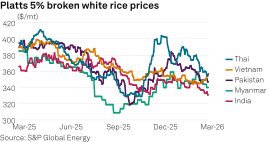
Thailand and Indian 5% WR both fell by $36/mt year over year to be assessed at $359/mt FOB and $330/mt FOB, respectively, Vietnamese 5% WR was assessed at $360/mt FOB, down by $29/mt year over year, and Pakistan fell $39/mt year over year to $351/mt FOB, Platts data showed March 25.
Platts is part of S&P Global Energy.
