Agriculture, Fertilizers, Chemicals, Grains
March 20, 2026
Ukrainian farmers hold back wheat and corn sales as fertilizer prices surge
Editor:
HIGHLIGHTS
Farmers halt grain sales as fertilizer surges
Urea prices jump to $850/mt from $450-$500/mt
Small farms cover 30% needs vs big farms' 70%
Ukrainian farmers are holding back sales of both old and new crop grain as fertilizer prices surge, traders and brokers said, in a fresh squeeze on liquidity as producers juggle wartime costs and agronomic constraints.
The cost of urea in the local market, a key nitrogen fertilizer used in both wheat and corn, has jumped to $850/mt or more from around $450-$500/mt before the Iran war, according to a local broker, making it unaffordable for farmers.
"Due to the rise in fertilizer prices, farmers have stopped selling old crop and new crop," another local broker said, adding that many producers are preferring to sit on inventory rather than lock in margins while input costs remain volatile.
Large agroholdings, however, have been more willing to offer forward sales. New-crop bids were heard around CPT $210/mt for corn and feed wheat and $215/mt for milling wheat. Old-crop values were cited higher at about $219/mt for wheat and $213/mt for corn.
"Farmers are coping with the rise in input prices but just not selling the new crop yet," a Ukrainian corn seller said.
A Kyiv-based trader said forward activity is usually seasonal in April and May, but uncertainty is keeping participation low. "With current uncertainty, no rush to sell," the trader said, adding that exporters still have significant corn stocks to work through.
Market participants said most farmers have already secured enough fertilizer for the current cycle, limiting immediate risk to the 2026 crop.
The bigger concern is for next year's crop, as the recent increase in fertilizer costs is expected to become apparent during the next major purchasing period, when farmers start preparing for the 2027 crop. Wheat planting for that season is set to start in autumn 2026.
"It is too early to know the impact," a local wheat seller said, since purchasing decisions, application rates and weather will ultimately determine outcomes.
This situation creates a two-speed market, with large operators and smaller farms facing different exposure to sustained high prices. Another local broker said big farming groups are covered for roughly 70%-75% of requirements, while smaller farms are closer to around 30%, leaving them more vulnerable if elevated prices persist into the next procurement season.
"Farmers are covered partially but not all, and of course it will have an impact on yields as they try to spend less, especially for corn," the Kyiv-based trader said.
The fertilizer squeeze is also landing on top of other wartime pressures, including elevated domestic logistical costs, labor shortages and ongoing security risks.
Ukraine's farmland is already under strain, with a local source estimating that about 75% of soils are exhausted. Without fertilizer, the land is "unable to process good yield," he said.
The source estimated 65%-70% of soils have a nitrogen deficit and around 45% have a phosphorus deficit, suggesting that sustained high prices could translate into weaker nutrient use and lower yield potential, particularly among smaller producers with thinner balance sheets.
Fuel costs are another concern. Market participants said diesel prices have risen by nearly 20%, squeezing margins for farmers who are not fully covered. Many farmers have some diesel in stock until April or May, but the price increase so far will still hit planting and harvest economics if the conflict continues.
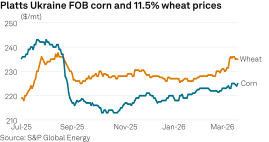
Platts assessed Ukrainian corn FOB POC at $225/mt on March 19, up $3/mt from Feb. 27 just before the conflict in the Middle East started, and wheat 11.5% FOB Black Sea at $235/mt, up $4.50/mt from Feb. 27, for loading April 16-30.