Fertilizers, Chemicals, Energy Transition, Renewables
March 19, 2026
Sulfur, nitrogen markets under pressure as Middle East war persists

Editor:
HIGHLIGHTS
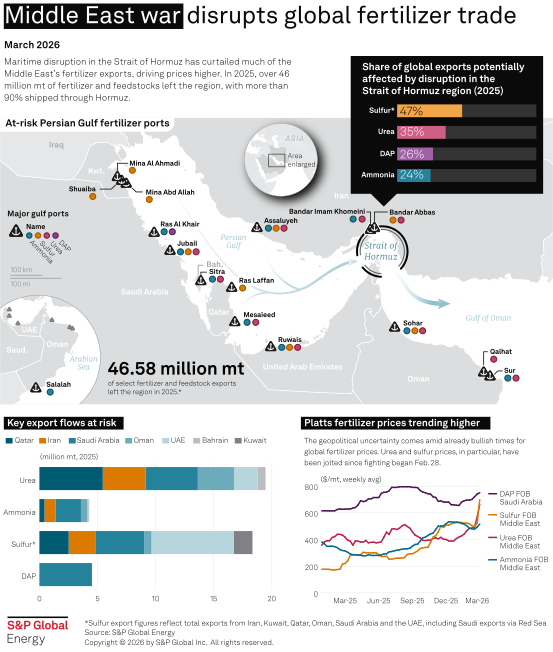
Middle East supplies 47% of seaborne sulfur, 35% of urea
Sulfur prices may surge above $800/mt
India faces acute urea, ammonia shortages
The ongoing conflict in the Middle East has impacted fertilizer markets east of Suez, with potential for significant long-term effects should hostilities persist, panelists said during the S&P Global Energy webinar on March 19.
The region accounts for nearly 50% of global seaborne sulfur trade, including shipments through the Strait of Hormuz and from Oman. Additionally, approximately 24% of ammonia and 35% of urea transported by sea globally originate from this area.
Among the world's 10 largest sulfur importers, seven countries source over 40% of their supply from the Middle East, and five exceed 50%, according to Yuya Pan, senior principal analyst for S&P Global Energy CERA. "This highlights how concentrated exposure is across major demand countries," Pan said. "Why does this matter? Because the large share of the Middle East trade depends on one narrow chokepoint, the Strait of Hormuz."
In 2025, the Middle East supplied nearly half of global seaborne sulfur and accounted for 63% of Asia's imports, while Africa relied on the region for about 48% of its sulfur. Conversely, the Americas depend primarily on Canada and the US Gulf Coast for their sulfur requirements, Pan said.
Disruptions lasting one month are projected to remove 1 million metric tons-1.5 million mt of sulfur from the market, while three months could result in losses over 4 million mt, likely prompting price increases and substantial downstream demand disruption, Pan said.
"If the Strait remains blocked until late April or even beyond, we move into a pronounced supply disruption scenario," Pan said. "Under this case, the sulfur price could rise above $800 per tonne, or even higher."
Such pricing would render sulfur uneconomical for certain consumers, including high-pressure leaching nickel producers and low-cost phosphate producers. Platts, part of S&P Global Energy, assessed the FOB Middle East sulfur price at $695-$700/mt on March 19, reflecting an increase of $200/mt from pre-conflict levels.
Long-term impact on nitrogen
Regarding volumes, nitrogen-based products such as urea and ammonia are expected to be the most affected if the conflict extends over several months, said Ella Mukerji, associate director, lead ammonia and nitrogen at S&P Global Energy CERA.
Mukerji identified two short-term impacts on nitrogen: supply and logistics -- which shape supply and demand balances -- and broader macroeconomic effects, notably elevated energy and feedstock costs in certain regions, coinciding with seasonal procurement periods.
"And if the Strait remains blocked, the urea market could face acute short-term shortages, and this will impact import-dependent countries and regions the most," Mukerji said.
India is probably the most exposed market from both an ammonia and urea perspective, she said. On the ammonia side, buyers were unconcerned until the Indian government decided March 9 to cut gas supply 30% to fertilizer producers. That led buyers to begin enquiring about deliveries, Mukerji said.
On the urea side, the Indian government is not expected to issue a tender until April for May delivery ahead of the kharif, or summer season, in June.
"The Indian government is watching closely and is thought to be avoiding tendering now due to current prices," she said.
Brazil, which is currently between application seasons and is, therefore, under less immediate pressure to secure prompt cargoes, also remains "structurally import dependent for urea," Mukerji said.
"But this essentially gives Brazilian buyers some flexibility to delay purchases and wait out volatility, although that flexibility is naturally going to erode the longer the conflict goes on," she said. "We have seen some domestic production return..., but this capacity is around 650,000 tonnes, and that doesn't cover this import dependence."
Ammonia is better covered with additional production capacity coming online in the US Gulf Coast, resumption of production in Trinidad and Tobago, and increased Chinese exports -- potentially up to 2 million mt annually -- expected to enhance the long-term outlook for ammonia supply. Collectively, these sources could contribute up to 6 million mt of additional supply, compared to around 4.3 million mt originating from the Strait of Hormuz region and Oman.
However, higher urea prices would likely put upward pressure, she said.
"Ammonia and urea prices are very closely linked," Mukerji said.
Platts assessed the daily FOB Middle East ammonia price at $550/mt on March 19, up 15.8% from pre-war levels, and assessed the FOB Middle East urea price at $710/mt, up 44.9% from pre-war levels.
Related link:
Analytics Webinar Series: Global Biofuels and Ags(subscriber content)
