Agriculture, Meat, Livestock
March 17, 2026
US beef imports forecast to rise on strong demand for lean trimmings

HIGHLIGHTS
USDA lifts 2026 beef import forecast 3.7%
Lean trimming demand remains strong in Q1
Import prices rise 22% year over year
The US beef and veal import forecast, in-carcass-weight equivalent, for the first quarter of 2026 was at 1.6 billion pounds, up 12 million lb, or 8%, compared to the first quarter of 2025, and up 50 million lb, or 3.2%, compared to the February forecast, the US Department of Agriculture said in its latest Livestock, Dairy and Poultry Outlook report.
USDA total US beef import estimates for 2026 were at 5.675 billion lb, up 200 million lb, or 3.7%, from 2025 estimates, and up 1.4 billion lb, or 22.4%, from 2024, the USDA data showed.
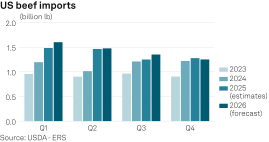
"The majority of the year-over-year increase in imports in 2025 occurred in the first two quarters," the USDA said in the report, which was released after the market closed March 16.
"First-quarter imports continue to grow due to the influx of imports in January as importers take advantage of the open tariff rate quotas," according to the USDA. "The seasonal pattern of higher imports in the first half of the year is expected to continue in 2026."
"Based on continued strong demand for imported lean trimmings, the import forecast for the [2026] first quarter is raised 50 million lb to 1.600 billion," the USDA added. "The forecasts for the third and fourth quarters are also increased 25 million lb each."
More trimming products available
"I see more lean beef trimmings products available due to increased imports," Caleb Hurst, cattle and beef principal analyst for S&P Global Energy CERA, said. "Just for January, we saw a 2% increase in imports compared to last year."
"Non-fed slaughter is strong, around the same level as last year, not due to beef cattle but thanks to dairy cows going to slaughter," Hurst said.
"Most major beef producers around the globe export to countries in the Gulf Cooperation Council, with the GCC share of trade value estimated at roughly 3%-4% for Australia, 5% for Brazil and 17% for India," Hurst said in the latest Weekly Beef Update report. "With the physical risk of shipments, it is likely that Brazilian and Australian shipments will be redirected to other high-value markets, with the US being the clear choice where demand remains robust."
"Given the redirection of trade flows and the clear direction toward US imports of lean beef, particularly with a rising dollar index, US import prices are likely to soften with the new available supply," Hurst also said in the weekly report. "With tightening global beef price processing margins, particularly in Australia, processors are at risk and could face a longer-term impact of slaughter contraction."
Prices
The market for imports of lean beef trimmings has seen limited trade volume, with buyers largely covered and holding out for improved prices, market sources said. CIF US prices for Australian and New Zealand origins have been steady, while South American origins faced downward pressure on FOB port-of-entry values.
Platts, part of S&P Global Energy, assessed 90CL beef CIF US at $8,378/mt, or $3.80lb, March 16 for a 30- to 60-day shipment, compared with $8,135/mt, or $3.69/lb, Feb. 17 and with $6,878/mt, or $3.12/lb, March 17, 2025.
The 90CL beef CIF US assessment rose 3% month over month and 22% year over year.

Editor: