Agriculture, Grains, Oilseeds
March 13, 2026
Wheat prices in Egypt soar amid currency volatility, war disruptions

Editor:
HIGHLIGHTS
Importers face payment delays, tight supply
Prices rise on weak currency, fuel costs
Import prices now match domestic wheat costs
Wheat prices in Egypt have surged to record highs as a depreciating currency, higher fuel costs and mounting logistics problems ripple through the country's grain market in the wake of the war in the Middle East.
Local wheat prices for 12.5% protein, ex‑warehouse, have jumped from Egyptian pounds 12,400/metric ton to 14,300/mt since the conflict began on Feb. 28, according to several market participants. The sharp rise has coincided with a steep depreciation of the Egyptian pound, which has fallen about 9.4% since the start of the war to 52.39 EGP per US dollar on March 13, its weakest level on record.
The government's recent fuel price hike has further driven up transportation costs, and prices for refined soybean oil have also soared, rising from Egyptian pounds 63,000/mt to 70,000/mt, compounding pressure on grain prices.
"Markets are on fire," said a local buyer, noting that the volatility is affecting not just wheat, but also corn and soybean oil.
Importers are facing additional hurdles, as some Egyptian buyers who rely on banks in Dubai said that some institutions have either closed operations or suspended services, leading to delays in payment processing.
"It will take more time than usual," a second wheat buyer said.
A local miller said, "We are not able to pay for the arrived vessels. It is now a logistics issue. We are trying to figure out some other choices, but there has been no result until now."
Due to a weak currency, buyers report that wheat import prices are now equal to domestic prices, whereas local prices are typically lower.
Since the war began Feb. 28, CIF Egypt 12.5% bids have risen by 2.7% at $263/mt with freight from Russia to Egypt climbing to $24/mt from $21/mt on March 13.
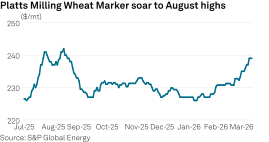
Platts, part of S&P Global Energy, assessed the Milling Wheat Marker at $239/mt on March 12, up 2.5% from Feb. 27.
Local demand
Egypt, the biggest wheat importer in the world, is forecast to import 13 million mt of wheat in the marketing year (July-June). As of early March, it has bought 9.5 million mt, according to local shipping data LATT Trading and Shipping.
"We don't have other options," a second miller said, with no choice but to maintain wheat imports to keep up with the local demand. "We can't stop. We have demands for flour, for the local market and for export," the miller added.
A third miller echoed similar sentiments. "We are a manufacturer, so we should always be buying ... we are buying on a daily basis," the miller said.
Some buyers report that some sellers in the local market may be holding back stocks in anticipation of further price increases. "We are trying to buy wheat from the local market, and no one is selling," a third wheat buyer said.
Russian sellers, key suppliers to Egypt, are also hesitating, with several not offering wheat and waiting to see how the situation develops. "There is a lot of uncertainty," a Russian seller said. CIF Egypt offers were heard in the mid $260s/mt.
