Agriculture, Fertilizers, Chemicals, Grains
March 13, 2026
War‑driven fertilizer costs reshape crop choices in Europe, raise import risks
HIGHLIGHTS
Middle East war raises urea costs 32% in Europe
Farmers cut corn acreage, boost soybean planting
EU faces nitrogen shortage risk by spring 2027
Rising fertilizer costs due to the Middle East war-related energy shocks and higher natural gas prices are forcing European farmers to cut usage and switch away from nutrient-intensive crops, such as corn and wheat.
The shift is already reshaping planting for 2026-27 and is likely to tighten European corn supply, increasing reliance on imports, market participants and analysts said.
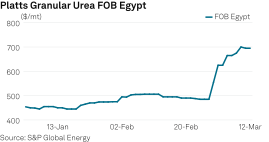
Prices of nitrogen fertilizers, particularly urea, have increased across Europe since the beginning of the war Feb. 27. The prospect of a lower Middle East natural gas supply lifted global prices, bringing Dutch TTF day-ahead gas to Eur50.30/megawatt-hour March 12 from Eur32/MWh Feb. 26.
The increase in natural gas feedstock costs directly reflected on European nitrogen fertilizer prices. Platts, part of S&P Global Energy, assessed granular urea FCA Italy at Eur700/metric ton March 12, up from Eur530/mt Feb. 26, or a rise of 32%.
Corn under pressure
Corn has been among the first casualties of high nitrogen costs, with acreage seen falling in several major EU producers and fertilizer application rates trimmed.
In Italy, farmers are increasingly opting for soybeans over corn due to higher fertilizer costs.
"The cultivation is in April and May, and farmers are choosing soybeans over corn as fertilizers are expensive," said a corn trader from Italy.
Another Italy-based trader confirmed that corn acreage has dropped this year and said the country is likely to rely more heavily on imports. The trend reflects broader market conditions than being unique to Italy, the trader added.
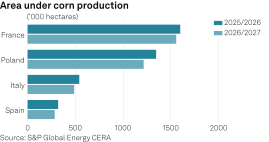
S&P Global CERA projects Italian corn area to drop to about 480,000 hectares in marketing year 2026-27 (July-June) from 541,000 hectares in MY 2025-26. Poland, France and Spain are expected to see declines of 9%, 3% and 11%, respectively, over the same period.
In the feed industry, ration formulations are already adjusting. EU feed wheat is emerging as a competitive alternative in livestock diets, as it is the "most attractive" option, partially substituting for corn, market participants said.
Farmers in the Balkans are still planting corn but are cutting back on fertilizer rates.
"Farmers are planting corn; they are not going to use fertilizer as much," said a trader from Serbia. "They will reduce or use cheaper stuff like KAN [calcium ammonium nitrate], not urea."
A Bulgarian trader said while planting continues, farmers are likely to rely on lower fertilizer applications, which is expected to weigh on yields.
Platts assessed corn FOB CVB at $233/mt March 12, up $4/mt from $229/mt on Feb. 26 before the war.
Wheat growers scale back yield
Wheat farmers in Romania are facing tough decisions as fertilizer prices climb, directly impacting their production plans for the upcoming season, especially following a period of negative profit margins.
Despite favorable winter conditions so far at the initial stages of production, including a protective snow blanket and only one episode of strong frost, growers said rising input costs are forcing them to reconsider their yield targets.
A wheat farmer in southwest Bucharest said the price of urea fertilizer has surged to $590/mt in Constanta in February, up from $520/mt in December and January, and even lower in the autumn of 2025.
"The high prices of fertilizers will force us not to aim for big yields right now," the farmer said.
After months of squeezed margins, farmers have become increasingly cautious about investing in expensive inputs.
Wheat is a particularly heat-sensitive crop. Elevated temperatures during critical growth stages can significantly reduce yields and grain quality, making wheat production especially vulnerable.
Romania faced quality issues in its 2025 crop because of a low W -- an index to calculate flour strength -- and high bug damage due to extreme drought, market participants said. Combined with reduced fertilizer use, the risk of poor harvests increases further.
Land rental prices are also trending up, though more slowly than fertilizer prices.
"There is a trend to increase [rental prices] but not at a fast pace," the farmer added.
CERA forecast Romania's wheat area to drop 2.43% year over year in the MY 2026-27 and Bulgaria's is projected to drop 14.61%.
Platts assessed FOB CVB 12.5% and 11.5% protein wheat at $243/mt and $241/mt, respectively, March 12, up $4/mt since Feb. 27.
Participants in Europe were focused on spring 2027 due to the ongoing affordability crisis. A distributor active in the Benelux area said March 11 that the fertilizer market is in a "perfect storm" of rising costs, including CBAM charges since Jan. 1, low grain prices and a sudden increase in nitrogen prices.
"Europe will run out of nitrogen fertilizer in spring 2027, due to CBAM and tight global supply ... This message needs to get to governments/EU," a source at one of the UK's largest fertilizer importers said March 12.
Editor:

Editor: