Agriculture, Energy Transition, Refined Products, Biofuels, Grains, Renewables, Jet Fuel
March 02, 2026
Praj Industries sees protein, SAF as dual growth drivers for global ethanol producers

HIGHLIGHTS
Protein co-products grow 8%-10% annually
SAF demand targets 30-40 bil liters
Brazil shifts to year-round grain ethanol
India's bioenergy company, Praj Industries, is positioning protein co-products as a key driver of future revenue growth for grain-based ethanol producers globally, Atul Mulay, president of corporate strategy, told Platts, part of S&P Global Energy, in an exclusive interview.
"Globally, distillers are increasingly integrating protein-rich co-products for applications in animal feed as well as human nutrition, driven by the need to improve resource efficiency and overall plant economics," Mulay said. "Fermentation-derived proteins are projected to grow at 8%–10% CAGR globally, supported by rising demand for sustainable protein sources and improved feed efficiency."
Praj's BioPrism platform targets this opportunity, encompassing renewable chemicals and materials such as bioplastics (PLA, PHA) and biobitumen — a co-product of compressed biogas (CBG) and second-generation (2G) ethanol production processes.
SAF takeoff: Alcohol-to-jet pathways scale up
Sustainable aviation fuel represents Praj's next growth frontier. "Global SAF demand today is below 1 billion liters, but industry bodies estimate it could reach 30–40 billion liters by 2030, driven by airline commitments and regulatory mandates," Mulay said.
Praj has validated both alcohol-to-jet (ATJ) and ethanol-to-jet (ETJ) pathways, leveraging decades of ethanol technology expertise. "India is among the world's leading ethanol producers, with annual production exceeding 13 billion liters," he said. "From the sugar sector alone, India's SAF potential is estimated at 3.5–4 billion liters."
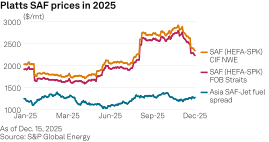
India's collaboration with IATA and ISMA is developing India-specific carbon intensity (CI) benchmarks for sugarcane-derived SAF. "Sugarcane-based ethanol pathways can achieve significantly lower CI levels than conventional fossil jet fuel," Mulay said.
Science-based CI standards are essential for global SAF trade and qualification under frameworks like CORSIA. Sugarcane ethanol delivers lower CI than fossil jet fuel, but India needs its own LCA framework.
Brazil grain ethanol Pivot: year-round operations
Brazil's transition toward grain-based ethanol is "structurally important," according to Mulay. "While sugarcane has traditionally dominated, grain ethanol—particularly corn—now accounts for close to one-fifth of Brazil's 35–38 billion liter annual output."
"Grain ethanol enables year-round plant operations, supports inland production closer to feedstock sources, and aligns well with export-oriented supply chains," he said. Praj's 24-32-year presence in Latin America — with over 80 references across Brazil, Colombia, Argentina, Mexico, and Paraguay — positions it to capitalize on this shift.

The EU-Mercosur deal further supports Brazilian ethanol exports to Europe, where annual consumption reaches 25–27 billion liters. "Praj already has reference installations supplying export-grade ethanol in Latin America and Europe," Mulay said.
Praj has operated in Latin America for 24 years, with over 80 references, supplying technology for the sugar and grain segments in markets such as Argentina, Mexico, and Colombia. The company has fingerprinted more than 10,000 feedstocks globally to tailor plants to local conditions.
Praj 2030: Three pillars for global scale
Mulay outlined Praj's 2030 vision, built on three pillars: decarbonization at scale through ethanol, CBG, SAF, bio-chemicals, and integrated biorefineries; globalization of India-developed technologies with solutions deployed across mature and emerging markets; and co-product valorization, including proteins, biobitumen, corn oil, and carbon management to enhance biorefinery economics.
He added that the IEA estimates sustainable biofuels could meet 15%–20% of global transport energy demand by 2030.

Policy, feedstocks, and carbon markets
Biofuel markets remain policy-dependent. "The US RFS volume obligations, Brazil's 30% blending mandate, and Europe's import opportunities create stable demand foundations," Mulay said. Globally, ethanol consumption reaches 110–115 billion liters annually, with the US and Brazil accounting for 70%.
Praj addresses feedstock volatility through multi-feedstock biorefinery designs capable of processing sugarcane, sweet sorghum, sugar beet, corn, and agricultural residues. "We've fingerprinted more than 10,000 feedstocks globally," Mulay said.
Bioenergy with carbon capture (BECCS) will be critical. "Carbon markets now exceed $900 billion, and CCS integration with biofuels is expected to gain momentum," he said.
"Transport decarbonization, aviation SAF mandates, and energy security will drive 2026–27 demand," Mulay concluded. "Biofuels support emissions reduction while strengthening energy self-reliance — particularly across the global South."

He said shipping accounts for 3% of global emissions and green methanol demand could reach 10–15 million mt by 2030. Encouraging results are emerging for ethanol-methanol blends in marine engines, and CCS integration with biorefineries will be key to narrowing the cost gap with fossil fuels.
Platts assessed hydrous ethanol (E100) ex-mill Ribeirao Preto at Real 3,440/cubic meter on Feb. 27, and anhydrous ethanol at Real 3,400/cubic meter.
Platts assessed hydrous ethanol delivered CIF Paulinia at Real 3,540/cubic meter, up Real 30-day over day.
The Asian fuel ethanol marker was unchanged day over day at $599/cu m CIF Philippines on Feb. 27, tracking steady ethanol futures amid slower gasoline demand.

Editor: