Agriculture, Energy Transition, Refined Products, Biofuel, Renewables, Jet Fuel
February 10, 2026
India net-zero pathway sees SAF at 32 billion liters by 2070

HIGHLIGHTS
India's SAF demand rises to 32 bil liters by 2070
SAF emerges as fastest-growing biofuel in net-zero scenario
Aviation remains reliant on blended jet fuel in 2070
Sustainable aviation fuel emerges as one of the fastest‑growing biofuel segments in India's new net-zero scenario, with demand rising from almost zero today to 13 billion liters in 2050 and 32 billion liters by 2070 as aviation becomes the most significant remaining oil consumer in the transport sector, government think tank NITI Aayog said Feb. 10.
The transport roadmap assumes that conventional jet fuel will retain a structural role even in 2070. Still, it will increasingly be blended with SAF as the International Civil Aviation Organization's CORSIA regime, national mandates and airline net‑zero pledges tighten over the coming decades, according to NITI Aayog report, "Scenarios Towards Viksit Bharat and Net Zero: An Overview."
India has already notified SAF blending targets of 1% for international flights in 2027 and 2% in 2028, with policymakers signaling that higher obligations could follow once domestic supply chains are in place.
The scenario work builds on an ICAO ACT‑SAF feasibility study that estimates the potential to produce around 41.5 billion liters of SAF from domestic biomass, which NITI Aayog argues is sufficient to support the modeled 2070 demand while still leaving room for exports – provided feedstock is shifted away from edible oils and into residues and advanced pathways.
The report underscores the hard-to-abate nature of the sector. NITI Aayog emphasizes that achieving Net Zero by 2070 will be "mathematically impossible" without a significant shift from traditional aviation turbine fuel to SAF.
The study outlines a trajectory where SAF blending must scale from initial pilots to double-digit percentages by 2040. To achieve this, the report advocates developing diverse technology pathways, including alcohol-to-jet using India's surplus sugar-based ethanol and hydroprocessed esters and fatty acids using non-edible oils.
HEFA diversification
The report frames SAF as a "priority use" for limited sustainable biomass, alongside shipping, because few other decarbonization levers exist for long‑haul aviation.
It assumes a mix of HEFA, co‑processing, alcohol‑to‑jet and other advanced routes, with cost curves driven down by global deployment and domestic policy support, including green tax incentives, viability‑gap funding and long‑dated offtake contracts leveraging India's refining system.
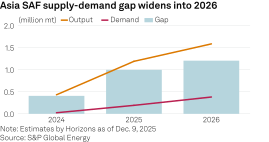
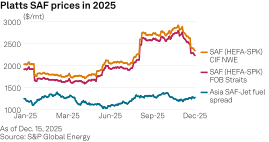
While technology costs, international policy and airline balance sheets introduce wide uncertainty bands, the authors see SAF volumes growing even under a current‑policies case as CORSIA offsets and corporate climate commitments pull low‑carbon jet supply into the market.
At the same time, the scenarios explicitly exclude breakthrough options such as hydrogen or all‑electric aircraft, treating SAF as the dominant decarbonization tool through 2070.
Carbon acumen
The report recommends that India move quickly on certification frameworks and carbon accounting for bio‑jet pathways so that projects built to meet domestic mandates can also tap export and voluntary credit markets, strengthening project economics in a sector where cost premiums over conventional ATF remain significant.
The report also stresses the need for policy frameworks that incentivize domestic SAF production to ensure energy security and avoid reliance on expensive international imports, positioning India as a potential regional hub for bio-jet fuel.
European SAF prices fell again over the week, on the back of strong supply and subdued procurement activity, although sources reported firmer bids toward the end of the week.
Platts, part of S&P Global Energy, assessed the SAF CIF NWE premium to jet cargoes down $65/mt, or 4.4%, in the week to Feb 4, closing at $1,425/mt.

Editor: