Agriculture, Energy Transition, Refined Products, Biofuel, Renewables, Jet Fuel
January 30, 2026
IEW 2026: ‘Feedstock agnostic’ tech key to unlocking SAF projects: Johnson Matthey CEO

HIGHLIGHTS
'Feedstock agnostic' tech handles varying raw materials
De-risked projects attract conservative financiers
India seen as 'fantastic area' for large-scale SAF
To scale sustainable aviation fuel to meet global demand, the industry must move beyond single-source solutions toward "feedstock agnostic" refineries and standardized, bankable project models that attract conservative investors, according to Johnson Matthey.
Speaking at India Energy Week 2026, Maurits van Tol, CEO of catalyst technologies at Johnson Matthey, argued that the variability of raw materials — from seasonal biomass to municipal solid waste —requires robust technology that can handle changing compositions throughout the year.
"The biomass composition is changing, or the municipal solid waste composition is changing," van Tol said Jan. 28. "That is why we develop our portfolio to be feedstock agnostic. Whether you use CO2 and green hydrogen, residual biomass, or urban waste, you need technologies that can convert those into the molecules society needs."
Municipal solid waste, agricultural residues, residual biomass and blended feedstock streams are increasingly being combined to reduce transport distances and stabilize supply, van Tol said. But doing so requires robust technologies that can handle changing composition not just across regions, but throughout the year.
"Biomass composition changes seasonally. Municipal waste changes too," he said. "If your technology can't handle that variability, you won't succeed on the global stage."
Attracting investors
A central theme of the panel was the "bankability gap." With commercial-scale SAF plants often requiring investments exceeding $1 billion, project developers — many of whom are new to the energy game — face massive hurdles in securing low-interest financing.
"By working with reputable partners, you de-risk the endeavor," van Tol said. "Insurance risk goes down, premiums go down, bankability goes up, and interest rates go down. It helps attract financiers who feel, 'Hey, this is a de-risked project; I'll pick this one.'"
This strategy is already being deployed through the UK SAF Project Accelerator, a joint initiative between Willis Sustainable Fuels and the Green Finance Institute. The program aims to create a "replicable financing model" for 2G SAF plants, bridging the gap between policy ambition and deliverable infrastructure.
Infrastructure bottleneck
While technology is ready to scale, van Tol cautioned that the "Power-to-X" pathway (combining green hydrogen with captured CO2) faces a major infrastructure threat. Expanding the electrical grid to support massive green hydrogen production can take up to a decade in some jurisdictions.
"If a permit to extend the grid takes 10 years, you lose valuable time," he warned. "We must connect early with infrastructure companies... ideally, you build your SAF plants close to where the blending and refueling happens, like airport pipelines."
KLM model: proving willingness to pay
Addressing the "chicken and egg" problem of high premiums, van Tol shared a personal anecdote regarding KLM Royal Dutch Airlines. The carrier now includes a mandatory SAF charge on tickets, a move that has seen little pushback from travelers.
"The feedback has been overwhelmingly positive. It is only a couple of pounds on the ticket, but because of so many flights, it pays for bringing this industry to a larger scale," van Tol said. "Planes are full, even with higher business class fares post-Covid. There is sufficient willingness to pay to help us reduce costs through scale."
India's potential for scale
Van Tol identified India as a premier destination for these large-scale, standardized facilities. With Johnson Matthey's 60-year history in the country, the company sees India's abundant agricultural residue and urban waste as the ideal "feedstock agnostic" testing ground.
This aligns with recent global moves, such as Samsung E&A signing an MOU to develop global SAF projects using Fischer-Tropsch technology and wood waste, aiming to bypass the limitations of used cooking oil supplies.
"Let's not make it overly complex and just start doing it at a large scale all around the world," van Tol concluded. "Standardize, modularize, and learn by doing."
Multiple SAF routes emerging in parallel
Johnson Matthey is working across several SAF pathways, including waste and biomass gasification via Fischer-Tropsch synthesis, methanol-to-jet routes, and CO2-based power-to-liquids configurations using green hydrogen.
The company is involved in projects where captured CO2 from refineries is combined with renewable hydrogen to produce SAF components, as well as facilities converting residual biomass and waste into syngas for fuel production.
"There is no single winning pathway," van Tol said. "It depends on where you are, what feedstock you have access to, and what your policy and infrastructure landscape looks like."
Scale, standardization key to cost, carbon reductions
Economies of scale remain one of the most powerful levers for lowering both SAF costs and carbon intensity, van Tol said, drawing parallels with the oil, gas and chemical industries.
"These are massive facilities — often $1 billion-plus investments," he said. "When you switch the plant on, it has to work."
Technology readiness, modularization and repeatable designs are essential to driving costs down, he said, including standardized components that can be shipped and deployed globally.
"If you believe in scaling principles, costs won't fall by 5% or 10% — they fall by 50% or more over time," he said.
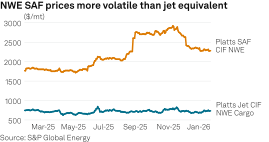
European SAF prices fell marginally in the week to Jan. 28, despite emerging buying demand, as strong imports exerted downward pressure on prompt levels.
Platts, part of S&P Global Energy, assessed the SAF FOB FARAG premium to jet barges down $61/mt, or 4%, in the week to Jan. 28, closing at $1,479/mt.

Editor: