Agriculture, Energy Transition, Refined Products, Biofuel, Renewables, Jet Fuel, Hydrogen
January 29, 2026
IEW 2026: Green hydrogen, utilities to decide real SAF winners, not just feedstock

HIGHLIGHTS
Green hydrogen, utilities to decide SAF competitiveness
Molasses ethanol offers low-CI shortcut to SAF
Aviation growth sharpens urgency for SAF adoption
The competitiveness of sustainable aviation fuel will increasingly be determined by how the entire production system is decarbonized — including hydrogen, steam and power — rather than feedstock conversion alone, India-based TruAlt Bioenergy said, as it bets on biomass-linked ethanol-to-jet pathways to scale low-cost SAF.
"SAF is not just about converting raw material," Vijay Nirani, founder and managing director of TruAlt Bioenergy, said during a SAF panel discussion at India Energy Week in Goa being held from Jan. 27-30. "It's about the steam you use, the power you consume, and the hydrogen that goes into making the molecule."
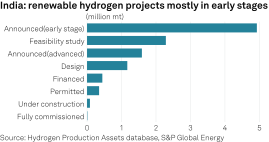
Biomass gasification-based hydrogen offers a decisive cost and carbon advantage over electrolyzer-based green hydrogen, which remains expensive and water-intensive, he said.
"Today green hydrogen via electrolysis costs around $4–$5/kg," Nirani said. "Biomass gasification is a big win — especially in a country like India where biomass is abundant."
Molasses ethanol offers low-CI shortcut to SAF
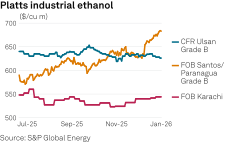
India's existing molasses-based ethanol pool provides a near-term, low-carbon pathway for SAF scale-up even before second-generation ethanol fully matures, Nirani said, citing lifecycle assessments commissioned by the Indian Sugar Mills Association.
According to the analysis, SAF produced from molasses-based ethanol delivers a carbon intensity of around 15–16 gCO2e/MJ, compared with 65–70 gCO2e/MJ for grain-based ethanol routes.
"That's almost comparable to second-generation ethanol," Nirani said. "It's a low-hanging fruit."
India currently has around 18 billion liters of gross ethanol capacity, of which roughly 11 billion liters are already available in the system, he said. Each liter of ethanol can yield about 0.6 liters of SAF, creating what he described as a "humongous opportunity" for aviation fuel decarbonization.
Aviation growth sharpens urgency
The urgency to scale SAF is intensifying as global aviation growth accelerates, Nirani said.
There are about 13,000 commercial aircraft operating globally today, with another 22,000 aircraft on order and expected to enter service by 2040. While only about 1% of the world's population flies frequently, that cohort already accounts for roughly 4% of global emissions, he said.
"If that 1% becomes 2%, it's not a fun place to live in," Nirani said.
TruAlt fast-tracks India's first ethanol-to-SAF plants
TruAlt is moving aggressively to commercialize ethanol-based SAF in India. The company recently formalized a partnership with Honeywell to deploy ethanol-to-jet technology at a proposed SAF plant in Andhra Pradesh, designed to produce about 80,000 mt/year of SAF.
The project is expected to leverage molasses-based ethanol, biomass cogeneration and gasification-derived hydrogen to compress SAF premiums, positioning India as a potential net exporter, Nirani said.
"The molecules are already cracked," he said, referring to ethanol-to-SAF technologies developed by firms such as Honeywell, JM and Praj. "Now it's up to companies like us to invest and produce."
Carbon markets, book-and-claim seen as missing link
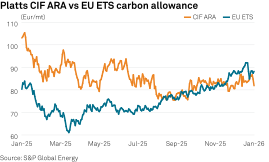
Beyond mandates and airline premiums, Nirani said carbon markets and book-and-claim mechanisms will be critical to bridging SAF's early cost gap.
Industries such as data centers and technology companies, which face rising decarbonization pressure but cannot directly consume SAF, could fund aviation's transition by purchasing verified carbon savings, he said.
India's emerging cooperation with Japan under the Joint Crediting Mechanism could allow SAF produced in India to generate transferable carbon value for countries with limited land or biomass, he added.
"If we have standardized carbon accounting — using globally accepted systems like ISCC and RSB — and an exchange where carbon savings can be traded, we solve two problems at once," Nirani said.
Mandate or levy both viable, SAF roadmap urgent
Nirani said either blending mandates or levies could drive SAF adoption, pointing to India's ethanol blending program as proof that penalties can accelerate market behavior.
"What motivated ethanol blending was simple — if you don't blend, you pay," he said.
With proposed SAF blending targets of 1% from 2027 and 2% from 2028, Nirani warned that India needs a clearer execution roadmap as timelines tighten.
"We are already in 2026," he said. "Next year blending begins, and we still don't have a full roadmap."
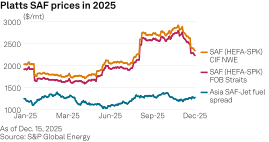
Despite the challenges, Nirani remains confident that SAF will follow the same cost trajectory as renewables.
"Fifteen years ago, renewable power cost Rs 15–20 per unit. Today it's around Rs 2," he said. "SAF will get there — but only if we think holistically."

Editor: