Agriculture, Energy Transition, Refined Products, Biofuel, Renewables, Jet Fuel
January 29, 2026
IEW 2026: Agri-residue to win SAF ‘carbon intensity’ race as carbon trading scales: Praj MD

HIGHLIGHTS
Agri-residue based ethanol emerges as low carbon intensity SAF pathway
Alcohol-to-jet seen as viable long-term SAF option due to feedstock availability
Long-term airline offtake deals crucial to de-risk SAF scale-up investments
Carbon intensity, not just cost, will ultimately determine which sustainable aviation fuel pathways scale as global carbon markets tighten, with agricultural residue-based ethanol emerging as a long-term winner, a leading bioeconomy executive said Jan. 29.
Speaking at a panel titled "Accelerating the adoption of Sustainable Aviation Fuel" during India Energy Week 2026, Ashish Gaikwad, Managing Director of Praj Industries, emphasized that CI scores will soon become the primary metric for airlines and investors.
"We believe that when the time comes, when carbon trading becomes more and more intense and people weigh their choices based on carbon intensity numbers, the winner can come from crop-based feedstocks," Gaikwad said. "Within that, it could be agri-waste -- bagasse, rice straw, corn cob, etc. The CI score will be lowest as it's coming from waste, and we are converting it into valuable molecules."
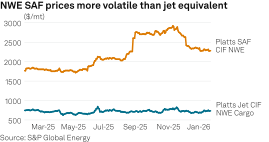
Feedstock choice central to SAF economics
Feedstock is one of the top three determinants of SAF economics," Gaikwad said. "It decides the ultimate price of SAF, the assurance of long-term supply and the cost of conversion. When carbon intensity becomes the primary decision metric, agricultural residue-based feedstocks will clearly stand out."
Gaikwad said Praj's internal analysis shows that while multiple bio-based pathways can technically produce jet fuel, not all deliver the same emissions reductions across the full lifecycle.
Within bio-based options, crop-derived routes deliver superior greenhouse gas reductions compared with other biomass sources, he said, with residue-based feedstocks offering the lowest carbon intensity because they valorize waste streams rather than competing with food supply.
"When you look across grain, sugar and biomass options, agricultural residues emerge as the strongest contender from a lifecycle emissions perspective," Gaikwad said. "These are wastes that are otherwise burnt or discarded, now being converted into valuable molecules."
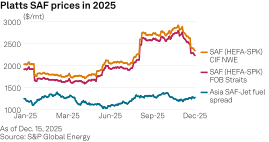
The AtJ edge
While more than a dozen technological pathways exist to produce SAF, Gaikwad said Praj sees alcohol-to-jet (AtJ) as the most viable option over a 20- to 40-year horizon, primarily due to feedstock availability and supply security.
"There are 11-plus pathways to reach the same SAF molecule, but they are not all equal," he said. "When you look long term, AtJ stands out because of the sheer availability and assurance of feedstock supply."
Second- and third-generation ethanol produced from agricultural residues is expected to further lower carbon intensity scores, making residue-based ethanol-to-jet particularly attractive as carbon pricing strengthens globally, he added.
"If I had to place my investment on one pathway today, it would be ethanol-to-jet," Gaikwad said.
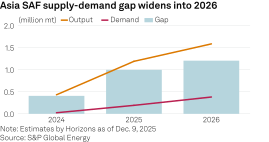
De-risking SAF scale-up
Gaikwad emphasized that SAF scale-up will hinge not only on technology but also on commercial structures that reduce volatility across the value chain.
Medium- to long-term offtake agreements with airlines would be critical to stabilizing pricing, enabling financing and accelerating investment decisions, he said.
"When variability exists in the ecosystem, it creates fear and sentiment-driven price swings," Gaikwad said. "Long-term contracts with end-consumers can smooth this volatility and give confidence across the supply chain."
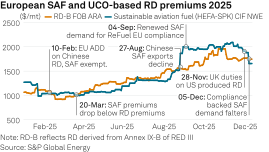
'Stick Approach' mandates
Despite the technical readiness, Gaikwad warned that the industry requires a stronger regulatory push to scale. He compared the current SAF landscape to India's transition from BS4 to BS6 emission standards, which happened rapidly because of a firm mandate.
"I would go with a 'stick approach' like a blending mandate with consequences," Gaikwad said. "Nothing will bring movement more than this. We saw this happen in India ... it just happened because the mandate was there."
India has already set indicative blending targets of 1% SAF by 2027, stepping up to 5% by 2030 for international flights. However, with SAF currently costing three to five times more than conventional jet fuel, Gaikwad emphasized that long-term offtake agreements between airlines and producers are essential to "smooth the ecosystem" and remove the variability and fear that currently hinder investment.
Global partnerships
Praj's commitment to this pathway is already manifesting in large-scale infrastructure. Earlier in 2025, the company partnered with Paraguayan firm Enersur to develop a $150-million biofuels plant capable of producing 600,000 liters/day of ethanol and SAF. The facility, located in Canindeyú, Paraguay, utilizes corn as a primary feedstock but is designed as a "future-ready" hub that can also produce high-value co-products such as distillers dried grains with solubles (DDGS) and biogas.
In India, the push is toward "integrated biorefineries" that can process multiple feedstocks simultaneously -- utilizing sugar molasses for 1G ethanol and rice straw for 2G ethanol. This model, pioneered by Praj in projects with Indian Oil Corp. and Bharat Petroleum aims to de-risk feedstock supply chains while maximizing carbon reduction.
India holds a massive biomass resource base, with ICF reports estimating 754 million metric tons of annual agricultural residues, of which 30% (228 million mt) are surplus and available for energy conversion.
The report highlighted that when combined with forestry residues (104 million mt), animal waste (61 million mt), and urban biomass (12 million mt), India has over 400 million mt of surplus biomass annually, with major concentrations in the states of Punjab, Madhya Pradesh, Uttar Pradesh, Gujarat and Maharashtra -- ideal for regional SAF production hubs.
