Agriculture, Energy Transition, Refined Products, Biofuel, Rice, Renewables, Jet Fuel
January 23, 2026
ASEAN poised to lead global SAF output with potential 8.5 mil b/d by 2050: report

HIGHLIGHTS
ASEAN demand to exceed 700,000 b/d SAF by 2050
Call for 'ASEAN SAF Alliance' to harmonize frameworks
Southeast Asia is positioned to become the world's leading driver of aviation decarbonization, with the potential to produce up to 8.5 million barrels/day of sustainable aviation fuel by 2050, according to the ASEAN SAF 2050 Outlook report.
The report, released on the sidelines of the ASEAN 2050 Sustainable Aviation Fuel Outlook summit in Hanoi on Jan. 23, projected that the Association of Southeast Asian Nations' internal demand for SAF will rise sharply, exceeding 700,000 b/d by 2050.
Meanwhile, the region's production potential from agricultural and forestry waste remains significantly greater, according to the report.
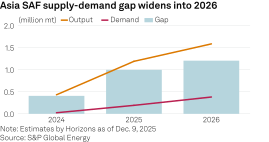
Potential supply is expected to rise to 8.5 million b/d by 2050 from 7.5 million b/d in 2030, with Thailand, Indonesia and the Philippines identified as having the greatest potential surpluses after meeting domestic mandates, the report said.
High-income hubs, including Japan, Singapore and South Korea, are projected to be the primary "off-takers," with an import demand of about 607,000 b/d by mid-century, the report added.
Bridging the 'green premium'
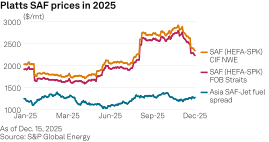
Despite abundant feedstock, a significant economic challenge is the "levelized cost" of production, the report said. The hydroprocessed esters and fatty acids pathway remains the only commercially deployable technology, yet its production costs are nearly double those of conventional petroleum-derived jet fuel.
Alternative pathways such as alcohol-to-jet and gasification/Fischer-Tropsch currently cost four to six times as much as fossil fuels, according to the report.
One potential cost-saver identified is the integration of SAF production into existing petroleum refineries. Retrofitting facilities to handle bio-alcohol intermediates could reduce unit capital expenditures by 20% and lower overall levelized costs by 10%, the report added.
Call for 'ASEAN SAF Alliance'
To capitalize on this comparative advantage, regional leaders in Hanoi called for the establishment of the ASEAN SAF Alliance to harmonize certification and trading frameworks.
"ASEAN regional SAF supply potential significantly outpaces projected demand, highlighting Southeast Asia's comparative advantage as a potential future SAF hub," the report said.
The report added that the region's primary feedstocks -- rice straw, cassava and forestry residues -- offer a low-carbon intensity path that avoids the land-use controversies currently affecting western biofuel markets.
The report also called for specific trade lanes between selected feedstock supply countries, such as Indonesia and Malaysia, and import countries like Singapore.
Such developments could promote the establishment of green trade lanes or corridors in Southeast Asia, aligning with the International Maritime Organization's greenhouse gas emission goals and existing sustainable shipping initiatives, the report said.
The report added that this could also serve as a progressive scale-up initiative, establishing regional supply chain hubs within Southeast Asia involving countries like Indonesia, Malaysia and Singapore, as well as countries such as Japan, the Philippines and South Korea.
Strategic outlook
For global markets, the Hanoi findings signal a pivot toward the "waste-residue" complex. As Europe phases out soy-based feedstocks by 2030, Southeast Asia's 8.5 million b/d SAF potential represents the most significant new supply frontier for an aviation industry under intense pressure to reach net zero, according to the report.
"Taking advantage of economies of scale and technology development can drive cost reduction through efficiency gains," the report said, urging immediate investment in "green trade lanes" between Southeast Asian producers and regional aviation hubs.
Platts, part of S&P Global Energy, assessed SAF FOB FARAG at $2,302.75/metric ton on Jan. 21, down $7.25/mt week over week. The SAF CIF Northwest Europe cargo price ended the week at an $11/mt premium to barge prices.
