Metals & Mining, Non-Ferrous
March 31, 2026
RARE EARTHS UNPACKED: 5 things to know about global supply chain shakeup
Editor:
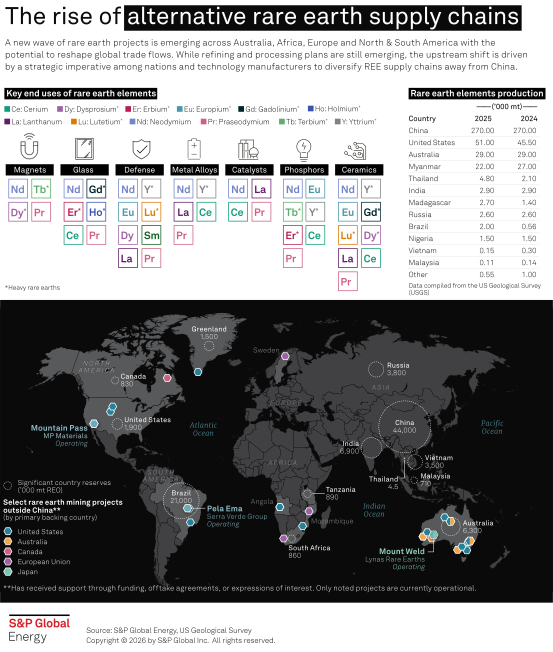
Rare earths, a group of 17 elements, are critical for defence, clean energy technology, and industrial manufacturing, among other applications.
They are split into two categories: Light Rare Earth Elements and Heavy Rare Earth Elements. LREEs are more abundant and used as bulk performance materials. HREEs are heavily concentrated in China and Myanmar, and used as performance enhancers.
While rare earths are not particularly scarce, they are difficult and expensive to extract, refine and process at scale. China dominates this supply chain and has not shied away from using it for geopolitical leverage, forcing other countries to explore diversification strategies. For example, China's 2025 export curbs and subsequent licensing changes left countries scrambling to secure rare earth elements.
China's 2024 exports were enough to manufacture components for millions of cars or to build thousands of strategic military systems, data centres or wind turbines, according to the International Energy Agency.
We answer five key questions on rare earths and why they play a key role in global industrial value chains.
1. Why is there a spotlight on rare earths?
Besides its applications in key renewable and automotive industries, some rare earth elements are crucial to defence applications. They are used in high-performance magnets for actuators, guidance, radar and flight-control systems. The US, the EU and NATO have already listed rare earth elements among "critical minerals."
China dominates the global production landscape, accounting for 91% of global refining and processing capacity, according to the IEA. It is also a major exporter of rare earth magnets. The global industry is seeking viable pathways to build a supply chain outside China, especially given a renewed focus on national security and defence applications.
2. How are China's export restrictions and dual-use licensing reshaping global supply chains?
China's export restrictions in 2025 on seven rare earth elements and its recent dual-use licensing rules targeting Japan have led to significant supply chain bottlenecks.
The April curbs have also driven up prices for the relatively scarce supply of some rare earths over 2025.
Following the April restrictions, many automakers in the US and Europe faced severe shortages of permanent magnets. This led them to reduce production utilization rates and, in some cases, temporarily close factories, according to the IEA.
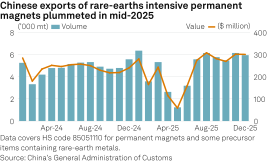
China exported 57,392 metric tons of rare earth magnets in 2025, down 1.3% year over year, according to Chinese customs data.
Supply disruptions are expected to persist through 2026 and 2027, particularly for heavy rare earths used in magnets, aerospace and electronics, according to David Merriman, a research director at the Project Blue metals consultancy.
Companies and governments are seeking clarity on whether these restrictions will become permanent policy or serve as temporary leverage in geopolitical negotiations, prompting them to secure an alternative supply chain.
3. Are there new pricing benchmarks to capture the rare earth supply chain shift?
Industry participants are calling for new rare earth pricing benchmarks in Europe and North America to reflect the different cost curves of Chinese and other producers, as well as higher incentive prices needed to boost the development of new rare earth projects.
Platts, part of S&P Global Energy, has proposed four market-first "alternative-supply-chain" rare earths price assessments, effective March 31. One of those assessments is Neodymium-praseodymium oxide, a LREE compound that can reduce reliance on heavy rare earth elements in magnet production. Such a substitution trend could alter trade flows in rare earths.
Already, a major consumer of rare earth magnets has changed its specification to eliminate heavy rare earths and shifted toward NdPr, according to MP Materials CEO James Litinsky. A new benchmark could serve as a reference price in contracts, aid risk management in a fragmented market and function as a policy tool for measures, such as strategic stockpiles, according to Cristiano Veloso, president, CEO and chairman of Verde AgriTech Ltd.
4. Can alternative supply sources be developed fast enough to meet demand?
Multiple initiatives are underway, with MP Materials' rare earth separation facility at Mountain Pass in the US beginning operations this year. US company REalloys is also developing North American capacity using feedstock from Kazakhstan and expects a partnership facility in Canada to be on track to deliver the first commercial product in early 2027. Lynas is expanding heavy rare earth elements separation in Malaysia and has already produced its first samarium oxide ahead of schedule.
There are more than 160 projects being explored and developed across multiple countries, with Brazil, Canada and the US topping the list, according to S&P Global Energy CERA. However, rare earth processing is extremely complex, takes over a decade to develop and requires specialized expertise in handling elements.
5. What is the true commercial viability of emerging rare earth projects outside China?
Emerging rare earth projects are facing significant commercial challenges despite accelerating development. For example, even as Japan was able to extract mud containing rare earths from deepsea deposits in February, an industry expert said commercial capacity is highly uncertain due to a lack of infrastructure. Japan also acknowledged it still needs to verify the economic viability of processing the material, from mining to separation and refining.
It took Canada's Saskatchewan Research Council over half a decade to refine the rare earth processing to optimize it for specification and economics, according to REalloys CEO Leonard Sternheim.
Even as companies advance through strategic partnerships and government support, China's refined rare earth compounds remain five to six times cheaper than Western alternatives, according to Kazuto Suzuki, professor at the University of Tokyo's Graduate School of Public Policy.