Energy Transition, Electric Power, Renewables
October 23, 2026
How Indian states are reshaping the data center landscape
India's data center capacity is projected to reach 26.3 gigawatts by 2031-32 from less than 2 GW today, according to a written reply submitted to the Rajya Sabha, the upper house of the Indian parliament, on July 27 by Minister of State for Power Shripad Naik. The expansion is spreading beyond traditional hubs as states compete for investment, with implications for electricity demand planning across the country.
For years, the country's data center industry has been concentrated around established technology and connectivity hubs such as Mumbai, Chennai, Hyderabad, Bengaluru and the National Capital Region. India has attracted data center-related investment commitments worth $100 billion since 2019, involving global cloud and hyperscale companies as well as major domestic operators, according to updated October data from real estate consultant CBRE India.
The next phase of expansion shows a different geographic pattern. As cloud computing, artificial intelligence and digital consumption increase demand for computing infrastructure, Indian states are developing more targeted policies to attract data center investment. State policy has become a key determinant of where capacity gets built.
From IT companies to digital infrastructure
S&P Global Energy CERA's policy analysis identifies four phases in data center development policy in India.
- Phase 1: IT-centric approach Initial information technology (IT) and IT-enabled services policies (2016-18) were primarily designed around IT parks, connectivity, skills and technology clusters. Telangana Data Centers Policy 2016 was an early exception, introducing provisions including grid assurance, open access, essential-services classification and data center-oriented building norms.
- Phase 2: Infrastructure recognition Between 2019 and 2022, states began treating data centers as a separate infrastructure category. Large data centers have requirements quite different from conventional IT companies, including substantial contiguous land, highly reliable electricity supplies, connectivity and longer project-development cycles, according to CERA. Policy incentives consequently expanded to include stamp-duty exemptions, open-access electricity, dual-grid supply and faster approvals.
- Phase 3: Economic optimization Policies introduced reimbursements of indirect taxes such as the State Goods and Services Tax (SGST) reimbursements, training support, infrastructure assistance and customized packages have increasingly focused on improving overall project economics, according to CERA.
- Phase 4: AI-ready infrastructure Since 2025, state data center policies have placed greater emphasis on AI-ready infrastructure, hyperscale development, renewable-energy procurement and advanced digital ecosystems, according to CERA. States are now competing to attract digital infrastructure supporting the AI economy, not just IT companies.
States compete with different strategies
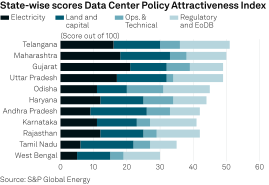
In the Data Center Policy Attractiveness Index (DCPAI) developed by CERA, Telangana has emerged as the most attractive state overall, while Maharashtra and Uttar Pradesh have relatively balanced packages spanning power, infrastructure, capital and regulatory incentives.
The index scores 19 data centers and IT policies across 11 states along four dimensions: electricity incentives, land and capital support, operational and technical support and regulation and ease of doing business. Other standout states include Gujarat, for its electricity framework that combines electricity duty benefits, tariff subsidies and renewable energy access; and Andhra Pradesh, for its land and capital support.
Policy differences matter because electricity represents a major long-term operating cost for data centers. Power availability and pricing influence where operators choose to build.
Accelerating capacity pipeline
India's computing requirements are expanding as state-level competition intensifies. CERA estimates current data center capacity at about 1.6 GW, with 5 GW of additional capacity committed and another 6-7 GW announced or at earlier stages.
Maharashtra has the largest share of announced capacity, according to announcements from developers and state governments. Projects linked to AirTrunk, NTT Inc. and AdaniConneX amount to about 3.5 GW linked to the state. Andhra Pradesh has secured a 1-GW Google commitment for a hyperscale facility in Visakhapatnam alongside additional AdaniConneX capacity. Telangana and Tamil Nadu also have robust project pipelines. Across states, 11-12 GW of pipeline was announced in 2025-26 alone.
This expansion has implications for both state economic-development strategies and electricity planning.
Geographic diversification of electricity demand
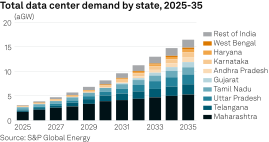
India's data center electricity demand is becoming more geographically distributed. Maharashtra, Tamil Nadu and Telangana will remain important demand hubs, while Uttar Pradesh, Gujarat and Andhra Pradesh will drive substantial capacity additions, according to CERA projections. The four largest states' share of data center demand is projected to decline from nearly 90% in 2025 to 66% by 2035.
Instead of data center electricity demand remaining overwhelmingly concentrated around Mumbai and Chennai, more states will participate in the sector's expansion. Haryana, West Bengal, Kerala, Rajasthan and Odisha are among the states expected to gain share, according to CERA.
The geographic spread makes data center planning a state-level electricity issue, linking digital infrastructure policy with power-system development and renewable-energy availability.
Why incentives are not enough
Policy incentives alone do not determine investment outcomes. Tamil Nadu retains a robust investment pipeline despite having a lower policy score in the DCPAI than several competitors. Connectivity and broader ecosystem advantages remain as important as incentives.
Fiscal concessions improve project economics by reducing upfront costs, while electricity incentives can potentially lower operating costs considerably. Similarly, faster permitting can make development easier. However, states require foundational elements: high-quality internet connectivity, affordable and reliable clean electricity, suitable infrastructure and an ecosystem capable of supporting large data center clusters.
India's data center expansion is therefore becoming a competition over which states can combine incentives with infrastructure, power and digital ecosystems most effectively. The states that achieve this balance are likely to attract the next wave of investment.
This article contains data, views and forecasts from S&P Global Energy CERA analysts and does not represent reporting by Platts, part of S&P Global Energy.
