Electric Power, Energy Transition, Nuclear, Renewables
April 30, 2026
India’s power and renewables market: Demand stalls, capacity rises
India's power sector reached a turning point in fiscal year 2025-26 (April 2025-March 2026), as record renewable capacity additions of 51 GW coincided with the first annual contraction in electricity demand since the pandemic. The unusual combination stemmed from prolonged monsoon conditions that suppressed cooling demand and accelerated clean energy deployment, according to Central Electricity Authority data and S&P Global Energy CERA analysis.
Energy demand contracts marginally
Electricity demand in FY 2025-26 contracted 0.3%, falling to about 1,690 terawatt-hours from 1,695 terawatt-hours in FY 2024-25, according to CEA data. This muted demand was largely due to milder summer temperatures and the early onset of the monsoon, which reduced cooling requirements during peak demand months, according to CERA analysis.
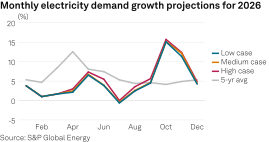
Looking ahead, CERA expects electricity demand to rebound 4.7%-5.4% between April and December. However, this outlook remains below earlier projections of 6.0%-6.6% for calendar year 2026, as GDP growth slows due to ongoing geopolitical disruptions stemming from the Middle East conflict, according to S&P Global Market Intelligence.
Renewables drive capacity expansions
India's installed capacity reached 533 GW by March, rising 12.2% year over year from 475 GW, according to CEA data. Renewables drove this expansion, contributing 51 GW of the total 62.4 GW added during FY 2025-26. Installed renewable capacity reached 223.3 GW, up 29.5% year over year from 172.4 GW in March 2025.
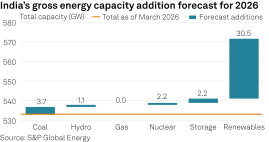
India is expected to add 38.5 GW of new capacity between April and December , with renewables accounting for 30.5 GW, according to CERA. Conventional capacity additions are projected at 3.7 GW of coal, 1.1 GW of hydro, 1.0 GW of nuclear and 2.2 GW of battery storage.
Power exchanges gain market share
Electricity trade through India's three power exchanges -- Indian Energy Exchange, Hindustan Power Exchange and Power Exchange India Limited -- reached about 158.7 TWh in FY 2025-26, accounting for about 9.4% of India's total electricity demand, according to the data compiled by CERA.
This represented a strong year over year growth of nearly 16%, driven primarily by higher open access participation and increased power cost optimization by distribution companies.
Thermal generation displacement
Overall electricity generation in FY 2025-26 increased marginally by 0.2% year over year to 1,817 TWh, according to CEA data. Renewable energy generation surged 19.7% to 301 TWh from 252 TWh, increasing its share to 16.6% from 13.9% in FY 2024-25.
This renewable surge displaced conventional generation. Coal-fired generation declined 3.9% year over year to 1,280 TWh. Gas-based generation fell by 17.4% to 26 TWh, accounting for just 1.4% of total generation.
During the January-March period, the rapid expansion of renewable capacity translated into strong growth in renewable power generation. Renewable output increased by more than 21% year over year, reaching nearly 75 TWh, compared with 62 TWh, according to CEA data.
As renewables continued to gain a larger share of the generation mix, coal-based generation declined modestly. Coal output fell by about 1.5% year over year to 337 TWh in January-March 2026, down from 342 TWh.
Renewable momentum
Activity in the renewable energy certificate market strengthened significantly during FY 2025-26, with traded volumes rising by 51% year over year to about 50 million certificates, according to IEX data. Prices softened modestly, declining by about 3% year over year but remaining broadly stable within the $3.6-$4.0/MWh range.
In the January-March 2026 period, REC transactions increased at a slower 8% year over year to about 15.7 million certificates, according to IEX data, reflecting weaker short-term demand conditions.
On the procurement side, renewable tendering activity remained robust during FY2026, with a total of 24 GW of capacity awarded through competitive bids. However, procurement momentum weakened in the January-March period, with awards falling to 7.6 GW, a 12% year over year decline.
The slowdown reflects growing caution among procurers as curtailment risks and integration challenges become more pronounced, even as long‑term renewable capacity expansion targets remain unchanged.
Curtailment represented 0.27% of the total variable renewable generation during the January-March 2026 period, according to NLDC data. Renewable energy curtailment rose sharply by about 200% year over year to 184 GWh, up from 61 GWh, indicating that while seasonal demand provided some support, underlying grid integration and flexibility challenges remained unresolved.
Path forward
India's power sector faces a delicate balancing act. The country must sustain renewable capacity additions -- CERA projects 30.5 GW between April and December 2026, representing 79% of total expected capacity additions, while simultaneously investing in transmission, storage and grid flexibility to ensure a reliable electricity supply. The sector has proven it can deploy renewable capacity at record speed, adding 51 GW in FY 2025-26 alone. The harder challenge now is building the ecosystem to effectively utilize that capacity.
With Ashish Singla.
Further reading: India Power and Renewables Market Briefing: Q2 2026
