Electric Power
April 21, 2026
Clean energy procurement held up in 2025 with more diversified approaches

By Caroline Zhu
Editor:
Significant regional variations and evolving market structures characterized the global clean energy procurement market in 2025.
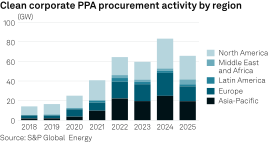
Headwinds challenged power purchase agreement contracting globally. Corporates announced a total of 66 GW of clean energy deals globally in 2025, reflecting a 21% decline from 2024, according to S&P Global Energy Horizon's corporate renewables PPA contracts database.
The decline was particularly pronounced in Europe, where the largest annual drop occurred. Multiple pressures affected corporate procurements amid escalating trade disputes and a focus on cost competitiveness. Legislative and timeline uncertainties in North America complicated deal execution, while Europe grappled with deteriorating capture prices and PPA prices falling below project breakeven levels.
Additionally, the ongoing revision of Greenhouse Gas Protocol requirements is prompting some corporates to adopt a more wait-and-see stance on longer-term commitments.
Solar continued to lead the charge in corporate procurement, accounting for half of announced capacities in 2025, despite a 16% decline. Hybrid deals, on the other hand, sustained volume as markets faced more zero and negative power prices and shifted toward more flexibility-backed hedges.
Data centers dominate
Data centers continued to dominate the clean energy procurement sector in 2025, accounting for 29 GW. The share of hyperscalers and large tech companies in overall corporate procurement increased to 44% in 2025 from 37% in 2024.
Data centers accounted for nearly 90% of deals in Europe and North America, reinforcing their status as the leading buyers in these regions. While globally other industries may be flickering, the technology sector's clear demand for power makes it the single most important driver of new renewable energy projects.
The manufacturing sector accounted for 6 GW, while the service sector accounted for 5 GW. Both sectors experienced significant contracting slowdowns -- declining 36% and 29% respectively, aligned with broader global trends.
Top offtakers were Amazon, Google, Meta, Microsoft and Rio Tinto. As the only non-technology company in the top five, Rio Tinto's inclusion highlights a growing trend in clean energy adoption within the mineral extraction sector. While contracting slowed down across the top buying sectors, the mining sector emerged as an outlier, recording a 17% growth in procurement activity.
Regional developments
In 2025, the Asia-Pacific region contracted 19 GW, a 22% year over year decrease. India and Australia remained the most active markets, with 11 GW and 4 GW corporate PPA announcements, respectively.
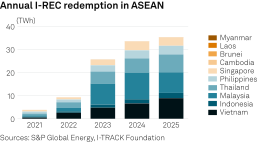
Unbundled energy attribute certificates have been one of the most prevalent procurement options in the region and have shown steady growth over the past few years. However, in key Southeast Asian markets, International Renewable Energy Certificates (I-RECs) redemption has slowed down, particularly in Singapore and Malaysia. In Singapore, companies' growing interests in bundled options, including cross-border import projects, weakened unbundled demand and led to plummeting I-REC prices. The revision of the GHG Protocol has fueled uncertainty about the location requirement.
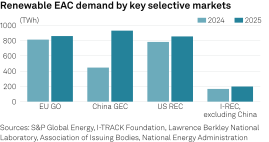
In contrast, India and China sustained accelerating corporate renewable offtake, with substantial growth in renewable energy trading and downward price trends. In 2025, India's the green day-ahead market surged 130%, while China's Green Electricity Certificate doubled to 930 terawatt-hour.
As different markets mature at varying speeds, the Asia-Pacific region exhibited starkly divergent procurement trajectories and strategies.
Europe's corporate PPA contracting fell 35% to 15 GW in 2025, revealing a market grappling with deteriorating economics and heightened risk aversion.
Spain retained its leadership with 5 GW, despite a 20% decline, followed by Poland (2.5 GW) and Italy (1.6 GW), both showing growth. Germany, Sweden and France exhibited substantial retreat during the year.
European PPA prices softened through 2025 due to weaker power demand growth and falling power prices. Solar PPAs saw the strongest downward pressure in 2025, particularly in Spain and Germany, reflecting rising cannibalization risks and widening gaps between wholesale capture prices and prices needed for project cost recovery. Onshore wind PPAs proved more resilient.
Corporates are shifting toward shorter contract terms and stronger downside protections, signaling a more defensive risk-management posture. Meanwhile, demand for renewable Guarantees of Origin grew 6% to 860 TWh, with solar and wind cancellations rising 28% and 11%, respectively.
Throughout the year, GO prices remained weak overall, with 2025 vintages trading about 20 euro cents/megawatt-hour at year-end of 2025, before recovering above Eur1 in early 2026 as the market rebalanced, according to Platts price assessments. Platts is part of S&P Global Energy.
Amid ongoing market caution toward long-term PPAs, unbundled GOs continue to offer a cost-competitive and flexible alternative for companies and could maintain strong momentum.
In North America, corporate clean energy procurement announcements in 2025 retracted by 21% to 24 GW. Although the US remained the largest PPA contracting market globally, the market has been navigating legislative changes, which have significantly impacted new announcements, leading to fewer deals and shorter contract lengths.
However, beyond volumes, the evolving policy landscape and rising power demand from data centers have reshaped procurement strategies and shifted the focus of signed technologies in 2025.
Nuclear remains a strong option for corporates and data centers, with about 4.3 GW contracted in 2025. Meanwhile, grid congestion and curtailment pressures eroded renewable capture rates, while lengthy interconnection queues cast uncertainty over project timelines.
This layered complexity -- higher development costs, supply chain constraints and policy flux -- triggered stronger price responses to risks. National average solar PPAs saw 30% price increase in 2025, while wind remained relatively stable, with more pronounced movement observed in the Electric Reliability Council of Texas, the powerhouse of PPA activities.
Short-term PPAs are gaining traction, particularly as a growing share of operational fleets exit long-term contracts-- although these deals often are less publicly disclosed. Amid this turbulence, the voluntary market in the US grew by 17% to 380 TWh in 2025, with voluntary REC prices holding steady above $2/MWh, providing a reliable hedge against PPA market complexity.
The flexible path forward
Looking ahead, as energy price volatility remains elevated, divergence across regions is likely to persist. China is poised for PPA growth in 2026, supported by new policies promoting direct supply of green power. Europe in particular faces renewed power price volatility driven by higher gas prices. Meanwhile, North America is entering a period of transition as renewable energy tax credits begin to phase down.
Data center demand will remain the stabilizing anchor, driving selective growth despite persistent regional disparities. Ongoing renewable energy penetration and unwavering corporates' commitment to credible renewable energy claims will sustain strong momentum for global demand for EACs, whether bundled with PPAs or purchased unbundled.
This landscape reflects the market recalibrating its approach -- not abandoning decarbonization goals, but navigating complexity through greater flexibility, technology diversification and more sophisticated risk management.
This blog is based on the published Global Corporate Clean Energy Procurement Market Briefing and Horizons Clean Energy Pulse.
To learn more, visit S&P Global Energy Horizons.
