Natural Gas
April 14, 2026
2026 CCUS: Navigating the tides of the great realignment
The carbon capture, utilization and storage sector entered its industrial hardening phase in 2026. Global operational capture capacity has reached 73 million metric tons/year, with nearly 1,300 projects in the pipeline, according to S&P Global Energy Horizons Clean Energy Technology Analytics. The reality shows a market bifurcating between regions that have solved regulatory challenges and those still navigating bureaucratic obstacles. From Iowa's cornfields to the North Sea's shipping lanes, the future projects have clear regulation and proven economics.
This sustained enthusiasm, along with the uncertainties behind many early-stage projects, lays the foundation for integrated views of the long term: by 2050, the Horizons CCUS Market Capacity Outlook remains on a trajectory in which global capacity could exceed 2 gigatons/year by mid-century.
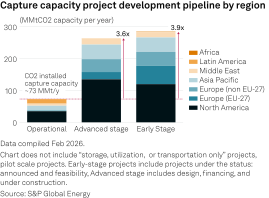
Here is how the landscape is evolving in 2026 and its implications.
1. The 'clean firm' reality: AI demands a new baseload
In its latest CCUS outlook, Horizons discussed the theoretical collision between AI energy demand and decarbonization. In January 2026, that collision is quickly evolving and unfolding into market realities.
The sheer scale of data center growth is forcing a pivot in the power sector. Tech giants are no longer just signing power purchase agreements and buying renewable energy credits with hourly matching; they are actively underwriting "clean firm" power, electricity that is available 24/7, regardless of the weather.
- The model: In October 2025, Google signed a first-of-its-kind corporate agreement to purchase power from the Broadwing Energy project in Illinois, a 400-megawatt natural gas plant equipped with carbon capture technology designed to sequester 90% of its emissions to provide reliable, "clean firm" energy for the company's AI data centers. This marks a milestone in the carbon capture industry as the first power purchase agreement signed by a hyperscaler in the US.
- The response: Utilities are responding fast. In January, NextEra Energy and ExxonMobil advanced their partnership for 1.2 GW of low-carbon natural gas power generation capacity, with Capsol Technologies and Babcock & Wilcox securing commercial wins for the carbon capture systems.
- The tension: However, the gigantic energy demand from datacenters cuts both ways. In the UK, BP's withdrawal from the H2Teesside project in December 2025, prompted by the landowner advancing a competing planning application for an AI data center on the same plot, is a stark signal that digital and decarbonization infrastructure are now competing for the same prime real estate and grid connections.
2. The rise of BECCS: Negative emissions go commercial
Bioenergy with CCS, or BECCS, generates energy by burning organic material and capturing the resulting carbon dioxide for permanent storage.
BECCS can function as a net-negative emissions technology if the carbon content of wood captured after combustion exceeds the lifecycle emissions of harvesting and transporting the biomass, including upstream land use impacts if the biomass is not simply a residual byproduct, such as sawdust from sawmill operations. BECCS has graduated from a niche concept to a centerpiece of the engineered carbon removal discussion. 2025 marked the first year that BECCS (excluding ethanol) exceeded direct air capture in carbon removal project development capacity. While DAC remains a high-cost frontier technology, BECCS is being developed at a comparatively greater scale for power and industrial heat.
- Feedstock integrity: As the BECCS industry moves into a critical planning stage to scale up sustainable feedstock supply networks prior to deployment over the coming years, research from Horizons into feedstock pathways suggests that success depends on transparency. Most of the planned BECCS capacity will rely on wood pellets as the feedstock. Currently, many major pellet production facilities with energy company offtakers source roughly 40%-60% of their forest material from non-residual sources, often involving traditional commercial logging operations. Crucially, when wood pellet blends incorporate significant percentages of non-residual clear-cut forest material, high embedded emissions from land-use change, soil organic carbon loss, and carbon debt generation can completely eliminate any potential negative-emission benefits of BECCS.
- The cost threshold: In "plant gate-to-grave" scenarios, a carbon price above $150-$200/mt is required to close the cost gap and allow BECCS to scale, according to Horizons analysis. The first commercial evidence is maturing in Europe, with the Swiss-based CO2 Energie project securing a storage deal with INEOS Greensand to ship biogenic CO2 across international borders starting in Q2, according to Horizons Clean Energy Technology Analytics.
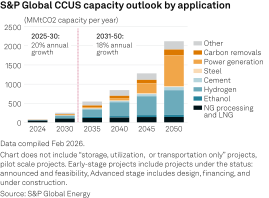
3. Industrial realism: Delays and divergence
Finally, 2026 is bringing a healthy dose of realism to project timelines.
- The recalibration: Dow's decision to delay its flagship Path2Zero project in Canada by two years (to 2029) reflects a strategic move to conserve capital amid a global chemicals downcycle and weak market conditions. Similarly, Petronas faces ongoing technical headwinds at the massive Kasawari offshore project, pushing back the timeline for its dedicated carbon capture and injection platform to the end of the 2020s.
- The counter-narrative: Yet, where market forces hesitate, state mandates accelerate. China continues to drive down costs at its coal bases, viewing CCUS not just as a climate tool but as a strategic industry. Meanwhile, the Northern Endurance Partnership in the UK defied the gloom by signing a seabed lease to commence construction, proving that well-structured clusters can still attract capital.
The path forward
As we look at the trajectory for the rest of 2026, the theme is resilience. The market is shedding the speculative fluff of the early 2020s. What remains is a hardened sector that is:
Operationally active: The industry is seeing the delivery of key milestones, from ExxonMobil and CF Industries launching commercial operations in Louisiana to the operational start of independent hubs like Meadowbrook. Even with strategic delays like Dow's Path2Zero (now 2029), the sector is moving toward a steady cadence of "first-of-a-kind" operations.
Logistically creative: The industry is solving the infrastructure puzzle through hubs and cross-border partnerships. Whether it is untangling permit locks through state primacy in the US or shipping biogenic CO2 from landlocked Switzerland to the North Sea, the circulatory system of the carbon economy is being built in real time.
Strategically vital: CCUS is no longer an optional "extra"; it is underpinning the global economy's most crucial drivers, including the AI energy boom, and enabling the rise of low-emission baseload offerings and even negative-emission opportunities via BECCS.
The transition from CCUS ambition to execution is unsynchronized and fraught with challenges. But for the first time, the challenges are about execution -- financing, pouring concrete, welding steel and signing permits, rather than just theoretical modeling.
Further reading:
Carbon capture, utilization and storage deep dive — Bioenergy with CCS
