Electric Power, Natural Gas, Energy Transition, Nuclear, Renewables
April 09, 2026
CERAWeek 2026: Power systems emerge as an energy security priority
Energy security has shifted from a competitive advantage to a critical requirement as CERAWeek 2026 revealed a fundamental transformation in global power systems. With electricity demand accelerating -- driven by data center demand, electrification and industrial growth -- the power sector has become the decisive arena where policy choices, infrastructure limits and investment realities converge.
1. Energy security is now a power system problem
Energy security discussions have shifted decisively toward grid reliability, capacity adequacy and local reliability. Extreme weather, geopolitical instability and demand growth are exposing weaknesses in aging transmission and distribution systems. Countries across the globe are demanding diverse generation portfolios, as firm capacity and flexible grids are proving critical to resiliency.
"The most pervasive takeaway from CERAWeek 2026 was that geopolitics is no longer a background risk; it is a primary driver of market structure," said Chengyao Peng, S&P Global Energy head of APAC power & renewables research.
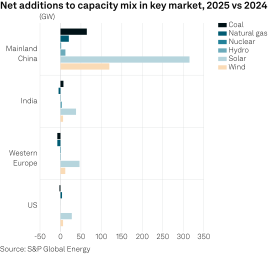
Global renewable additions reached an estimated 700 GW in 2025, according to S&P Global Energy CERA, extending record growth from 2024. As global energy shocks prioritize security, the 2026 outlook may shift toward mature "quick-wins" like solar-plus-storage, especially in the US and new natural gas.
2. AI-driven demand growth is rewriting power planning assumptions
Artificial intelligence has moved from long term forecast to an immediate system stressor. Data centers and AI training loads are accelerating, overwhelming interconnection queues, compressing reserve margins and forcing difficult conversations about cost allocation and reliability standards.
In the US, utilities, regulators and hyperscalers are now tightly coupled as power demand growth has become a strategic national priority. "The current supply and price pressures are also an opportunity to revisit past plans, processes and agreements, and design new models that can unlock affordable supply more quickly," said Sylvain Cognet-Dauphin, S&P Global Energy head of EMEA power and renewable research.
Executives from National Grid and Dominion Energy emphasized that the primary bottleneck is not capital but permitting, pipelines, power assets, transmission build-out and skilled labor.
3. Energy transition is redefined by affordability and security constraints
Rather than retreating from decarbonization goals, discussions at CERAWeek placed the transition squarely within the realities of cost and reliability.
European Commission's Director-General for Energy, Ditte Juul-Jørgensen, noted that European states with lower shares of power generation reliant on imported fossil fuels reliably have lower prices. The EU will aim to reduce its import dependence. It will also seek to improve its competitiveness by reducing regulatory barriers, improving transnational competition and cooperation between power markets, and revisiting long-term natural gas supply contracts that will still be needed in the coming decades.
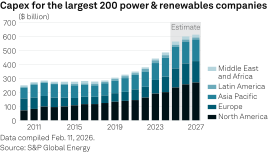
Rising electricity prices, grid congestion and geopolitical volatility are shaping what is politically and economically durable, amid an investment surge from companies across the globe. The most immediate cleantech beneficiaries will be more mature renewable technologies that can be quickly deployed to address near term security and affordability challenges, including solar-plus-storage projects and standalone grid storage, Amit Chandra, head of Climate Technology at Barclays, said.
While the focus in the US has shifted to speed-to-power for data center demand, many other nations remain committed to a robust energy transition, but this transition must protect consumers, maintain system stability, and support economic competitiveness. The transition is no longer a linear pathway, it is an exercise in balancing climate ambition with affordability and energy security.
4. Permitting emerges as critical constraint
Across power conversations at CERAWeek, permitting emerged as one of the most binding constraints on energy security. Lengthy approval timelines for transmission lines, generation and storage are delaying projects even where capital and demand are strong.
While the US has seen a rapid acceleration in LNG permitting, transmission has not yet had the same focus. Regulatory reform, institutional coordination and practical dialog between data center developers, utilities and their regulators were frequently mentioned at CERAWeek as critical steps that must be taken immediately. Despite slow progress, Jenny Yang, S&P Global Energy head of global power renewables research, highlighted that "there is a clear opportunity to use technology to extract more value from the existing assets, especially where permitting remains a constraint".
5. Nuclear power returns to deployment
One of the more notable shifts at CERAWeek was the focus on near-term nuclear deployment milestones. Faced with rising load, reliability requirements and energy security concerns, policymakers and utilities are increasingly viewing nuclear power, both conventional reactors and small modular reactors, as a development priority.
The focus has moved toward licensing timelines, supply chains and financing models, signaling that for many regions, nuclear power is being reconsidered as a delivery solution for clean, firm power. Several speakers argued that the current moment represents a new nuclear "renaissance," distinct from the mid-2000s wave that faltered on cost overruns.
Utilities and industrial players reinforced this view. Dow Chemical highlighted its partnership with X-energy on SMR as part of a long-term strategy to secure reliable, lower-carbon power for energy-intensive manufacturing. Others stressed that standardization, modular construction and regulatory predictability are critical to success.
Developers such as Kairos Power are pursuing repeatable construction models, including plans to build multiple reactors to supply hyperscaler demand. Building a fleet of reactors enables learning-by-doing efficiencies and supports commercial scalability, while integrated project sequencing can help reduce risk prior to full-scale construction, executives said.
From vision to execution
CERAWeek 2026 underscored that a new map has been drawn for the energy transition. New technology players were prominent throughout the week, making a strong case for clean technologies that can be deployed rapidly at manageable costs.
Electrification is accelerating faster than infrastructure and institutions are adapting. The decisive challenge of this decade is not vision, but execution -- at scale, at speed and at a cost society can sustain.
