Crude Oil, Maritime & Shipping
March 10, 2026
COMMODITY TRACKER: 6 charts to watch this week

By Staff
The war in the Middle East disrupts commodity markets as Russian crude differentials narrow after US sanctions relief. Middle Eastern aluminum shipments face significant delays amid shipping route changes, while European gas prices increase, impacting ammonia production costs. Asian used cooking oil prices rise following the Lunar New Year holiday.
1. Russian crude differentials narrow after US sanctions waiver
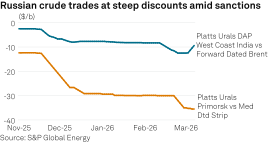
What's happening? The discount on Russian Urals crude has narrowed following a US Treasury Department 30-day waiver allowing sanctioned Russian oil already loaded onto vessels to be sold to India. Platts, part of S&P Global Energy, assessed Urals DAP West Coast India at a $9.4/b discount to Forward Dated Brent on March 9, compared to $12.5/b on Feb. 27. Buyers are seeking Russian barrels as a potential replacement for Middle Eastern crude amid supply concerns from regional infrastructure attacks and Strait of Hormuz restrictions. Prior to the US waiver announcement, discounts on Russian crude had widened, after sanctions on its largest producers, Rosneft and Lukoil, as well as an EU ban on imports of refined products made from Russian oil, came into effect.
What's next? US officials may issue additional sanctions relief to minimize price impacts from Middle East conflicts. Russian crude exports could potentially increase, though supplies fell 4% month over month to 3.4 million b/d in February. Notably, supplies to India dropped significantly, averaging 503,000 b/d in February, a 43% month over month decline, according to S&P Global Commodities at Sea data.
2. Middle East conflict disrupts aluminum supply
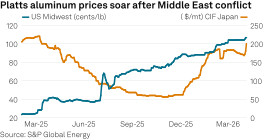
What's happening? Middle East aluminum exports have been stifled by the region's conflict. The region, accounting for 9% of global primary aluminum supply, is a crucial aluminum supplier due to the Persian Gulf's access to low-cost natural gas. On March 6, the Platts-assessed US Midwest Premium for primary aluminum reached an all-time high of 110.95 c/lb, plus LME cash, reflecting the supply chain disruption.
What's next? North American aluminum markets face potential severe supply constraints, with the UAE and Bahrain supplying 23% of US aluminum imports in 2025, up from 16% in 2024. The potential inactivity of Qatalum and Alba smelters could temporarily remove over 2.2 million metric tons of annual aluminum capacity. Asian countries like Japan and South Korea are expected to seek alternative supply sources, potentially driving regional premiums higher.
3. European ammonia producers face gas price increase
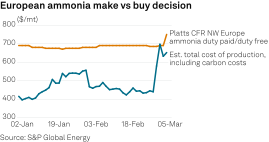
What's happening? The Strait of Hormuz disruption increased European natural gas prices, raising ammonia production costs. Platts-assessed delivered ammonia into Northwest Europe at $750/mt on March 5, a three-year high. While current cash costs still support European production, a prolonged disruption could force producers to either operate at high costs or shut down and rely more on imports, market sources have said.
What's next? With gas supply from the Middle East cut off, continued disruptions risk pushing up ammonia production costs. European consumers must weigh producing with expensive gas against importing, as supply west of Suez was already tight due to earlier plant outages. New US Gulf Coast capacity, including Gulf Coast Ammonia and Woodside Beaumont facilities, coming online soon could help ease import price pressures, according to Georgy Eliseev, associate director for S&P Global Energy CERA.
4. European MMA prices rise on Middle East supply concerns
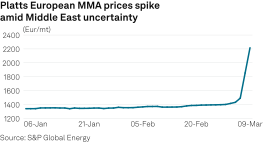
What's happening? European methyl methacrylate spot prices have increased 58.2% between March 2-9, 2026, driven by supply concerns following the Strait of Hormuz closure. The market tightness is compounded by reduced European inventories, stemming from closed Asian arbitrage in Q4 2025. With Trinseo's 100,000 mt/year Italian plant shuttered in 2025 and Roehm as Europe's sole producer, Saudi Arabia had become critical for regional supply. Suppliers are capitalizing on uncertainty by raising offers and withholding positions.
What's next? The Middle East export disruption is expected to drive increased buying activity as European buyers seek to hedge supply risks. Import options remain constrained as Asian prices rise alongside escalating freight costs, making arbitrage economics challenging. The combination of geopolitical supply risks and limited import alternatives suggests the European market will remain under severe pressure, with continued price volatility expected as buyers compete for available material.
5. Asia feedstock prices rebound after Lunar New Year
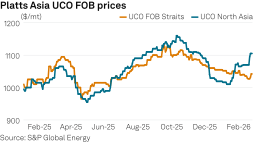
What's happening? Post-Lunar New Year demand has driven used cooking oil prices in Asia to their highest levels in months. Platts assessed FOB Straits at $1,050/mt on March 9 and FOB North China at $1,099/mt, compared to recent lows of $1,027/mt on Feb. 24 and $1,010/mt on Jan. 13. The market remains cautious due to ongoing geopolitical tensions in the Middle East.
What's next? In China, the domestic UCO market is expected to receive support as sustainable aviation fuel plants return from maintenance and resume normal procurement. Market participants anticipate continued price volatility due to freight rate fluctuations and geopolitical risks. Buyers may continue to postpone purchases or rely more heavily on domestic UCO supply, reflecting the current market uncertainty.
Related topic: US-Israeli Conflict with Iran
6. Colorado River Basin water supply forecast drops
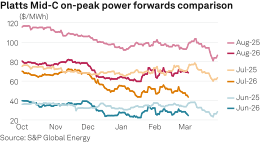
What's happening? A record warm winter has created extremely dry conditions across the Colorado Basin River Forecast Center region. Snowpack is 52% of normal above Lake Powell, up 5 points from January due to February's near-normal precipitation, according to senior hydrologist Cody Moser. On March 5, Palo Verde on-peak June pricing was around $31.50/MWh, nearly 29% lower than the 2025 package a year ago, according to S&P Global Energy data.
What's next? Warmer and drier conditions are expected to further deteriorate the water supply outlook over the next two weeks. Despite the challenging water situation, Platts M2MS power forwards in the Western US have been trending lower. Lake Powell's water supply forecast for the April-July period stands at just 36% of normal, a 42-percentage point drop from the 2025 outlook, according to CBRFC data.
Reporting and analysis by Rosemary Griffin, Rohan Somwanshi, Anthony Rizkala, Katya Bouckley, Jeffrey McDonald, Luke Warren, Chau Kit Boey, Yoke Mae Goh and Kassia Micek

Editor: