May 11, 2026
INSIGHT CONVERSATION: Chris Ninnes, Aquaculture Stewardship Council

By Lalita Avd
Editor:
In this Insight Conversation series on global protein markets, leaders from the shrimp, pork and beef sectors examine the forces reshaping international trade. This is the first of five in-depth interviews where industry executives share their insights on how tariffs, import quotas, regional conflicts and cost inflation are redirecting protein trade flows and challenging established market dynamics.
The global shrimp and seafood industry is navigating a period of sustained adjustment following the post-pandemic demand surge and the subsequent oversupply, which disrupted pricing cycles across key producing regions, such as India and Ecuador. Lalita Avd, S&P Global Energy agriculture and food editor, speaks with Chris Ninnes, CEO of the Aquaculture Stewardship Council, to explore how producers, processors and buyers are responding to these challenges. The Aquaculture Stewardship Council certifies and labels responsibly farmed seafood.
Ninnes addresses the impact of oversupply, shifting demand and recent geopolitical developments -- including US tariffs, changing freight dynamics and the Middle East conflict.
How would you describe the current state of the global shrimp and seafood industry?
The sector is best characterized by continued uncertainty and ongoing readjustment.
Following the COVID-19 period, shrimp producers expanded output to meet elevated demand, but as consumption normalized, the market shifted into oversupply. This led to weaker prices and financial pressure across parts of the value chain.
While demand has since stabilized and resumed moderate growth, recent trade disruptions -- particularly tariff changes in the US -- are reshaping competitive dynamics between producing countries. Inventory buffers initially masked the impact, but more recent trade data suggests demand softening in some origin markets, especially India, while others, such as Ecuador, have gained relative advantage.
What are the biggest structural challenges facing shrimp producers today?
The core challenge is not only production, but alignment across the full supply chain.
While farm output remains cyclical, the bigger constraint lies in processing capacity and market-specific product requirements. Different markets demand different formats, and the ability to convert raw production into the right product mix is increasingly a bottleneck.
This means competitiveness is no longer just about farming efficiency -- it is also about integrated supply chains, processing infrastructure, and responsiveness to shifting trade routes.
Are you seeing shifts in the seafood demand across major markets such as North America, Europe and Asia?
At a broad level, underlying seafood demand continues to grow globally, driven by long-term consumption trends.
However, from a certification and sustainability perspective, demand signals remain the clearest indicator of structural change. Certification uptake continues to expand, suggesting stronger emphasis on traceability and sustainability across markets -- even if short-term trade flows are uneven.
How important is certification in the current market environment?
Certification demand remains on a positive trajectory.
Even as market volatility increases, sustainability requirements continue to strengthen, particularly in export-oriented supply chains. However, certification growth is ultimately linked to broader market health -- if demand slows significantly, certification expansion could also moderate.
How are global seafood trade flows evolving amid geopolitical uncertainty?
Seafood consumption continues to rise, but supply chains are increasingly sensitive to macroeconomic and geopolitical shocks.
Wild-capture fisheries remain largely static, so growth is being driven by aquaculture. However, trade flows are being influenced by tariffs, regional conflicts, and broader economic weakness in key importing markets.
If recessionary pressures intensify in Europe or the US, seafood demand could soften temporarily, even as long-term consumption trends remain positive.
What role does the Middle East play in the global shrimp market, and how are current regional conflicts impacting seafood supply chains?
The Middle East is a smaller but structurally import-dependent market.
Domestic production exists but is limited, meaning much of its shrimp consumption is met through imports. However, its scale remains significantly below major consuming regions such as the US, Europe and China.
The impact is more indirect than direct at this stage.
Higher oil prices increase production and logistics costs across global supply chains. More significantly, macroeconomic pressure could reduce disposable income and consumer demand if it contributes to a broader economic slowdown.
There is also a key risk scenario: if maritime routes, such as the Suez Canal, were disrupted, global shipping times and costs would rise sharply, affecting east-west seafood flows.
Have you seen price impacts in shrimp due to logistics and energy pressures?
Price signals remain mixed.
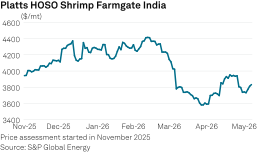
There is some downward pressure in farmgate prices, but broader consumer-level impacts are not yet fully visible. The transmission of logistics and energy cost increases typically takes time to fully flow through global seafood markets.
How are tariffs affecting shrimp trade flows to the US, and what trends are you seeing in European shrimp consumption?
Tariffs are actively reshaping trade allocation.
For some origins -- particularly India -- US competitiveness has weakened, prompting exporters to explore alternative destinations. At the same time, Europe and the UK are emerging as relative growth opportunities, supported by trade agreements and shifting cost structures.
This is accelerating a broader reconfiguration of global shrimp supply chains.
European consumption has been volatile in recent years.
Demand increased during COVID due to at-home consumption patterns, then softened post-pandemic amid oversupply. More recently, recovery has been interrupted by geopolitical and trade-related uncertainty, which is again weighing on near-term sentiment.
What is your outlook for the shrimp and seafood industry in the next 12-18 months, and how do you view its longer-term prospects?
The short-term outlook depends heavily on two variables: the duration of geopolitical conflict in the Middle East and the persistence of US tariff regimes.
If both factors remain in place, they are likely to continue exerting downward pressure on seafood demand and increasing cost volatility. If either ease, markets could stabilize more quickly. Regardless, the next several months are expected to remain turbulent.
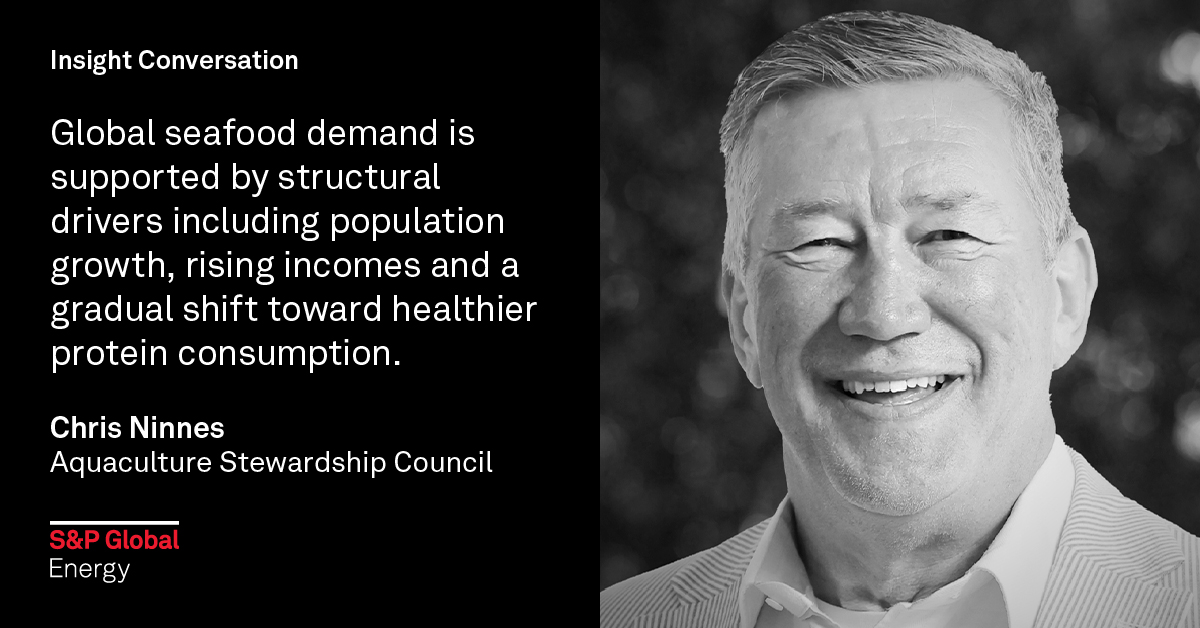
Despite near-term volatility, the long-term trajectory remains positive. Global seafood demand is supported by structural drivers including population growth, rising incomes and a gradual shift toward healthier protein consumption. Aquaculture will continue to play a central role in meeting this demand. At the same time, sustainability expectations are becoming more central to market access, reinforcing the importance of certification and responsible production systems.
This interview has been edited for length and clarity.
