LNG, Natural Gas
October 14, 2025
Naftogaz proposes EU strategic gas reserves employing Ukrainian storage

By Matt Hoisch
HIGHLIGHTS
Argues measure could contribute to $750 billion US energy trade commitment
Calls for end of EU storage targets after 2027
Seeks study on effects of zero-tariff gas transit regime
Ukraine's Naftogaz has called for the EU to establish EU-wide strategic natural gas reserves and allow Ukraine's vast storage system to contribute, as well as for the EU to abandon its storage filling targets after 2027.
Ukraine's state-owned oil and gas company made the comments Oct. 13 in a letter to the European Commission provided as feedback for the EU's ongoing revision of its energy security framework and seen by Platts.
"Given the crucial role of the energy system for the economy, daily life, and national defense, it must achieve a level of redundancy and resilience against high-impact climate, cyber, or physical disruptions that purely market-based instruments cannot deliver," Naftogaz said in the letter. "Strategic storage and stockpiling initiatives in the EU should therefore be strengthened."
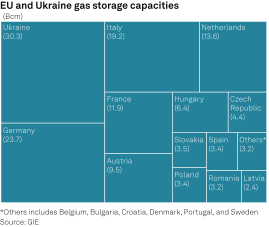
Ukraine's gas storage capacity -- the largest in Europe -- exceeds its domestic needs, Naftogaz said.
"Ukrainian underground gas storages have redundant storage capacities and available technical withdrawal capacities to serve the neighbouring region, on top of capacities needed to cover Ukraine's demand," it said. "Those capacities should be counted in for storing a share of EU-wide strategic gas reserves if established."
In addition to aiding EU energy security, Naftogaz also framed the proposal as a way to contribute to the EU's recent commitment to purchase $750 billion of energy resources from the US over the next three years, including LNG.
"The Commission could draw on the recent EU-US trade framework (including its energy provisions)," it said of the proposal.
The EC has underscored that the EU will not itself buy the energy resources agreed under the trade deal.
"The [US energy] purchases themselves are not done by the EU or the Commission itself," it said in August. "The Commission acts as a facilitator to help ensure Member States have sufficient energy resources."
An EC spokesperson declined to comment on the Naftogaz letter.
EU storage targets
Naftogaz distinguished between "strategic" and "commercial" gas stocks in its letter. Whereas the former, it said, should be procured and managed by the EU, the development of the latter should be "fully market-based," it argued.
In particular, the company called out the EU's storage filling targets for removing the incentive to use Ukrainian storage, since such gas commercially stored outside the EU does not count toward member states' filling targets, it said.
"The continued application of the EU-level storage filling target, combined with its territorial limitation to the EU, therefore undermines the operational and investment attractiveness of Europe's largest storage facilities located in Ukraine," it said.
Naftogaz advocated for abolishing the EU's storage target after 2027.
"This would restore a level playing field between EU and Ukrainian storage operators and maximise commercial operations," the company said.
The EU recently extended its gas storage regulation through the end of 2027, while also allowing for more flexibility in meeting the target.
Transmission tariffs
A third related focus for Naftogaz was the EU's gas transmission tariffs. It called in the Oct. 13 letter for a study on the economic effects of a zero-tariff gas transit regime.
The EU's pivot away from Russian pipeline gas and toward LNG imports since 2022 has shifted the routes gas needs to travel throughout the continent, Naftogaz said. It argued that this has driven up transmission costs for landlocked countries without access to LNG terminals, especially when it means crossing several borders and incurring multiple tariff charges.
"These costs will negatively affect the competitiveness of such economies and will also permanently undermine the commercial attractiveness for the usage of the Ukrainian underground storages, whose role in providing flexibility for the EU and Energy Community markets has been crucial in recent years," it said.
The EC said it aims to release a proposal for a revised energy security framework in the first quarter of 2026.
European energy markets faced unprecedented stresses after Russia's full-scale invasion of Ukraine and the EU's subsequent retreat from Russian gas imports.
The benchmark TTF month-ahead gas price hit an all-time high of Eur319.975/MWh on Aug. 26, 2022, putting European economies and energy policymakers under pressure.
Since then, prices have come down. Platts, part of S&P Global Energy, assessed the Dutch TTF month-ahead price at Eur31.445/MWh Oct. 13.

Editor: