ECONOMICS COMMENTARY — 24 Sep, 2026
Advanced economies report further growth in September, but US outperformance widens

S&P Global’s flash PMI surveys indicated a further improvement in economic growth across the G4 advanced economies to the fastest for four and a half years in September, albeit fueled to a considerable degree by a marked acceleration in the US. The US outperformed the other G4 economies in terms of both manufacturing and services activity, while also recording by far the strongest jobs growth among the group.
The eurozone also saw faster expansion, but Japan slowed and the UK remained the weakest performer.
In a month which saw further energy price rises, cost pressures stayed elevated across all four economies, highlighting persistent upside inflation risks for the coming months, and sending a hawkish signal for further interest rate rises, especially in the US, Japan and the eurozone.
US leads developed market growth to highest since March 2022
Business activity rose across all four largest advanced economies – the US, eurozone, Japan and the UK (the ‘G4’) – in September, according to flash PMI data, but the US extended its lead to the greatest for over five years.
Although the GDP-weighted output index for the G4 economies rose from 54.3 in August to 55.7 in September, its highest since March 2022, much of the improvement was due to the US, where output growth surged to the highest since July 2021.
The impressive US growth spurt means the spread between the US index and the G4 average is now its widest since June 2021.
The US led the G4 in terms of both manufacturing output and service sector activity growth, as both accelerated sharply in September. US services growth hit the highest since July 2021, outperforming the G4 average to an extent not beaten since June 2021. Meanwhile manufacturing growth in the US revived after three months of slowdown to hit the highest since April 2022, reclaiming its outperformance against the G4 average for the first time since June.
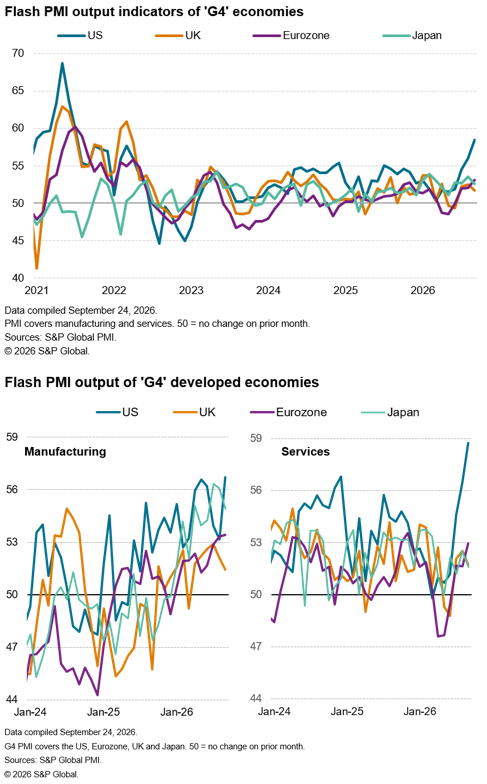
The eurozone was the only other G4 economy to report faster business output growth in the September flash PMIs, its rate of expansion hitting the highest since April 2023 to indicate encouraging resilience in the face of higher energy prices and the uncertainty caused by geopolitical events so far this year. However, whereas the eurozone PMI is indicative of the region’s GDP rising at a quarterly rate of 0.4% in September (1.6% annualized), the US PMI is indicative of over 1% growth (around 5% annualized), underscoring the US’s outperformance.
Growth meanwhile slowed in Japan, albeit with the PMI remaining at a level indicative of 0.5% quarterly GDP growth (or 2% annualized), leaving the UK as the worst performer. A drop in the UK PMI takes the survey’s main output gauge to a level consistent with GDP growth of a meagre 0.1% (0.4% annualized).
US also leads jobs upturn
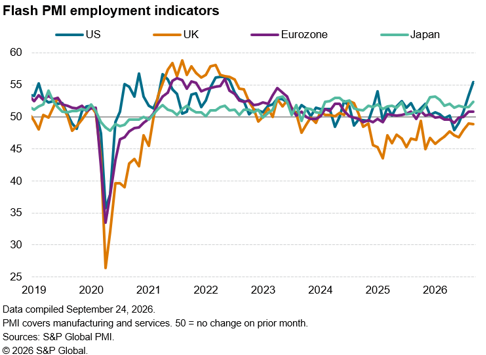
The US outperformance also extends to the labour market, with the US reporting by far the strongest rate of job creation of the G4 economies in September. Across manufacturing and services combined, US employment growth was the strongest for just over four years. However, jobs were also added in both Japan and the eurozone in September, the latter having revived from job losses signalled earlier in the year, while Japan’s rate of job creation picked up to its highest since the outbreak of the war in the Middle East in late February.
In contrast, UK jobs continued to be cut, as has been the case over the past two years, though the past two months have seen the rate of job shedding ease.
Elevated cost growth
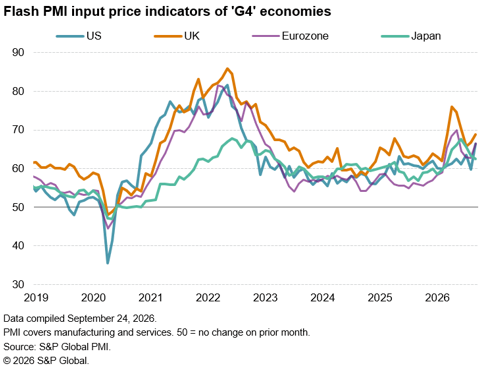
All four major advanced economies meanwhile saw sustained elevated cost pressures, the rate of increase accelerating most markedly in the US to reach its highest since October 2022. However, faster rates of increase were also seen in the eurozone and UK, the latter consequently continuing to see the steepest cost growth of the G4. Cost growth slowed in Japan for a third successive month, but remained higher than at any time since early 2023.
Outlook and policy
The data therefore suggest that the third quarter has seen a robust rebound of the major developed economies from the war-related slowdown in business activity seen in the second quarter, but none more so than the US.
Survey contributors highlight increasing AI-related spending, rising defence spending and a pick-up in consumer spending as having helped drive the expansion, the latter signalling encouraging resilience in the face of higher energy prices.
Many companies also report a steadying of the economic environment as some of the shocks to business confidence, such as US tariff announcements and the war in the Middle East, have so far proven less damaging than feared. However, there are several areas of concern which could pose downside risks to the summer growth spurt.
Survey contributors continue to report lengthening suppliers’ delivery times across the G4 economies, as well as constrained capacity from shortages. Ongoing conflicts, with associated shipping constraints, as well as agricultural shortages linked to climate and El Niño, could cause production issues and push prices higher later in the year, with oil and derivatives clearly a key potential cause of higher inflation.
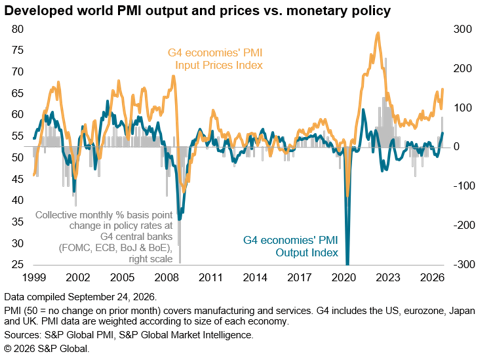
Second, tightening financial conditions could dampen growth, for example if inflation proves stickier than currently believed by many or if markets dip. Financial market risk appetite, tracked via the S&P Global Investment Manager Index™ survey, notably slumped in early September, and the FOMC, Bank of Japan and ECB have all hiked interest rates amid inflation worries. With September’s PMI data sending further hawkish signals for the FOMC, ECB and BOJ – and to a lesser degree the Bank of England – more interest rate hikes look imminent.
© 2026, S&P Global. All rights reserved. Reproduction in whole or in part without permission is prohibited.
Purchasing Managers' Index™ (PMI®) data are compiled by S&P Global for more than 40 economies worldwide. The monthly data are derived from surveys of senior executives at private sector companies, and are available only via subscription. The PMI dataset features a headline number, which indicates the overall health of an economy, and sub-indices, which provide insights into other key economic drivers such as GDP, inflation, exports, capacity utilization, employment and inventories. The PMI data are used by financial and corporate professionals to better understand where economies and markets are headed, and to uncover opportunities.
Read our latest PMI commentary here.
This article was published by S&P Global Market Intelligence and not by S&P Global Ratings, which is a separately managed division of S&P Global.
Theme
Location
Products & Offerings