ECONOMICS COMMENTARY — 23 Sep, 2026
US flash PMI signals fastest growth for over five years in September

Flash PMI data from S&P Global shows US business continues to boom, with output growing at the fastest rate for over five years in September. Payroll growth meanwhile hit the highest for over four years as companies sought to meet strong demand. Cost growth meanwhile also picked up, hitting a near four-year high, in part due to renewed upward pressure on energy prices alongside rising capacity constraints.
The overall picture from the September flash PMI is therefore one of an economy growing strongly but also seeing stubbornly high inflationary pressures, and therefore sending a hawkish signal for interest rates.
Growth surges to fastest for over five years
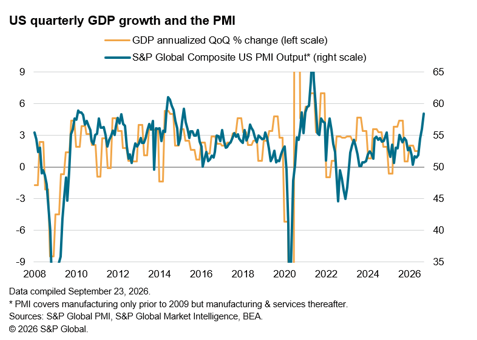
US business activity growth accelerated for a fourth successive month in September to reach the fastest for over five years. The headline flash S&P Global US PMI Composite Output Index rose from 56.0 in August to 58.4 in September, registering the strongest expansion since July 2021.
The survey data for the third quarter is now pointing to annualized growth of 4.0%, with a 5.0% pace signalled for September, to point to accelerating momentum.
To put the growth surge in context, barring the spike in demand following the opening up of the economy after the COVID-19 lockdowns, the latest improvement in business activity is the greatest recorded since early 2015.
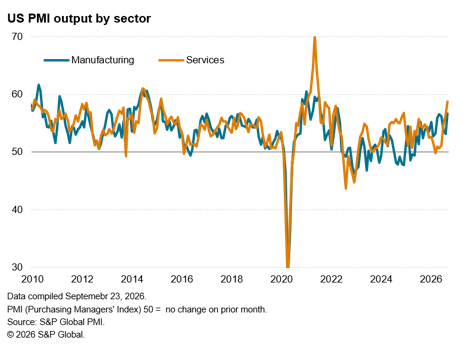
A further marked upturn in service sector business activity – one of the strongest in the survey’s history – was accompanied by a renewed improvement in manufacturing growth, which was among the strongest since the pandemic.
Jobs created at fastest rate for over four years
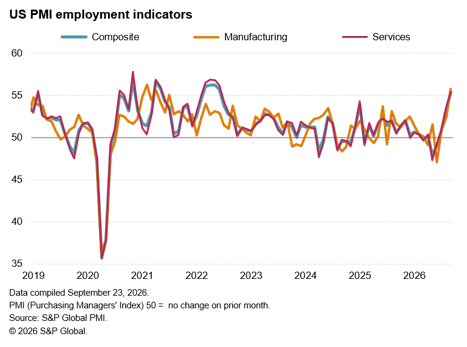
Employment also rose sharply in September, with jobs added at a pace not seen for over four years (since June 2022) and at a rate rarely exceeded since comparable data were first available in 2009, as firms across both manufacturing and services sought to meet rising demand in growing numbers.
Stretched capacity
However, despite the rise in employment, the growth spurt is being accompanied by some of the most severe supply chain bottlenecks seen in the near two-decade survey history, excluding the pandemic, with companies also reporting problems finding suitable staff. Backlogs of work are consequently rising sharply, accumulating at the sharpest rate since May 2022, and suppliers’ delivery times lengthened markedly again in September. The incidence of supply chain delays was the most widespread since July 2022.
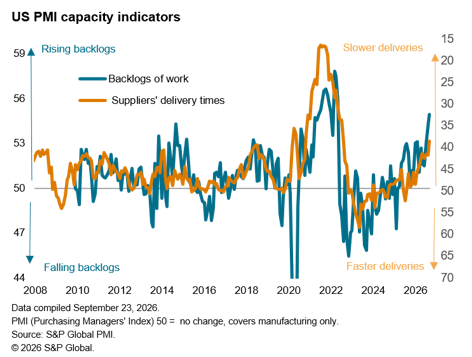
While this accumulation of uncompleted orders and stretching of capacity bodes well for further expansion of output and capacity in the coming months, it also indicates that companies are developing more pricing power, and hence is a worry for the inflation outlook.
Cost growth at near four-year high
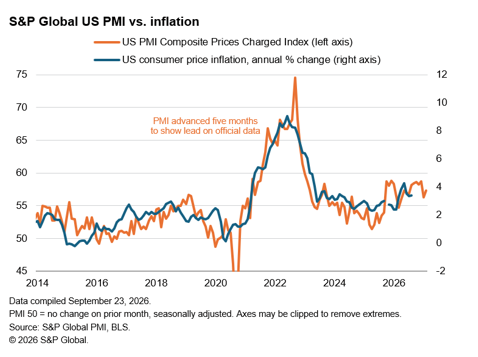
Firms’ input costs meanwhile jumped in September at the steepest rate for nearly four years, with fuel and transport costs spiking higher thanks to the rise in oil prices seen during the month, which will add further upward pressure on selling prices and inflation in the coming months.
Selling price inflation also picked up in September, though was muted by competition in some instances, notably in the service sector. While above that seen in August, September’s overall selling price rise was below the rates seen between March and July. However, the overall pace of selling price inflation remains well above levels consistent with the Fed’s 2% target, and the rise in cost pressures in September suggests inflation could remain elevated in the coming months.
Outlook
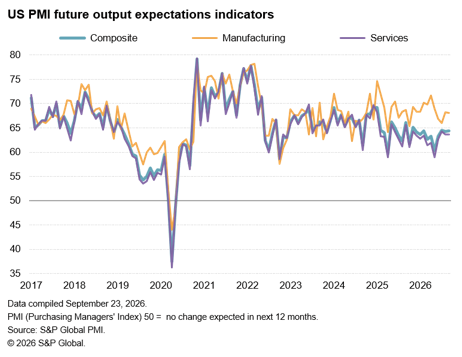
Business output expectations for the year ahead were unchanged in September, having regained their pre-war level in recent months. Business expansion plans reflected reports of confidence being buoyed by signs of ongoing demand growth and economic resilience. Manufacturers remained more upbeat than service providers, and factory confidence has nearly returned to its long-run average. In contrast, service providers’ sentiment remained well below trend level amid worries over the cost-of-living, higher borrowing costs and political uncertainty.
Rate hike territory
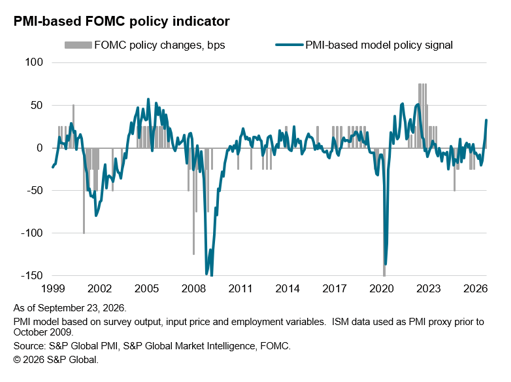
The combination of accelerating business activity growth, renewed strong job creation and a jump in business costs sends a hawkish signal for interest rates. A composite indicator based on the three PMI variables covering output, employment and costs rose sharply in September, hitting its highest since June 2022 to now sit very much in rate hike territory.
© 2026, S&P Global. All rights reserved. Reproduction in whole or in part without permission is prohibited.
Purchasing Managers' Index™ (PMI®) data are compiled by S&P Global for more than 40 economies worldwide. The monthly data are derived from surveys of senior executives at private sector companies, and are available only via subscription. The PMI dataset features a headline number, which indicates the overall health of an economy, and sub-indices, which provide insights into other key economic drivers such as GDP, inflation, exports, capacity utilization, employment and inventories. The PMI data are used by financial and corporate professionals to better understand where economies and markets are headed, and to uncover opportunities.
Read our latest PMI commentary here.
This article was published by S&P Global Market Intelligence and not by S&P Global Ratings, which is a separately managed division of S&P Global.
Theme
Location
Products & Offerings