ECONOMICS COMMENTARY — 23 Sep, 2026
UK flash PMI signals slower growth and rising inflation in September

Flash PMI data signalled a disappointing combination of sluggish economic growth and intensifying inflationary pressures in September, with subdued business confidence continuing to discourage hiring.
High energy prices, elevated business costs, geopolitical worries, higher borrowing costs and uncertainty over government policy at home in the run up to the autumn Budget, were all reported as drags on growth.
The survey’s price gauges suggest the Bank of England looks likely to keep a hawkish bias, but the hamstrung economic growth picture may knock the odds of any imminent rate hikes.
Economy slows in September
Business activity rose across the UK private sector for a third straight month in September, rounding off a quarter of modest economic growth. The headline output index from the flash PMI surveys fell from 52.5 in August to 51.7, but remained above the 50.0 no change level, thereby signaling higher output for a third month in a row. At 52.1, the average PMI reading in the third quarter is consequently up from 50.5 in the second quarter, pointing to an acceleration of quarterly growth, albeit still at a sluggish pace.
Past comparisons suggest that the September PMI reading is indicative of just 0.1% quarterly GDP growth, though a 0.2% expansion is signalled for the third quarter, up from a broadly flat reading signalled for the second quarter. The overall pace of growth therefore remains subdued, and below that seen prior to the outbreak of the war in the Middle East at the end of February, which saw a marked slowing in the pace of expansion.
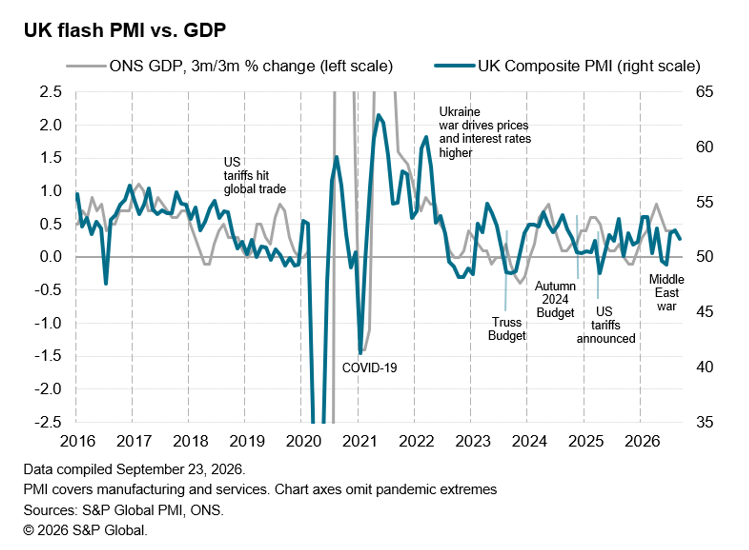
Note that the pattern of economic growth signalled by the PMI so far this year differs from that indicated by the official GDP data. However, the latter remains prone to revision and has displayed a more seasonal pattern over recent years than the PMI, the GDP data typically signalling a robust start to the year which gradually fades in the second half of each year (see chart).
Financial firms dampen service sector growth
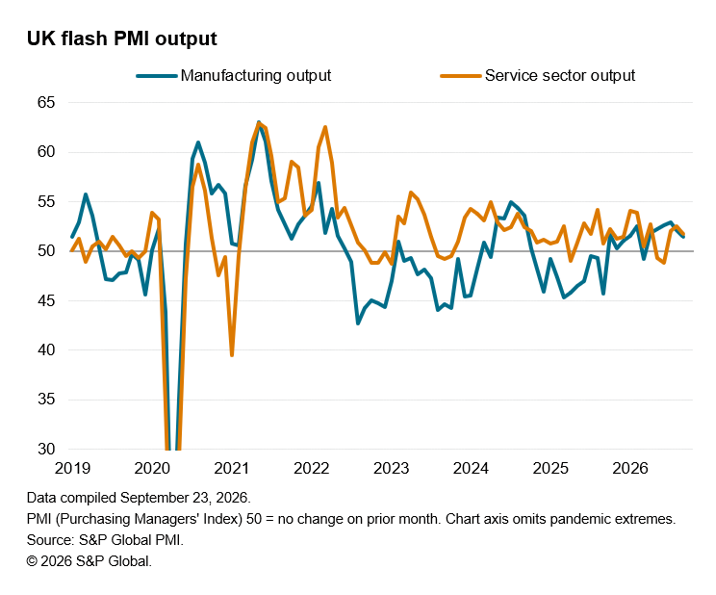
The PMI sector data showed both manufacturing and services continuing to expand, though both lost a little momentum. Computing and IT services remains by far the best performing sub-sector. However, while financial services continue to lose momentum, linked to higher market interest rates and financial market volatility, business services and consumer-facing services providers reported improved growth.
While good weather reportedly helped boost hospitality spending again in September, companies also noted how broader spending and investment had at times been postponed awaiting clarity on government policy direction in the upcoming Budget. High prices also dampened demand.
Subdued confidence keeps hiring under pressure
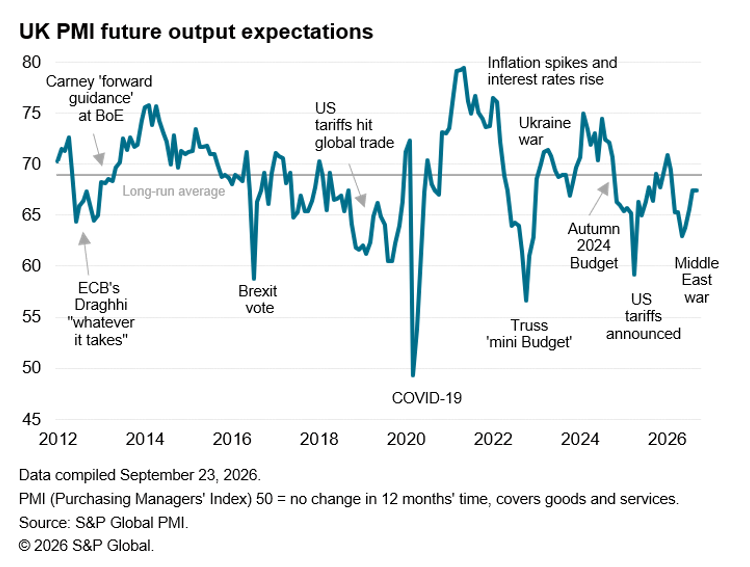
Business confidence meanwhile held steady on August’s six-month high, having risen from the lows seen in the early months of the onset of war in the Middle East, but remaining well below both levels seen at the start of the year and the long-run average. High energy prices, uncertainty over government policy, geopolitical worries, low consumer confidence, and the prospect of higher interest rates, were all commonly cited factors dampening business sentiment.
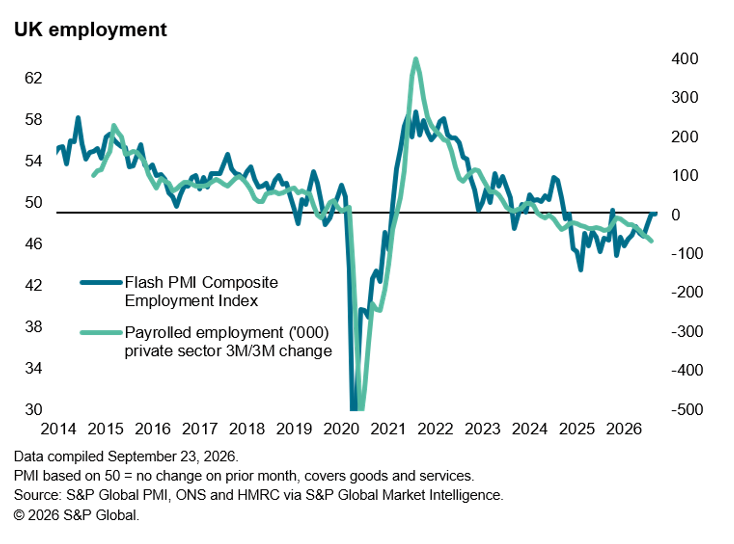
High cost pressures and uncertainty meanwhile continued to discourage hiring, though measured overall employment fell at an unchanged rate, hence showing the joint-weakest decline seen since October 2025 (the PMI employment index has signalled continually falling employment since the autumn Budget of 2024). Encouragingly, the PMI data hint at a steadying of the official payroll numbers as reported through HMRC.
Prices push higher
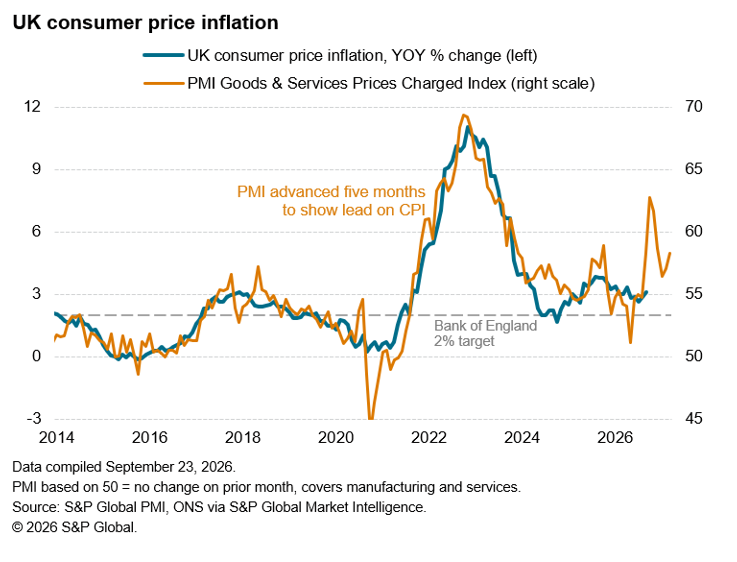
Supply chain constraints, wage pressures and higher energy prices continued to drive up average selling prices across goods and services in September. The overall rate of inflation was the highest since June (though well off recent highs), and points to consumer price inflation accelerating further in the coming months from the 3.1% rate seen in August.
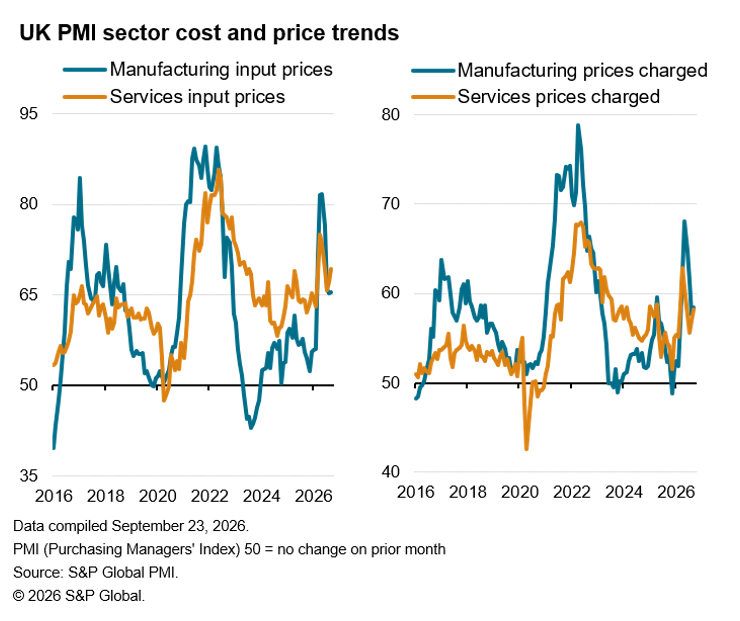
A worrying aspect of the higher inflation in September was increased service sector price pressures, which will be a concern to the Bank of England. Services inflation tends to be more highly correlated with core inflation than the more volatile commodity market driven manufacturing prices, which are often ‘looked though’ by policymakers.
Bank of England to weigh opposing signals for rates, likely to retain hiking bias
The flash PMI data for September therefore pull policymakers in two different directions. On one hand, the renewed intensification of price pressures, notably in the service sector, will add to calls for rates to rise to help anchor inflation expectations, but the insipid output growth being signalled will fuel concerns that the economy will struggle amid the additional impact of higher borrowing costs.
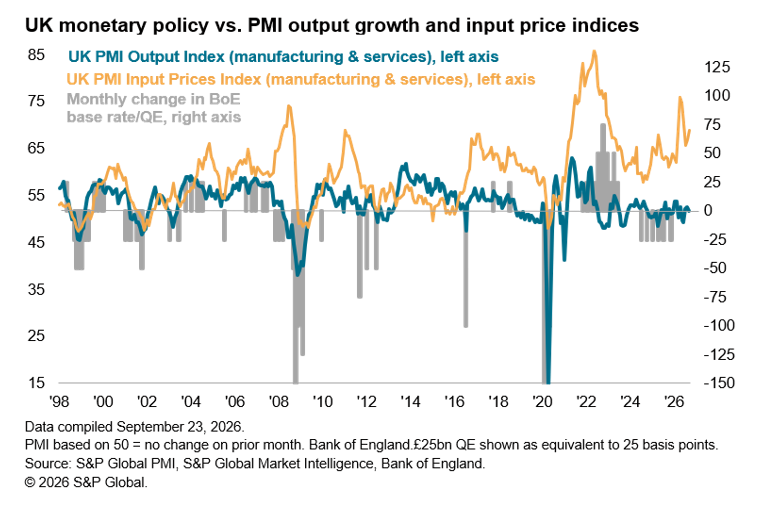
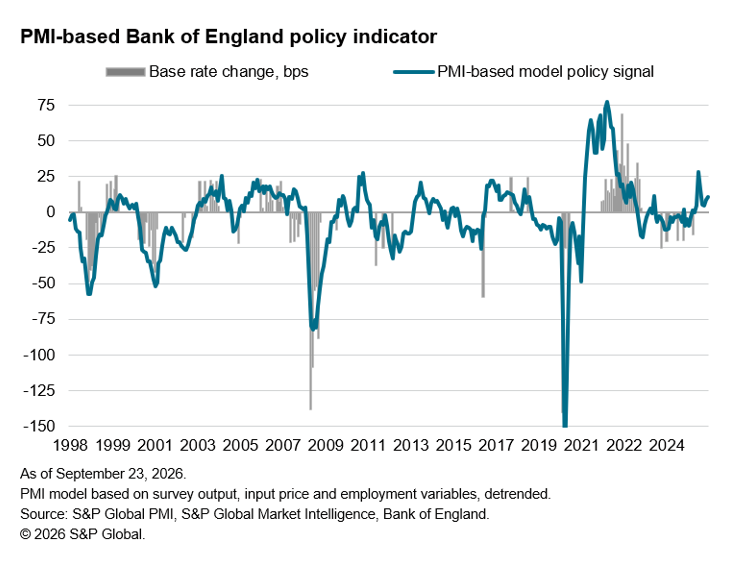
The PMI data follow the latest Bank of England policy meeting in which three of the nine rate setters voted to hike the policy rate from 3.75% to 4.0% but six voted to keep rates steady. The resulting bias toward tighter policy is consistent with the PMI’s overall message (as depicted by a composite indicator based on PMI output input cost and employment data).
Read the press release here.
© 2026, S&P Global. All rights reserved. Reproduction in whole or in part without permission is prohibited.
Purchasing Managers' Index™ (PMI®) data are compiled by S&P Global for more than 40 economies worldwide. The monthly data are derived from surveys of senior executives at private sector companies, and are available only via subscription. The PMI dataset features a headline number, which indicates the overall health of an economy, and sub-indices, which provide insights into other key economic drivers such as GDP, inflation, exports, capacity utilization, employment and inventories. The PMI data are used by financial and corporate professionals to better understand where economies and markets are headed, and to uncover opportunities.
Read our latest PMI commentary here.
This article was published by S&P Global Market Intelligence and not by S&P Global Ratings, which is a separately managed division of S&P Global.
Theme
Location
Products & Offerings