ECONOMICS COMMENTARY — 21 Aug, 2026
Flash PMIs signal summer growth spurt for advanced economies: assessing the growth drivers and outlook

S&P Global’s flash PMI surveys have signaled a summer growth spurt across the major advanced economies, with business activity in the four largest economies rising in August at the fastest pace since early 2022. The drivers of growth have switched between the second and third quarters of the year, with the upturn now led by revived demand for services as earlier manufacturing-led stock building momentum faded. While the US recorded the strongest expansion, the summer improvement was also evident across the eurozone, UK and Japan. However, the out-look remains vulnerable to various potential headwinds, including supply constraints, tighter financial conditions, renewed energy and food price pressures, geopolitical risks, and weaker confidence after a summer ‘recess’.
Major developed market growth hits highest for over four years
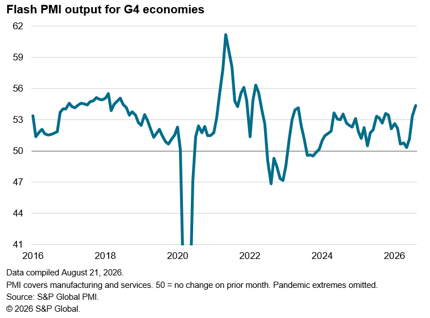
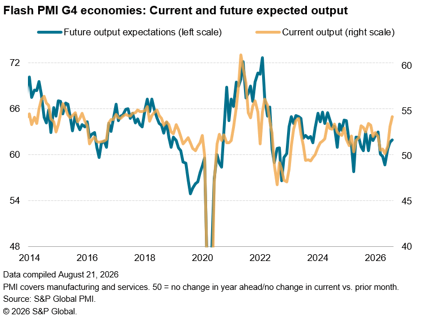
Business activity across the four largest advanced economies – the US, eurozone, Japan and the UK (the ‘G4’) – accelerated in August, according to flash PMI data, reaching the fastest since April 2022.
August’s increase follows a strong gain in July, pointing to a solid third quarter so far for the largest developed economies, which are collectively on course for their best performance since the second quarter of 2022. The data therefore suggest a strong rebound from the war-related slowdown in business activity seen in the second quarter, when surging energy prices, supply chain worries and travel disruptions emanated from the conflict in the Middle East.
While recent months have seen an easing of these drags on business growth in the major advanced economies, this has caused the principal growth drivers to change amid the developing situation in the Gulf.
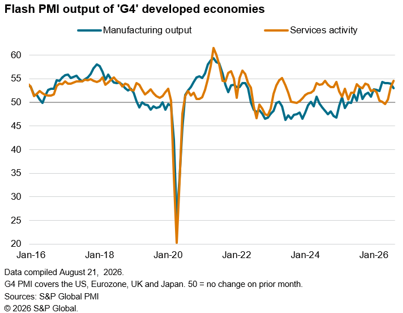
Whereas the second quarter saw growth led by the manufacturing sector, widely linked to a surge in precautionary stock building amid heightened concerns over supply constraints and price hikes resulting from the war, this stock accumulation has become less pronounced in July and August.
At the same time, while services growth slowed sharply in the second quarter as soaring energy prices dampened discretionary consumer spending, which was exacerbated by concerns over international travel and jet fuel short-ages, and led to hawkish views on demand-sapping interest rate hikes, this drag has eased in recent months amid energy price falls and some restoration of confidence regarding the economic outlook. Good weather in many economies and events such as the FIFA World Cup and US250 celebrations have also helped developed world ser-vice growth in the third quarter.
Hence, the flash PMI surveys for August showed G4 developed market manufacturing output growth weaken to its lowest since March while service sector activity rose at a pace not beaten since May 2023.
US leads broad-based upturn
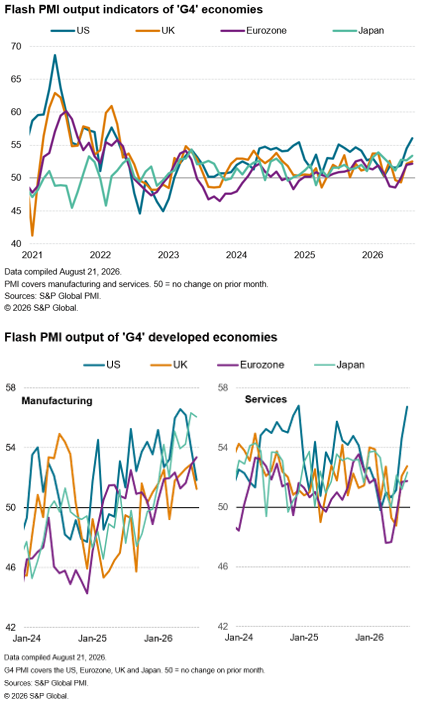
The acceleration of business growth in August was broad-based across the G4 economies, though most pronounced in the United States, where the changing pattern of manufacturing and service sector growth was also most evident. A surge in services activity drove the US expansion to its fastest since April 2022. Factory growth, in contrast, slipped sharply to the lowest for just over a year.
A similar scenario was evident in the United Kingdom, where overall growth recovered to its fastest since April as an acceleration of service sector activity more than offset a marked slowing in manufacturing.
In the Eurozone, the changing pattern of growth was less clear, but still evident. Overall, eurozone growth edged up to the highest since November of last year, aided by a second month of rising services activity (after three months of decline). The ‘periphery’ (here defined as the region excluding France and Germany) notably recorded the fastest services growth for three years. However, the eurozone also saw accelerating manufacturing output growth, driven in particular by Germany, where factory output rose at the steepest rate since January 2022. Producers again reported a boost from stock building, albeit diminished compared to prior months, but also reported higher AI/tech and machinery & equipment spending, in part reflecting rising defence spending.
An especially robust expansion was meanwhile also reported in Japan, where the rate of growth hit the fastest since the war began and the second-fastest since May 2023. Here, service sector activity was reported to have grown at the fastest rate since March, but played second fiddle to a further strong manufacturing performance. In Japan’s case, an export boost from the weak yen, which is currently trading around a 40-year low against the US dollar, has coincided with surging tech equipment spending, driving factory orders growth in August to the fastest since January 2018.
Assessing downside growth risks
Looking ahead, many companies report a steadying of the economic environment as some of the shocks to business confidence such as US tariff announcements and the war in the Middle East have proven manageable and less damaging than feared, typified by survey contributor remarks such as “we are now in a new normal which we just need to navigate”. However, there are several areas of concern which could pose downside risks to the summer growth spurt.
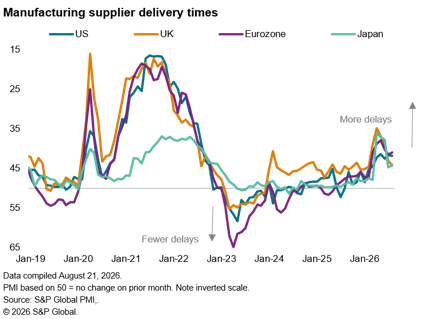
First, some of the reduction in precautionary stock building reflects a lack of supply to purchase inventory. Suppliers’ delivery times across the G4 economies continued to lengthen in August to one of the greatest extents since 2022. Further supply squeezes, perhaps linked to low water levels in the Rhine and Panama Canal, could exacerbate lower shipping volumes through the Strait of Hormuz and Red Sea, as could low agricultural yields.
Second, recent months have seen a loosening of financial conditions which have supported growth. This has included a pull-back in hawkish interest rate expectations for the major advanced economies as well as financial market gains, notably for equities. Any tightening of financial conditions will likely dampen growth, for example if inflation proves stickier than currently believed by many. Financial market risk appetite can be tracked via the S&P Global Investment Manager Index™ survey, which had shown rising risk appetite in August.
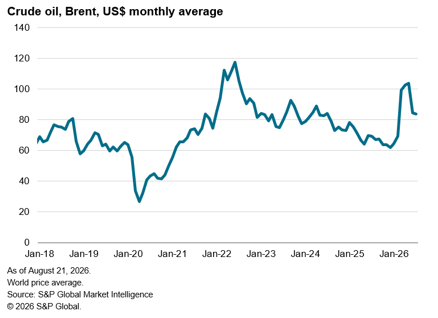
Third, oil prices could threaten the benign inflation outlooks that have become more widespread in recent weeks. While Brent crude traded at an average of $83.73 in July, its lowest since February, the price has risen above $90 again in recent days amid concern over the conflict in the Middle East, and could feed through to further price hikes for refined products such as diesel. Similarly, low agricultural yields could drive up food prices, hitting consumer price inflation measures later in the year.
A fourth factor is therefore broader confidence around the geopolitical situation globally, with any escalation of conflict in any region having the potential to drive renewed risk aversion and derail the recent improvement in business activity.
Finally, a further factor to consider is the simple possibility that the fillip to spending from unusually sunny weather in many economies, combined with one-off events, could reverse as the autumn approaches and we move into a spell less conducive to consumer spending and optimism.
In this respect, it is a concern that the August surge in business activity was not accompanied by an equal improvement in business confidence about the next 12 months, sending a warning shot about the potential unsustainability of the upturn unless the recovery itself drives a virtuous circle of improved business sentiment.
© 2026, S&P Global. All rights reserved. Reproduction in whole or in part without permission is prohibited.
Purchasing Managers' Index™ (PMI®) data are compiled by S&P Global for more than 40 economies worldwide. The monthly data are derived from surveys of senior executives at private sector companies, and are available only via subscription. The PMI dataset features a headline number, which indicates the overall health of an economy, and sub-indices, which provide insights into other key economic drivers such as GDP, inflation, exports, capacity utilization, employment and inventories. The PMI data are used by financial and corporate professionals to better understand where economies and markets are headed, and to uncover opportunities.
Read our latest PMI commentary here.
This article was published by S&P Global Market Intelligence and not by S&P Global Ratings, which is a separately managed division of S&P Global.
Theme
Location
Products & Offerings