ECONOMICS COMMENTARY — 21 Aug, 2026
Japan flash PMI signals near-record price pressures amid ongoing growth spurt

The S&P Global Flash PMI® data showed Japan’s private sector expansion gathering pace in August, with output growth reaching its second-strongest for over three years. Manufacturing remained especially buoyant, growing at the fastest rates since 2014 over the past two months, and services activity gained a little momentum. Easing supply pressures and a weak yen helped support factory production and exports, while solid domestic demand underpinned services growth. However, selling price inflation stayed close to record highs, which will keep pressure on the Bank of Japan to consider further interest rate hikes.
Faster third-quarter GDP growth signalled as expansion gains momentum in August
Japanese business activity growth accelerated for the second time in three months in August, adding to signs of a robust economic recovery from the brief spell of softness seen in the early months of the war in the Middle East. After falling to a five-month low of 51.1 in May on intensifying war, supply chain and inflation worries, the headline S&P Global Flash Japan PMI Composite Output Index has risen steadily to reach 53.4 in August. The latest reading is the highest since February and the second-highest since May 2023.
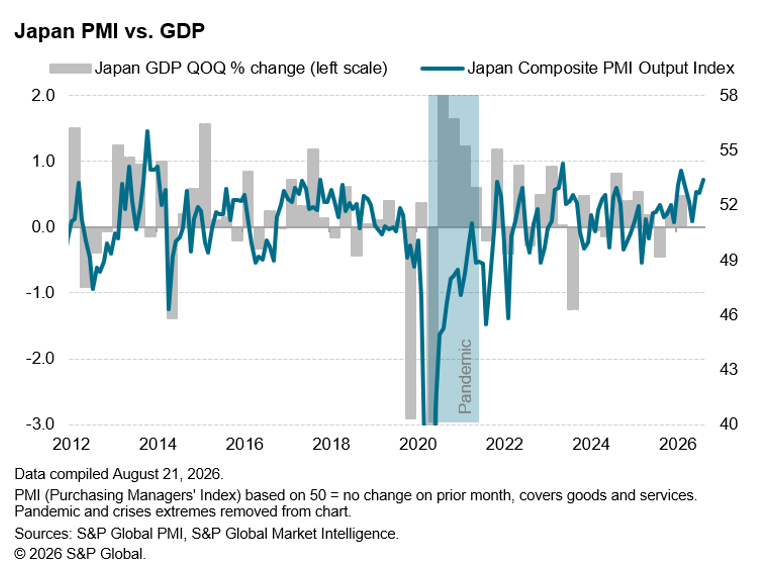
Historical comparisons suggest that the PMI is broadly consistent with GDP growth of around 0.8% so far in the third quarter, approximately double the rate signalled for the second quarter.
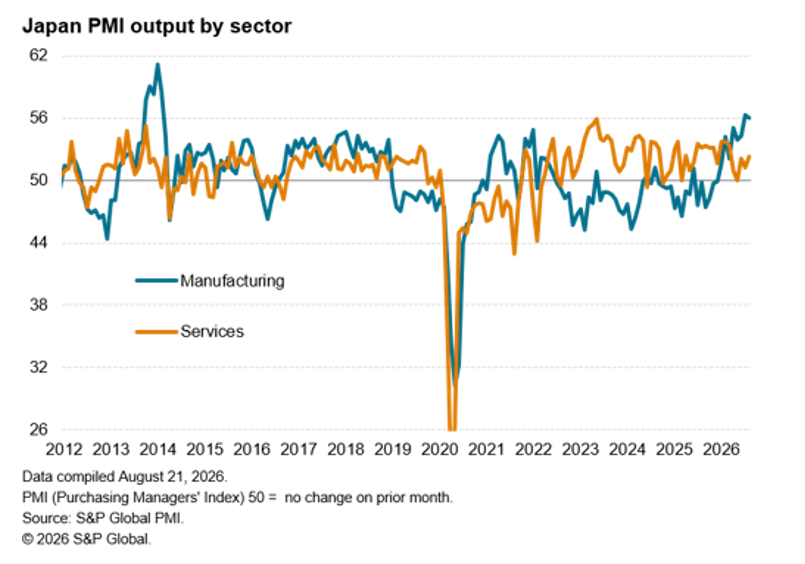
Manufacturing booms
The improved expansion was again driven by the goods-producing sector, where manufacturing output rose at only a slightly reduced rate compared to that seen in July, which had in turn been the fastest since February 2014.
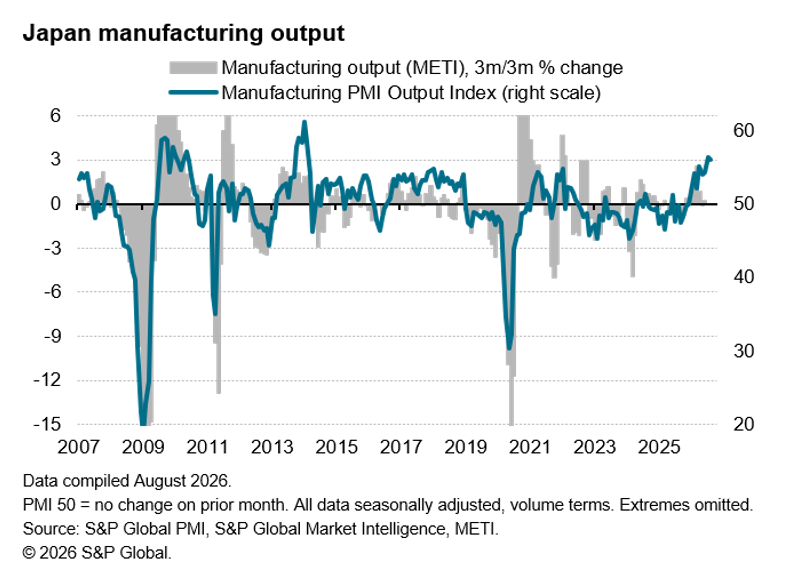
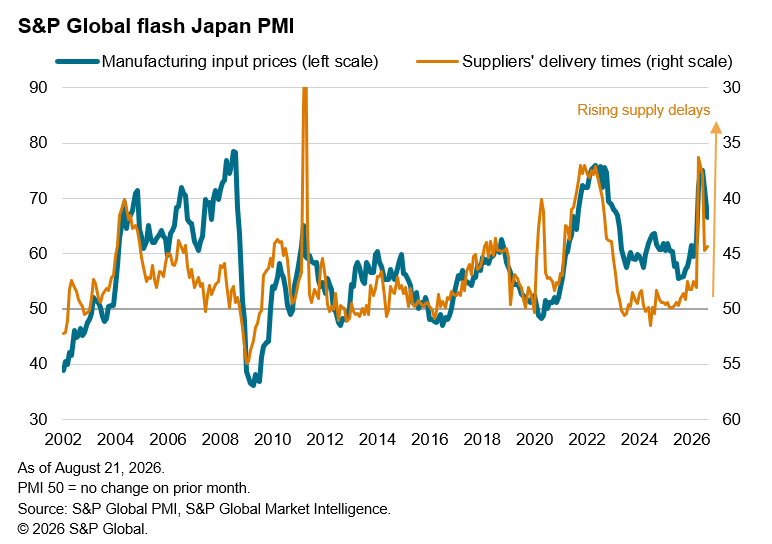
Several factors have helped boost the manufacturing sector’s performance in recent months. Although remaining a source of concern, and encouraging further precautionary stock building, supply chain worries stemming from the Middle East have cooled to alleviate bottlenecks. Supplier delivery delays have eased markedly in the past two months compared to the second quarter, albeit remaining more widespread than at any time since 2022. Factory input costs have also risen at a reduced rate compared to June’s near-record high, growing sharply again in August but at the slowest rate for five months.
The data therefore suggest that the price and supply squeeze from the war in the Middle East remains a key area of concern for Japanese manufacturers, especially amid ongoing disruptions to shipping in the Strait of Hormuz, though less so than earlier in the conflict.
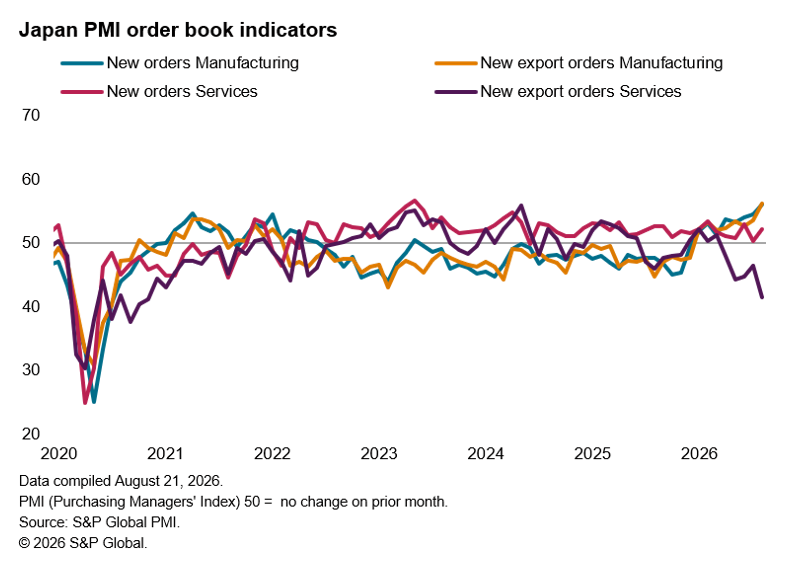
Meanwhile, the weakened yen – trading at around a four-decade low against the US dollar – has helped to boost the competitiveness of Japanese exports, which rose in August at the fastest rate since January 2018, supporting a broader order book improvement that was also the strongest since the start of 2018.
Adding to the order book gains were higher shipments of technology goods, demand for which has risen sharply in recent months due to the AI build-out. Tech equipment producers have been the fastest-growing global sector in recent months.
Service sector adds support to growth
In contrast, the weak yen failed to generate an improved export performance for services, overseas trade in which fell in August at the fastest rate since 2020. However, overall new business inflows into the services economy remained solid thanks to good domestic demand, with growth ticking higher to drive the fastest growth of business activity since March and therefore add support to the pace of economic growth alongside manufacturing.
Inflation rates hold near record highs
While the cooling of inflationary cost pressures seen in the manufacturing sector was also evident in the services economy, selling price inflation rates for both sectors remained elevated. The rise in manufacturing selling prices was unchanged from July, which had been the third-highest since October 2022. Charges levied for services prices meanwhile also rose at a rate unchanged from the near-record pace seen in July.
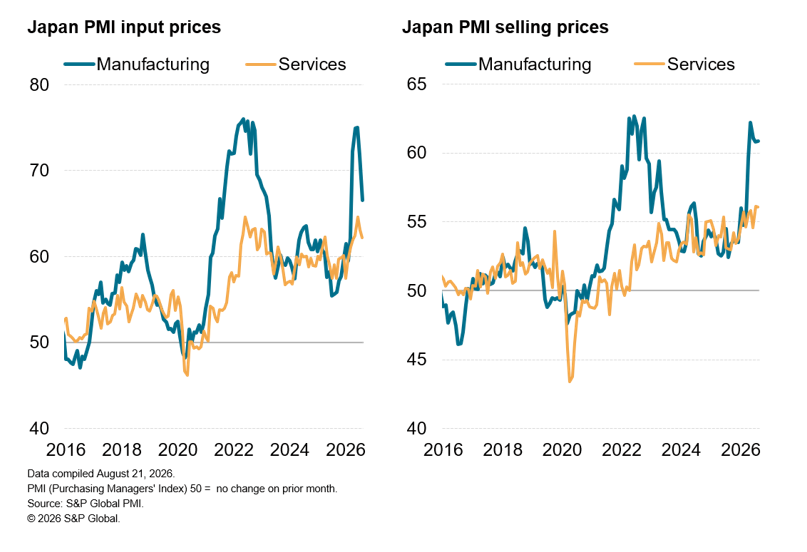
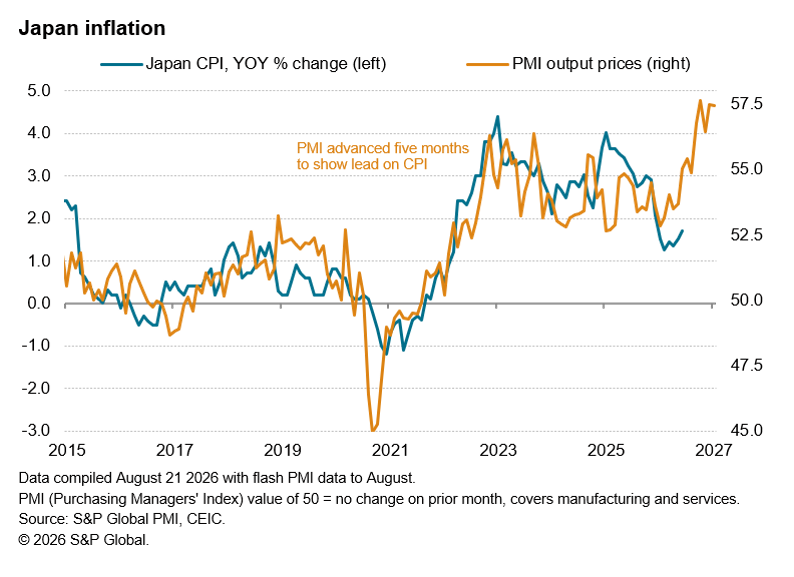
As a result, average prices charged for both goods and services collectively rose at a rate close to the survey high reached back in May, hinting at further upward pressure on consumer price inflation in Japan in the coming months.
Flash PMI supports further rate hike expectations
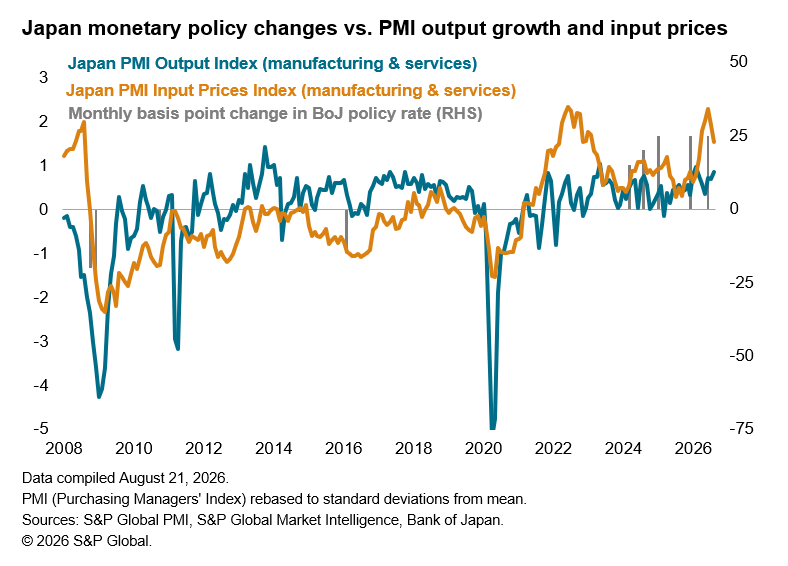
The August flash PMI follows the latest decision by the Bank of Japan to hold interest rates steady at 1%, their highest since 1995, continuing a tightening cycle that began in early 2024, although the bank hinted that high inflation may lead to further rate hikes. Consumer price inflation rose to 1.7% in July, drawing closer to the bank’s 2% target. Hence, the sustained upward price pressures seen in the PMI survey, alongside the improving growth picture, suggest another rate rise could soon be on the cards. The weakness of the yen would naturally add support to calls for higher rates.
Access the press release here.
© 2026, S&P Global. All rights reserved. Reproduction in whole or in part without permission is prohibited.
Purchasing Managers' Index™ (PMI®) data are compiled by S&P Global for more than 40 economies worldwide. The monthly data are derived from surveys of senior executives at private sector companies, and are available only via subscription. The PMI dataset features a headline number, which indicates the overall health of an economy, and sub-indices, which provide insights into other key economic drivers such as GDP, inflation, exports, capacity utilization, employment and inventories. The PMI data are used by financial and corporate professionals to better understand where economies and markets are headed, and to uncover opportunities.
Read our latest PMI commentary here.
This article was published by S&P Global Market Intelligence and not by S&P Global Ratings, which is a separately managed division of S&P Global.
Theme
Location
Products & Offerings