ECONOMICS COMMENTARY — 05 Aug, 2026
Global PMI signals faster economic growth as equipment spending surges

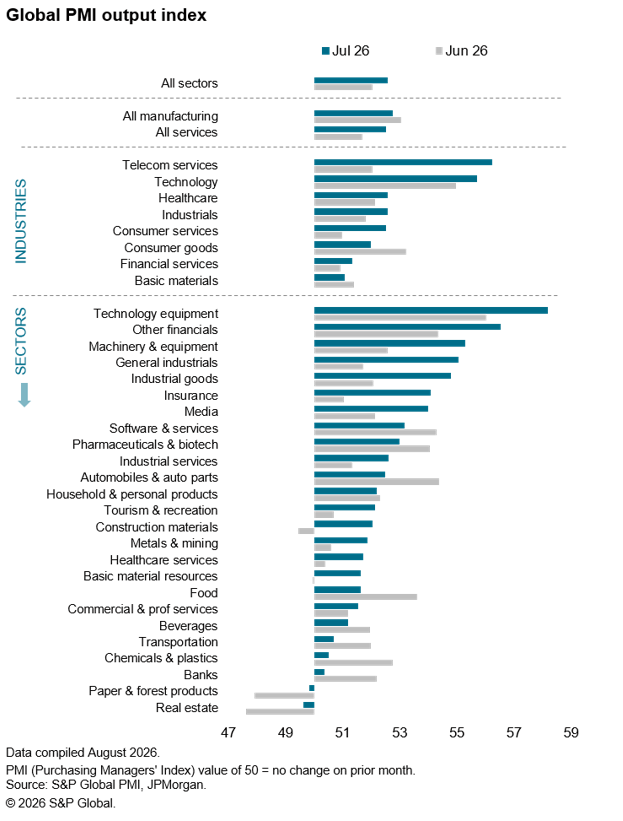
Global economic growth strengthened to a five-month high in July, according to PMI survey data, signaling GDP growth close to its long-run trend. Manufacturing continued to outperform services as technology sector output accelerated sharply amid AI-and defense-related demand, though the boost from precautionary stock building faded. Consumer services also revived as lower oil prices and reduced geopolitical uncertainty supported spending. However, some of these service sector gains reflected one-off events and favourable weather across a number of countries and regions, and subdued banking activity pointed to lingering risks for the economic outlook.
Global PMI reaches five-month high
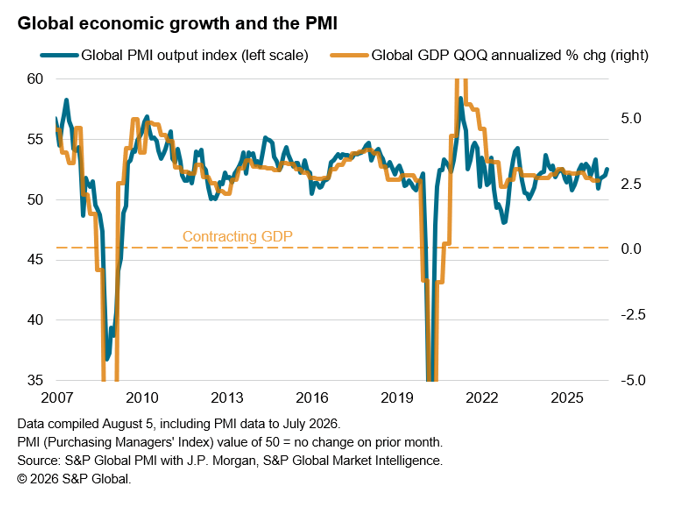
Global business activity growth gained momentum for a fourth successive month in July, pointing to a waning hit to the economy from the war in the Middle East. The J.P. Morgan Global Composite PMI Output Index, compiled by S&P Global, rose from 52.0 in June to 52.6, its highest since February and therefore its strongest reading since the outbreak of the war.
The latest PMI readings are broadly indicative of global GDP growth running at an annualised 2.6% rate at the start of the third quarter, only modestly below the long-run average of 2.9%.
July’s data were collected over a period during which a tailwind from lower oil prices and improved prospects for the situation in the Middle East, including increased shipping flows through the Strait of Hormuz, went into reverse toward the end of the month, with oil prices rising sharply again amid renewed hostilities and escalating disruptions to shipping.
Manufacturing growth slows as stock-building boost fades
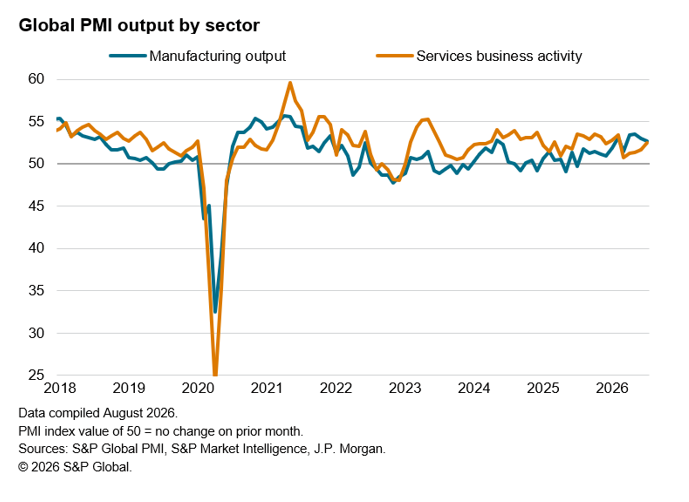
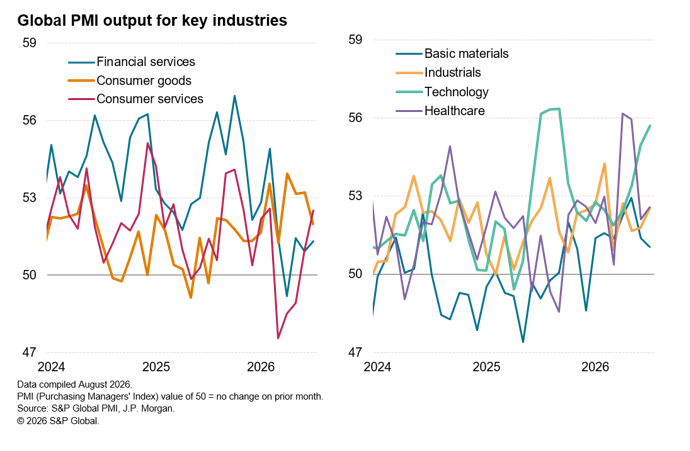
In an unusually sustained development by recent standards, manufacturing outpaced services in terms of output growth for the fifth successive month in July. However, the spread narrowed to signal only a marginal difference. While manufacturing output growth slowed globally to its weakest since March, service sector activity grew at the sharpest rate since the outbreak of the war in the Middle East in February.
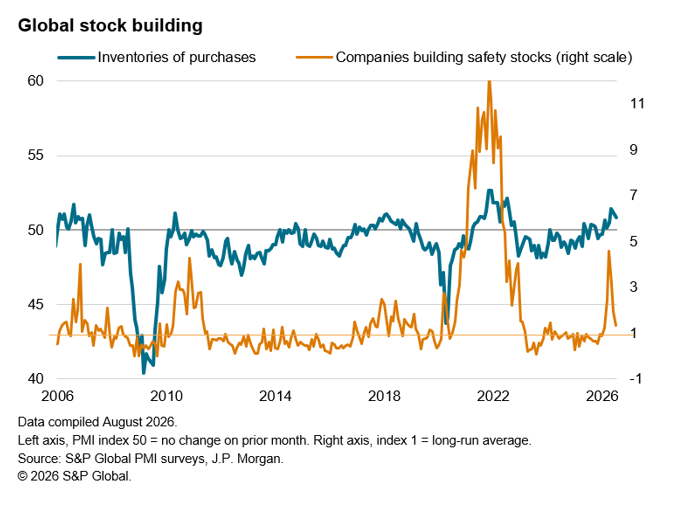
As seen over the prior four months, inventory building — often linked to the accumulation of buffer stocks amid war-related supply and price concerns — again buoyed manufacturing in July, though this effect waned markedly during the month, leading to greatly reduced output growth in sectors such as metals, mining and other basic materials.
AI and defense spending drives global growth
Although the recent precautionary stock build has moderated, a growing source of momentum is coming from the technology sector. Output of tech equipment grew in July at the fastest rate since May 2021. Alongside rising demand for software and related IT services, technology reported the fastest growth for ten months.
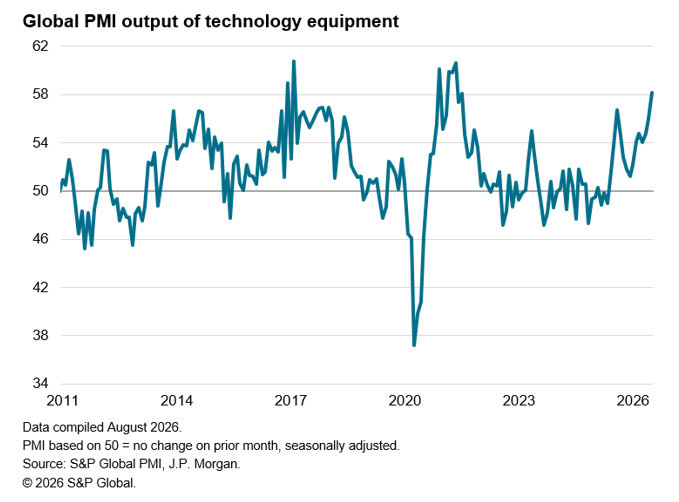
Rising demand for AI-related equipment and services has been a key driver of the sector’s expansion, benefiting growth in economies such as Taiwan, the Netherlands and the US, according to our analysis.
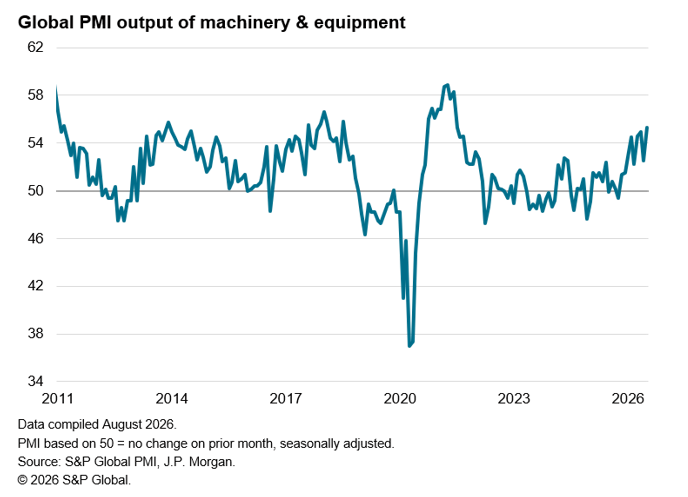
The machinery & equipment sector also fared well, coming in third place in the global sector rankings with the fastest output growth for five years. The increase in part reflects a boost in demand via greater defense spending in many economies, including the US and European nations rather than a broader increased appetite to invest in assets by companies.
Consumer services demand rebounds as uncertainty eases
The biggest improvement in growth among the major industries, however, was reported for consumer services. Reduced oil prices and lower geopolitical uncertainty helped boost demand for consumer services to a degree not seen since the start of 2025, driving activity higher and supporting a rebound in tourism & recreation. However, some caution is warranted as some of the renewed strength of spending for consumer-facing services reflected activities related to the FIFA World Cup and US250 celebrations as well as favorable weather in many countries.
Banking slowdown warns of weaker economic outlook
Uncertainty over interest rates and financial market volatility meanwhile meant financial services was the second-slowest growing industry in July (after basic materials). However, trends varied within the financial sector. Real estate notably suffered the steepest drop in activity of all sub-sectors monitored by the global PMI, though the downturn — which commenced back in March — cooled to register only a marginal contraction. ‘Other financials’, which includes investment firms, pensions and advisers, meanwhile reported the fastest growth in business activity since February.
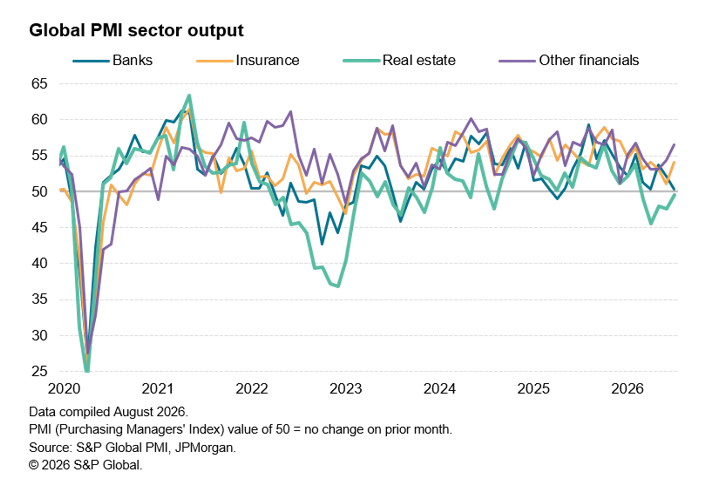
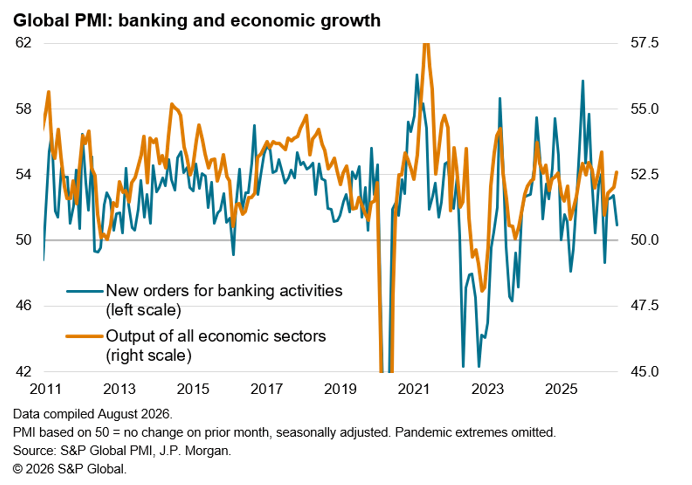
More worrying, however, was a near-stalling of banking activity, which registered one of the weakest expansions seen for over a year amid slower growth in orders for banking services — the latter often a guide to future business activity in the broader economy.
Access the latest Global Composite PMI press release here.
Access the latest Global Sector PMI press release here.
© 2026, S&P Global. All rights reserved. Reproduction in whole or in part without permission is prohibited.
Purchasing Managers' Index™ (PMI®) data are compiled by S&P Global for more than 40 economies worldwide. The monthly data are derived from surveys of senior executives at private sector companies, and are available only via subscription. The PMI dataset features a headline number, which indicates the overall health of an economy, and sub-indices, which provide insights into other key economic drivers such as GDP, inflation, exports, capacity utilization, employment and inventories. The PMI data are used by financial and corporate professionals to better understand where economies and markets are headed, and to uncover opportunities.
Read our latest PMI commentary here.
This article was published by S&P Global Market Intelligence and not by S&P Global Ratings, which is a separately managed division of S&P Global.
Theme
Location
Products & Offerings