ECONOMICS COMMENTARY — 21 Jul, 2026
Economies central to AI development drive global manufacturing growth
By Eleanor Dennison and Andrew Harker
Latest PMI data from S&P Global show that those economies and sectors which are particularly focused on AI-related development outperformed the global benchmark at the midway point of 2026, highlighting the impact that AI investment is having on the wider economy. More broadly, the PMI suite of products provide a range of indicators to help illustrate the impact of the AI boom on the global economy.
Production rises faster in economies central to AI development in June
By aggregating the PMI data for those economies which are most central to developing AI capabilities – the US, Mainland China, Japan, Taiwan, South Korea and the Netherlands – we can see that manufacturing production in these economies is growing more strongly than the global average signalled by the J.P.Morgan Global Manufacturing PMI. This has been the case in each month since the end of 2025, with the past three months seeing an unusually large outperformance of these economies.
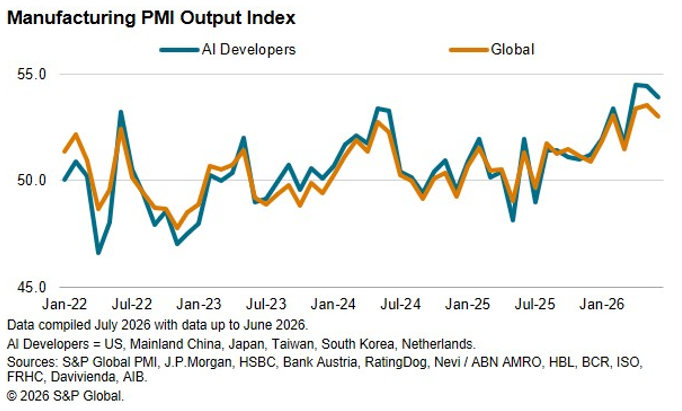
Similarly, new orders growth among the AI Developers has been faster than that seen globally in five successive months, helped by a better export performance. A more positive picture for employment and softer inflationary pressures has also been apparent in this aggregate compared to the global average over recent months.
Taiwan and the Netherlands among export growth leaders
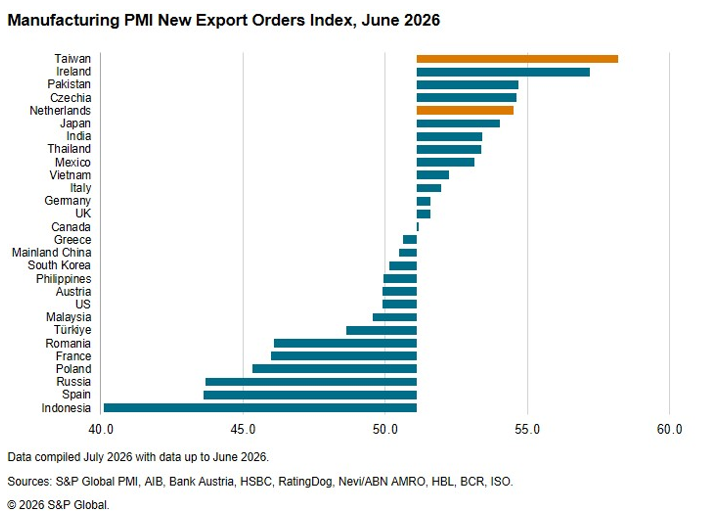
While global manufacturing new export orders dipped in June, there were some pockets of strength. Of all the manufacturing economies covered by PMI data, the sharpest rise in new export orders was reported in Taiwan, where its dominant role in semiconductor manufacturing meant that firms there were able to benefit from demand created by the AI boom.
Similarly, the Netherlands was near the top of the rankings in June. Home to advanced chipmaker ASML, the Dutch manufacturing sector has an important upstream role in supporting AI advancement, including the production of crucial inputs and machinery.
Even after the outbreak of conflict in the Middle East, demand for Dutch intermediate goods strengthened considerably. Rates of growth in output and new orders accelerated to their highest in two years, before softening in June (albeit remaining above respective trend levels).
Technology Equipment posts fastest expansion of all sectors in June
The S&P Global Sector PMI has meanwhile signalled strong performances in those sectors focused within the AI space in recent months. Responsible for providing AI-related hardware, Technology Equipment led the global expansions of both output and new orders in June. The rate of growth in production was the second-strongest in almost five years (behind August 2025), supporting the wider Technology category to the top of the broad sector rankings.
Of the 21 monitored sectors, Technology Equipment has ranked highly in terms of new orders since the start of 2026. While some respondents linked growth in order books to semiconductor and AI-related demand, others reported higher sales to the US, mainland China and European markets in particular. Strength in demand has supported sustained job creation, with the sector signalling the longest current trend of jobs growth of all 21 monitored sectors globally (13 months). May also saw the strongest recruitment drive the sector has recorded in over three years, albeit with a softer expansion seen in June.
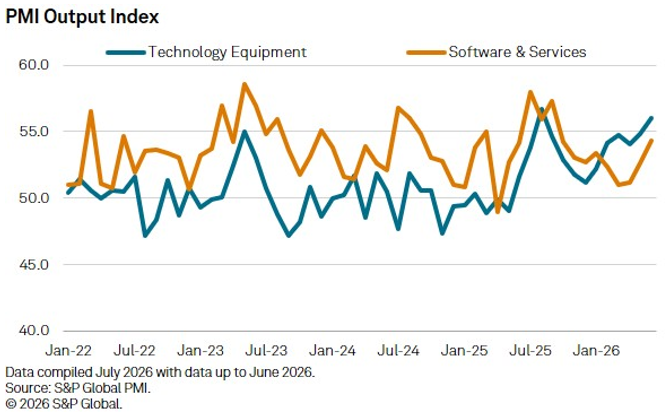
This growth momentum was also apparent in Software & Services – a sector heavily embedded in the processes behind making AI usable. Here, June saw business activity rise globally at the strongest rate since last September, ranking fourth of the 21 monitored sectors. Although growth in new business was only modest, the sector led in terms of exports. The increase in new export orders was the joint-strongest on record (since September 2014). While Software & Services firms widely pinned upbeat expectations for the coming 12 months on strong order pipelines, there were also reports that AI advancement would be supportive of growth.
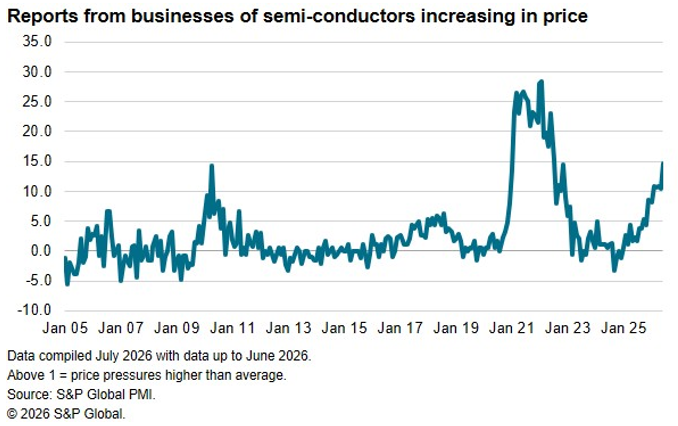
The strength of demand for items such as semiconductors, combined with some issues with supply, are contributing to widespread reports of higher prices for those inputs among manufacturers monitored by the PMI surveys around the world. In fact, June 2026 saw the most widespread reports of price increases for semiconductors since the severe supply-chain disruption in 2022. Outside of that period, price pressures are the most pronounced on record.
Capex investment set to pick up
Our latest Global Business Outlook data also highlight the potential for AI-related investment to drive growth over the coming year. Companies globally were more confident that capital expenditure would rise in the near future than was the case at the start of the year. This contrasted with more subdued expectations around business activity, profits and employment. Central to the more optimistic outlook for capex was the US, where predictions of increased spending were at their highest since early-2022.
For more on this and a range of other topics, including how to combine PMI data with longer-term macroeconomic forecasting, listen to our latest podcast.
© 2026, S&P Global. All rights reserved. Reproduction in whole or in part without permission is prohibited.
Purchasing Managers' Index™ (PMI®) data are compiled by S&P Global for more than 40 economies worldwide. The monthly data are derived from surveys of senior executives at private sector companies, and are available only via subscription. The PMI dataset features a headline number, which indicates the overall health of an economy, and sub-indices, which provide insights into other key economic drivers such as GDP, inflation, exports, capacity utilization, employment and inventories. The PMI data are used by financial and corporate professionals to better understand where economies and markets are headed, and to uncover opportunities.
Read our latest PMI commentary here.
This article was published by S&P Global Market Intelligence and not by S&P Global Ratings, which is a separately managed division of S&P Global.
Theme
Location
Products & Offerings