ECONOMICS COMMENTARY — 21 Aug, 2026
Eurozone flash PMI signals cooler inflation amid sustained expansion of output

The eurozone economy gained further momentum in August, with the flash Composite PMI rising to its highest level since last November and pointing to solid third-quarter GDP growth. Manufacturing led the upturn, especially in Germany, while services growth was supported by rising demand outside the two largest economies. Hiring returned for the first time this year and price pressures eased, though inflation remains high enough to sustain a hawkish bias among policymakers.
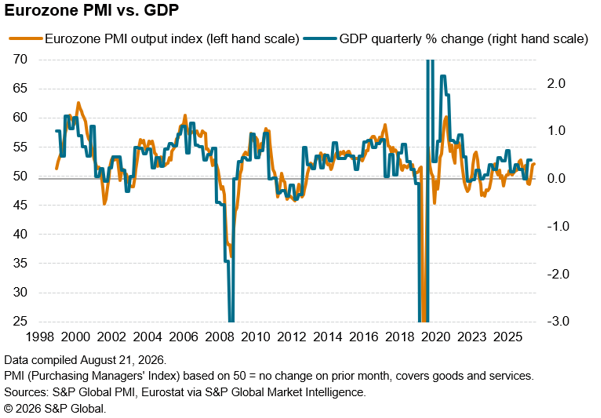
Eurozone set for solid third-quarter GDP growth
The headline S&P Global Flash Eurozone Composite PMI Output Index edged up to 52.1 in August from 52.0 in July, its highest since last November.
The sustained solid rise in business activity in August sets the eurozone up for a robust increase in third-quarter GDP of around 0.3%.
Manufacturing upturn supported by sustained services expansion
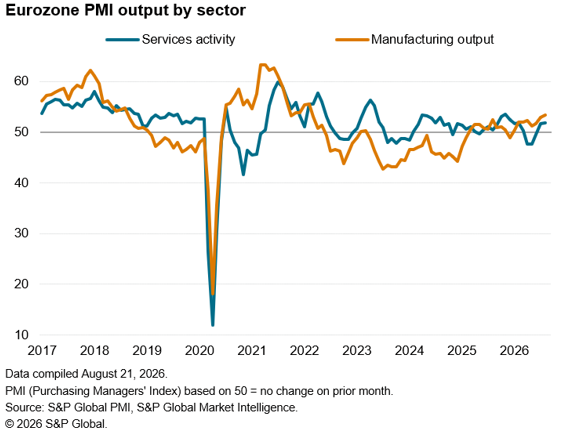
The manufacturing sector is again the star performer, enjoying its strongest growth for four-and-a-half years, with the services economy providing a supporting role, notching up another month of decent growth after the malaise seen in the second quarter.
German factory boom accompanied by rising services demand in the periphery
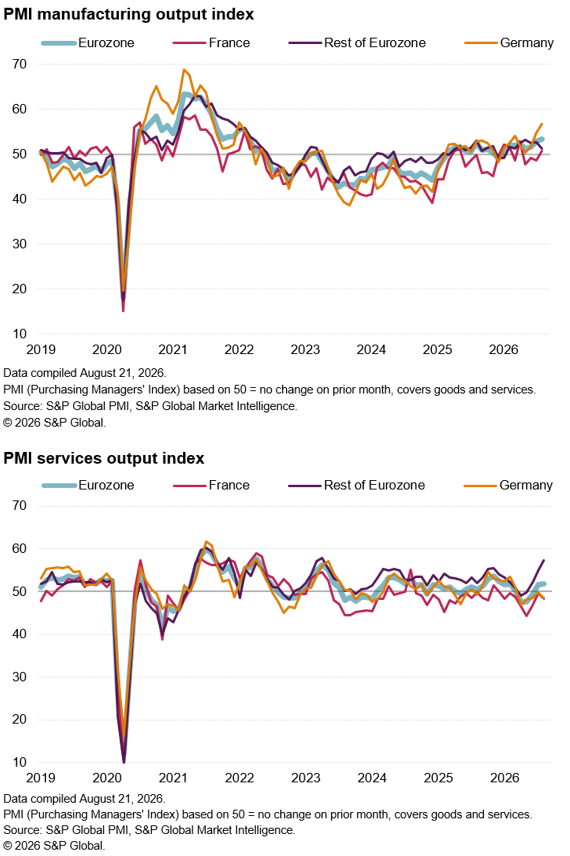
The improved manufacturing growth picture was in large part centred on Germany, where production rose at the fastest pace since January 2022. However, a fifth straight month of falling services activity meant overall business growth in Germany was only modest in August. France, meanwhile, posted a further decline. Output here has fallen continually this year. However, the rest of the euro area as a whole fared better, reporting the fastest expansion since April 2022.
We are again seeing reports of precautionary stock building helping support the goods-producing sector amid the ongoing supply chain disruptions emanating out of the Middle East, with supply chain delays again remaining worryingly widespread in August. However, there are also encouraging signs of rising demand for AI-related tech goods and rising equipment demand, thanks to higher defence spending, notably helping Germany in particular achieve increasingly impressive production gains.
In the service sector, rising tourism spending is helping boost economic growth, but notably outside of France and Germany.
Hiring improves
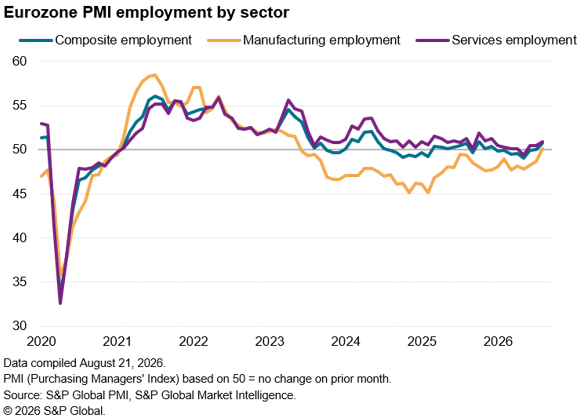
The flash PMI also showed companies in the eurozone adding to workforce numbers in August for the first time so far this year. Service providers upped their rate of job creation during the month, while manufacturing employment increased fractionally, ending a sequence of job shedding that has extended for over three years.
Eurozone inflationary pressures ease further
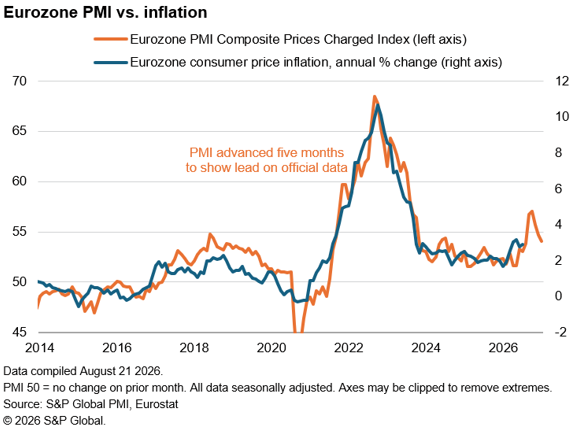
Although high prices reportedly continue to dampen demand, price pressures have shown signs of further easing. Policymakers will be especially encouraged to see services selling price inflation back down to the joint-lowest so far this year (alongside March), with goods price inflation also continuing to moderate.
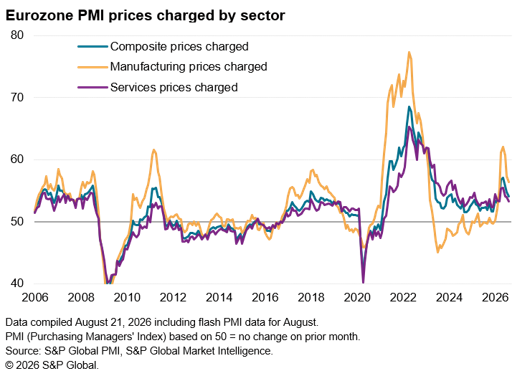
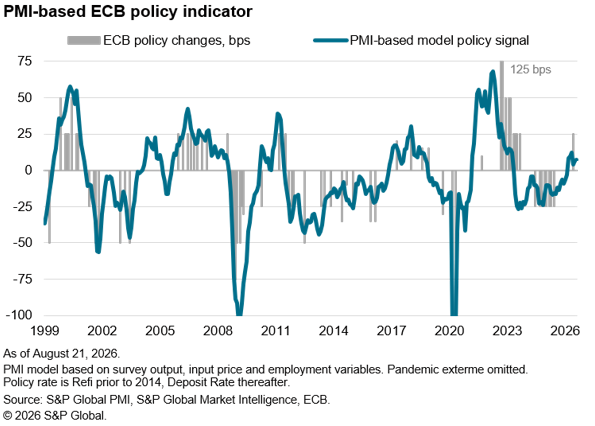
However, with the flash PMI signalling solid third-quarter GDP growth, a return to hiring by companies for the first time this year, and inflation remaining elevated by historical standards, a hawkish bias is likely to be maintained and further imminent rate hikes cannot be ruled out.
Access the press release here.
© 2026, S&P Global. All rights reserved. Reproduction in whole or in part without permission is prohibited.
Purchasing Managers' Index™ (PMI®) data are compiled by S&P Global for more than 40 economies worldwide. The monthly data are derived from surveys of senior executives at private sector companies, and are available only via subscription. The PMI dataset features a headline number, which indicates the overall health of an economy, and sub-indices, which provide insights into other key economic drivers such as GDP, inflation, exports, capacity utilization, employment and inventories. The PMI data are used by financial and corporate professionals to better understand where economies and markets are headed, and to uncover opportunities.
Read our latest PMI commentary here.
This article was published by S&P Global Market Intelligence and not by S&P Global Ratings, which is a separately managed division of S&P Global.
Theme
Location
Products & Offerings