ECONOMICS COMMENTARY — 21 Aug, 2026
UK flash PMI signals stronger economic growth and improved confidence in August

The UK economy picked up a bit more pace in August, adding to signs that we should see solid economic growth of around 0.3% in the third quarter. The expansion is being helped by sunny weather and tech investment, though as expected we have seen some softening of growth in the manufacturing sector as precautionary stock building cools. This reflects easing concerns, for now, over the economic impact of the war in the Middle East. Businesses are feeling more upbeat than at any time since the war began. Job losses are also moderating.
It’s clear, however, that the Middle East and concerns over domestic government policy continue to have a damaging effect. Most worryingly, cost pressures remain high, largely due to energy prices and supply disruption linked to the Middle East conflict alongside high staffing costs.
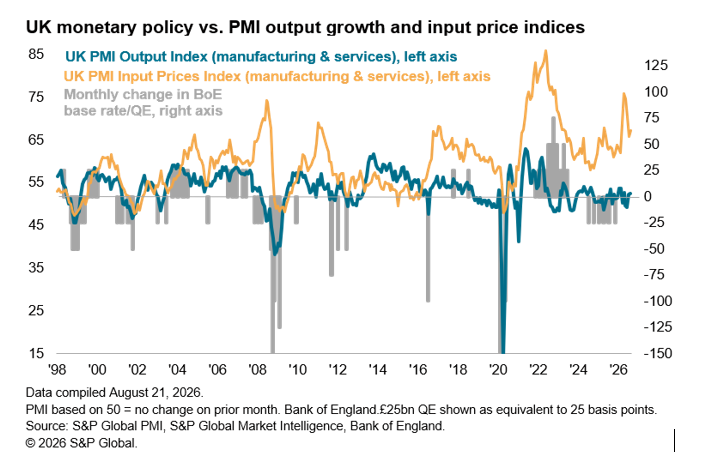
The data suggest the Bank of England looks likely to keep a hawkish bias but will stay cautious, holding off any rate hikes until the growth and inflation trajectories become clearer.
Output rises for second month
Business activity rose across the UK private sector for a second successive month in August, with growth momentum building further following the brief downturn seen in May and June. The headline Composite PMI Output Index rose from 52.2 in July to 52.5 in August, according to the preliminary ‘flash’ reading, its highest since April. At this level, the PMI is broadly indicative of 0.3% quarterly GDP growth.
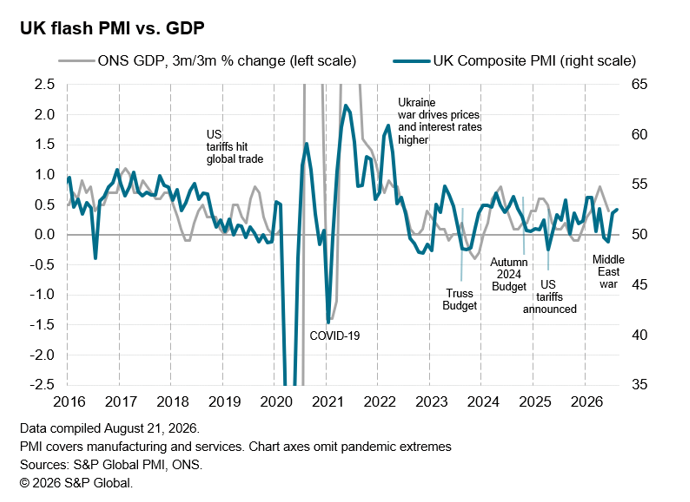
The survey data have tracked a volatile path for business activity so far over 2026. After the outbreak of war in the Middle East caused a setback to a good start to the year, business growth has accelerated so far in the third quarter. This differs from the more seasonal pattern of economic growth that has been evident in the GDP data for recent years, which have tended to show a repeating pattern of strong growth early in the year which subsequently fades (see chart).
Service sector growth strengthens
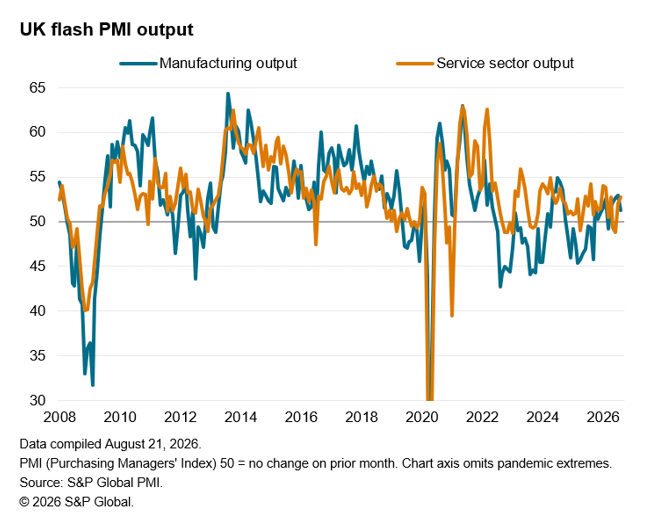
Higher output in August was driven by the services economy, where output rose at the sharpest rate since February to signal a second successive month of relatively robust growth. In contrast, manufacturing output growth slackened to a five-month low.
Similar trends were seen in terms of orders, with new business inflows into the service sector gaining momentum to show the largest rise since February, contrasting with a slowing of new orders into factories.
However, both sectors saw weakened export trends: although goods exports rose, the increase was only marginal and the smallest so far this year, while overseas trade in services fell at the second-steepest rate since March.
Tech investment and sunny weather boost business growth
Drilling down deeper, the expansion of service activity was focused on the tech sector with additional support from consumer-facing services and travel and transport, where sunny weather was seen to have boosted trade for many leisure-focused companies.
In manufacturing, growth slowed in part due to reduced reports of precautionary stock building, which had boosted demand over the second quarter in particular amid heightened war-related supply worries.
Supply shock eases but persists, pushing prices higher
Supply disruptions and high prices continued to subdue demand for both goods and services during the month.
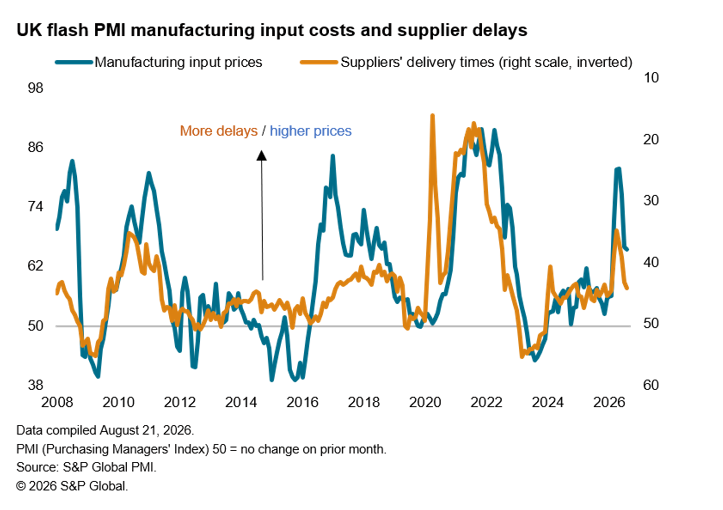
Although supply chain delays in factories have fallen sharply since peaking back in April, delays remain widespread amid the ongoing disruptions to supply emanating from the Middle East conflict.
Likewise, the rate of increase of factory input costs has eased from the peaks seen earlier in the year, but remains higher than at any time since 2022. High costs were blamed in particular on energy prices as well as a broader supply-related price lift stemming from the war in the Middle East, though with companies also citing steel tariffs and food-related supply worries.
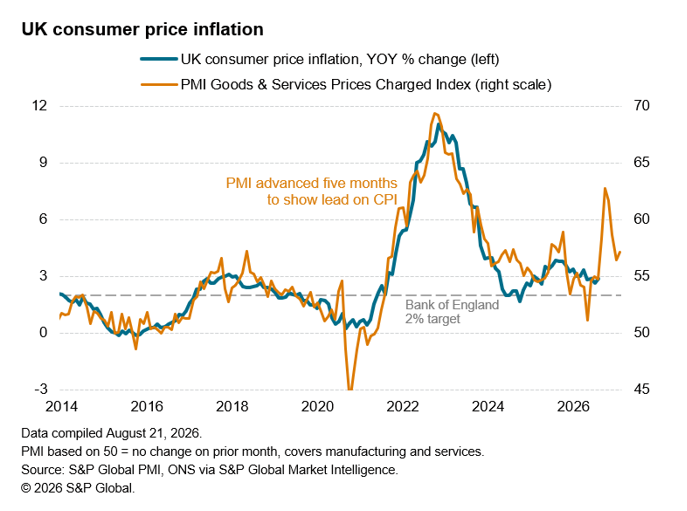
Meanwhile, high energy prices and increased goods prices ensured that service sector input cost and selling price inflation rates remained stubbornly elevated by historical standards. Both rates edged up from July, albeit well down on prior recent peaks.
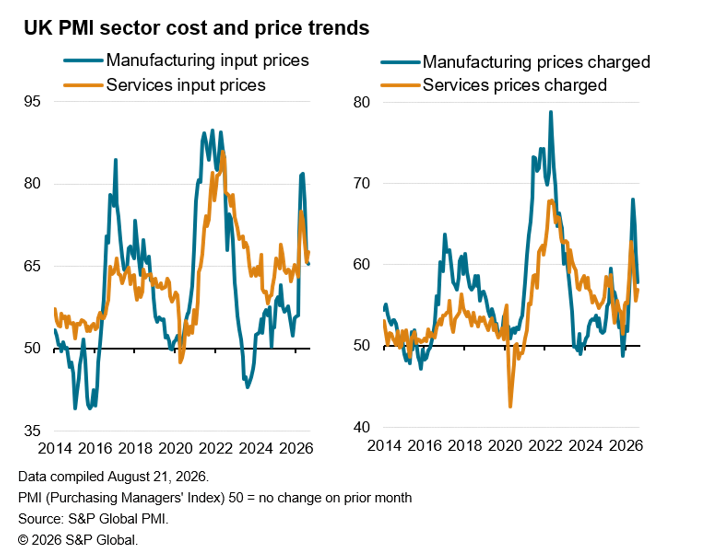
The PMI data therefore hint that consumer price inflation in the UK is likely to rise further from the 2.9% rate seen in July, according to official data, as high energy and raw material costs feed through to prices paid for goods and services by households.
Greater expectations
August has also seen businesses become more upbeat about their prospects for the year ahead. Business growth expectations remain below their long-run average due to concerns over global geopolitics as well as uncertainty over interest rates and government policy closer to home, awaiting news on policy direction from the new Burnham government. However, expectations have revived to their highest since the outbreak of the war back in February.
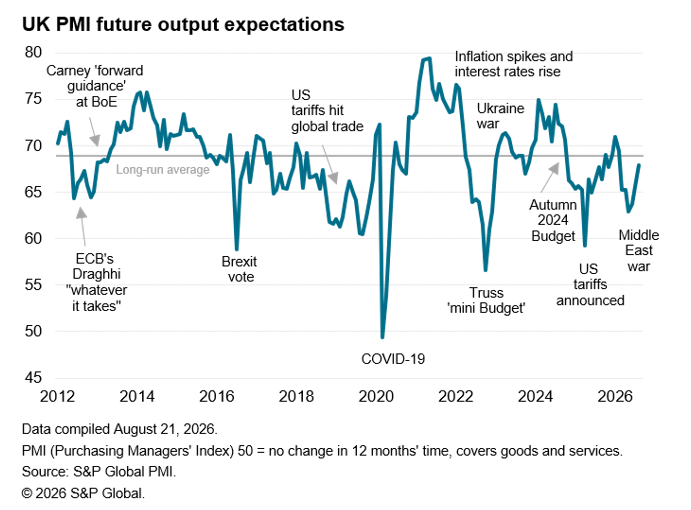
Brighter prospects are principally attributed by companies to easing concerns over the economic impact of the war in the Middle East and bullishness over economic growth both at home and in export markets. The survey also saw hopes that government policy will be more supportive to business under the new government: a small sign of a “Burnham Bounce” in business confidence.
Employment fall shows signs of steadying
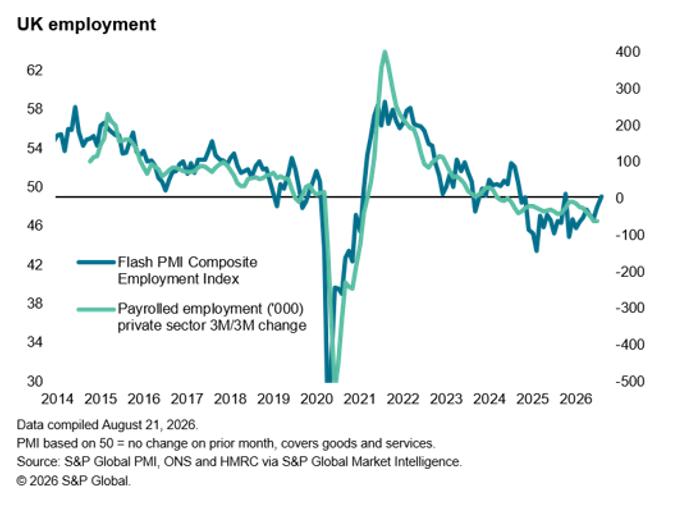
High cost pressures were again reported as stymieing demand for staff, though employment fell at a reduced rate in August thanks in part to the improvement in business confidence. August’s drop was the smallest since October of last year, and the second-smallest since employment began falling after the autumn Budget of 2024, hinting at a steadying of the official payroll numbers as reported through HMRC.
Bank of England on hold, for now
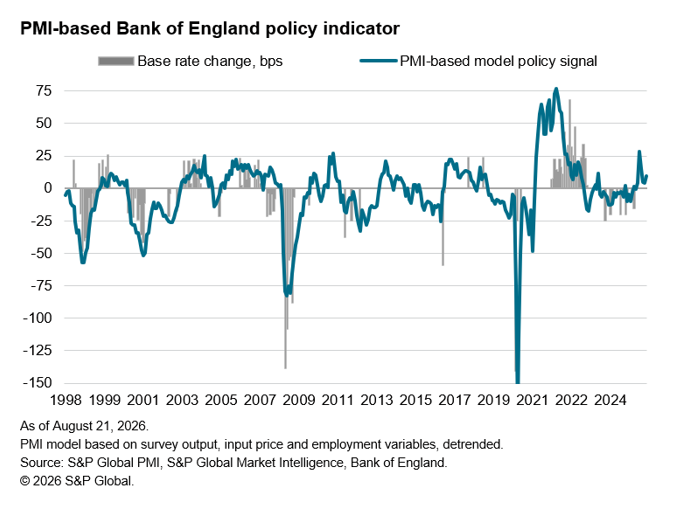
A simple policy indicator derived from PMI output, price and employment indices remains at a level suggesting a rate hike bias from central bank policymakers, though less so than earlier in the year. The data therefore support speculation that the Bank of England will likely hold rates steady in the near-term, awaiting clearer signals on the trajectories of economic growth and inflation, and in particular the driving forces of the latter should it remain elevated. A purely energy-related period of elevated inflation may be looked through. However, if supply chain issues cause broader based price rises alongside reviving economic growth, we may see policymakers become more hawkish again.
Read the press release here.
© 2026, S&P Global. All rights reserved. Reproduction in whole or in part without permission is prohibited.
Purchasing Managers' Index™ (PMI®) data are compiled by S&P Global for more than 40 economies worldwide. The monthly data are derived from surveys of senior executives at private sector companies, and are available only via subscription. The PMI dataset features a headline number, which indicates the overall health of an economy, and sub-indices, which provide insights into other key economic drivers such as GDP, inflation, exports, capacity utilization, employment and inventories. The PMI data are used by financial and corporate professionals to better understand where economies and markets are headed, and to uncover opportunities.
Read our latest PMI commentary here.
This article was published by S&P Global Market Intelligence and not by S&P Global Ratings, which is a separately managed division of S&P Global.
Theme
Location
Products & Offerings