
Guide to Healthcare REIT Industry KPIs
This guide highlights the key performance indicators for the healthcare REIT industry and where investors should look to find an investment edge.
Industry Overview
A Real Estate Investment Trust (REIT) is a company that owns, operates, and/or finances income-producing real estate properties. Healthcare REITs specifically focus on investing in and managing income-producing real estate assets within the healthcare sector. These assets typically include properties such as hospitals, medical office buildings (MOBs), senior housing, assisted living facilities, skilled nursing facilities, and other healthcare-related properties.
Some of the key types of properties that healthcare REITs own and/or operate include:
- Senior housing: Independent living, assisted living, and memory care facilities
- Medical office buildings (MOBs): Facilities used by healthcare professionals for consultations, diagnostics, and outpatient services
- Hospitals: Acute care, rehabilitation, and specialty hospitals
- Skilled nursing facilities
- Life science research facilities
This guide focuses mainly on healthcare REITs. However, we have separate industry KPI guides on other REIT industries, including hotel and retail. These guides provide in-depth insights into the key performance indicators relevant to each industry. If you’re interested in understanding the KPIs for the hotel REIT industry, please check out our guide on Hotel REIT KPIs. Similarly, please refer to our guide on Retail REIT KPIs for insights into the retail REIT industry.

Key Healthcare REIT Industry Metrics
Key performance indicators (KPIs) are an industry’s most important business metrics. When understanding market expectations for the healthcare REIT industry, whether at a company or industry level, some KPIs to consider include:
- Number of Units - Senior Living
- Total Square Feet - Medical Office Building (MOB)
- Portfolio Occupancy Rate (%) (Senior Living, Medical Office Building)
- Acquisition Volume
- Development Volume
- Disposition Volume
- Cap Rate (%) (Acquisition Rate, Development Rate, Disposition Rate)
- Same-store Net Operating Income (NOI) Growth (%)
- Average Lease Term (Years)

Healthcare REIT Industry Business Model
-
Expenses
-
Revenue
-
Profitability
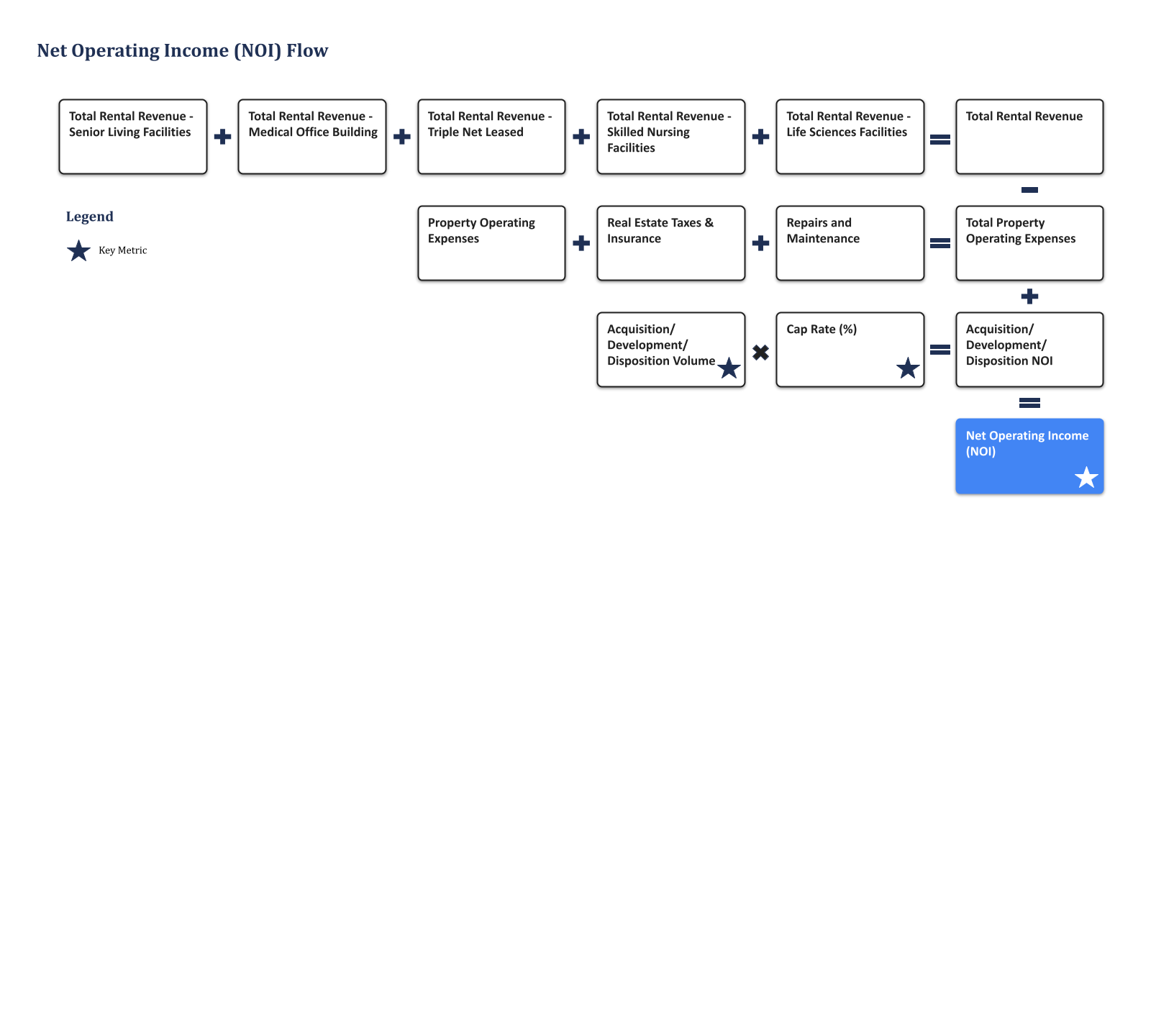
Total rental expenses: REITs incur expenses to operate the portfolio of properties they hold. These expenses are classified into four main categories:
- Property operating expenses – Property operating expenses are ongoing costs associated with operating a rental property. These are the costs that affect the daily operations of a REIT’s property and are crucial to maintaining the revenue stream of a REIT.
- Real estate taxes – Real estate taxes are taxes paid on the property owned by a REIT company.
- Property maintenance and repair expenses – These are expenses related to repairs and maintenance of the real estate property, management fees, utilities, and insurance costs.
- Capital expenditures (CapEx) – REITs are a capital-intensive industry that requires a substantial amount of CapEx for the development and redevelopment of a property. This makes CapEx a major expense for a REIT.
Similar to other REITs, healthcare REITs generate income through the collection of rent from healthcare providers or operators leasing their properties. Lease agreements with healthcare providers, such as hospitals or senior living operators, form the basis of their income stream.
Healthcare REITs derive their income primarily from five segments; senior living facilities, medical office buildings (MOBs), triple-net leased properties, skilled nursing facilities, and life sciences facilities.
Income from senior living facilities is generated through resident fees and services provided within these facilities. Resident fees are paid by the residents of senior living facilities for accommodations, amenities, and healthcare services. These fees may include rent for living spaces, meals, housekeeping, and recreational activities. Healthcare REITs may derive additional revenue by offering or facilitating various other services within senior living facilities. These services could range from basic healthcare assistance to more specialized care for residents with specific medical needs.
Income from medical office buildings (MOBs) is derived by renting space within the MOBs to healthcare practitioners, hospitals, and other healthcare facilities. Healthcare professionals and institutions lease space within MOBs for medical practices, consultations, diagnostics, and outpatient services. The rent paid by these tenants forms a significant portion of the REITs’ income. MOBs are designed to meet the specific needs of healthcare providers, often including features such as specialized infrastructure, medical equipment, and compliance with healthcare regulations.
Another source of revenue for healthcare REITs is triple-net leased properties. Triple-net leased properties, often abbreviated as “NNN” leases, are a type of lease agreement where the tenant pays for all of the property’s operating expenses, such as property taxes, insurance, and maintenance costs, in addition to the base rent. So, the difference between total rental revenue and triple-net leased properties is the portion of rental revenue from properties where the operating expenses are not borne by the tenant. The “triple net” designation refers to the three net expenses that the tenant is responsible for:
- Property Taxes: The tenant pays the property taxes associated with the leased space
- Property Insurance: The tenant is responsible for insuring the property, including liability and casualty insurance
- Property Maintenance: The tenant covers the costs of maintaining the property, which can include repairs, upkeep, and general maintenance
The healthcare REIT, in turn, receives the base rent from the tenant, as well as any additional fees or reimbursements for specific expenses incurred.
Healthcare REITs also derive income from skilled nursing facilities by renting space to facilities that provide inpatient skilled nursing care to patients in need of medical, nursing, or rehabilitative services.
Finally, healthcare REITs also generate income from the life science segment by renting space to tenants involved in life science research. Life science tenants may include biotechnology, pharmaceutical, and other research and development companies. These tenants require specialized laboratory and office spaces for conducting experiments, developing new drugs, and other scientific activities. Life science leases are often long term and may involve complex facilities to meet the specific needs of the research conducted by tenants. The rent from these life science tenants contributes to the income of healthcare REITs.
Investors in healthcare REITs evaluate the profitability of REIT companies by looking at net operating income (NOI), funds from operations (FFO), and adjusted funds from operations (AFFO).
- Net operating income (NOI) – NOI is a measure of the profitability of a REIT, after deducting all expenses associated with operating and maintaining the properties that a REIT manages.
Here, acquisition/disposition/development NOI is acquisition/disposition/development volume multiplied by the cap rate.
- Acquisition volume refers to the total value of healthcare properties that a REIT purchases within a specific period.
- Disposition volume represents the total value of healthcare properties that a REIT sells or divests during a specific period.
- Development volume refers to the value of healthcare properties that a REIT constructs or develops from the ground up.
- Cap rate represents the relationship between the NOI of a property and its market value. It’s typically expressed as a percentage and is used to estimate the property’s potential return on investment.
- Same-store net operating income (NOI) growth (%) – This refers to the percentage increase in the NOI of properties that have been owned and operated by a REIT. The “same-store” designation means that it excludes the impact of new property acquisitions or dispositions during the specified period.
- Funds from operations (FFO) – FFO is useful to investors in measuring the operating and financial performance of a REIT. It is calculated as net income applicable to common stockholders excluding non-cash adjustments.
- FFO payout ratio – FFO payout ratio helps investors understand dividend payments as a percentage of earnings. It is calculated by dividing total dividends paid by funds from operations (FFO).
- FFO Per Share – This refers to FFO divided by the total number of shares outstanding for a REIT.
- Adjusted funds from operations (AFFO) – AFFO is a financial measure used to estimate the value of a REIT. It is calculated as FFO minus capital expenditures and maintenance CapEx.
- AFFO payout ratio – AFFO payout ratio helps investors understand dividend payments as a percentage of earnings. It is calculated as total dividends paid during a given period, divided by adjusted funds from operations (AFFO) in the same period.
- Finally, investors also monitor debt/assets and debt/equity ratios to analyze investment efficiency and leverage.
Available Comp Tables - Consensus Estimates
Visible Alpha offers 11 healthcare REIT industry-related comp tables, comparing forecasts for key financial and operating metrics, to make it easy to quickly conduct relative analysis, whether you are interested in looking at key values for global companies, Americas, or Europe. Every pre-built, customizable comp table is based on region, sub-industry, or key operating metrics.
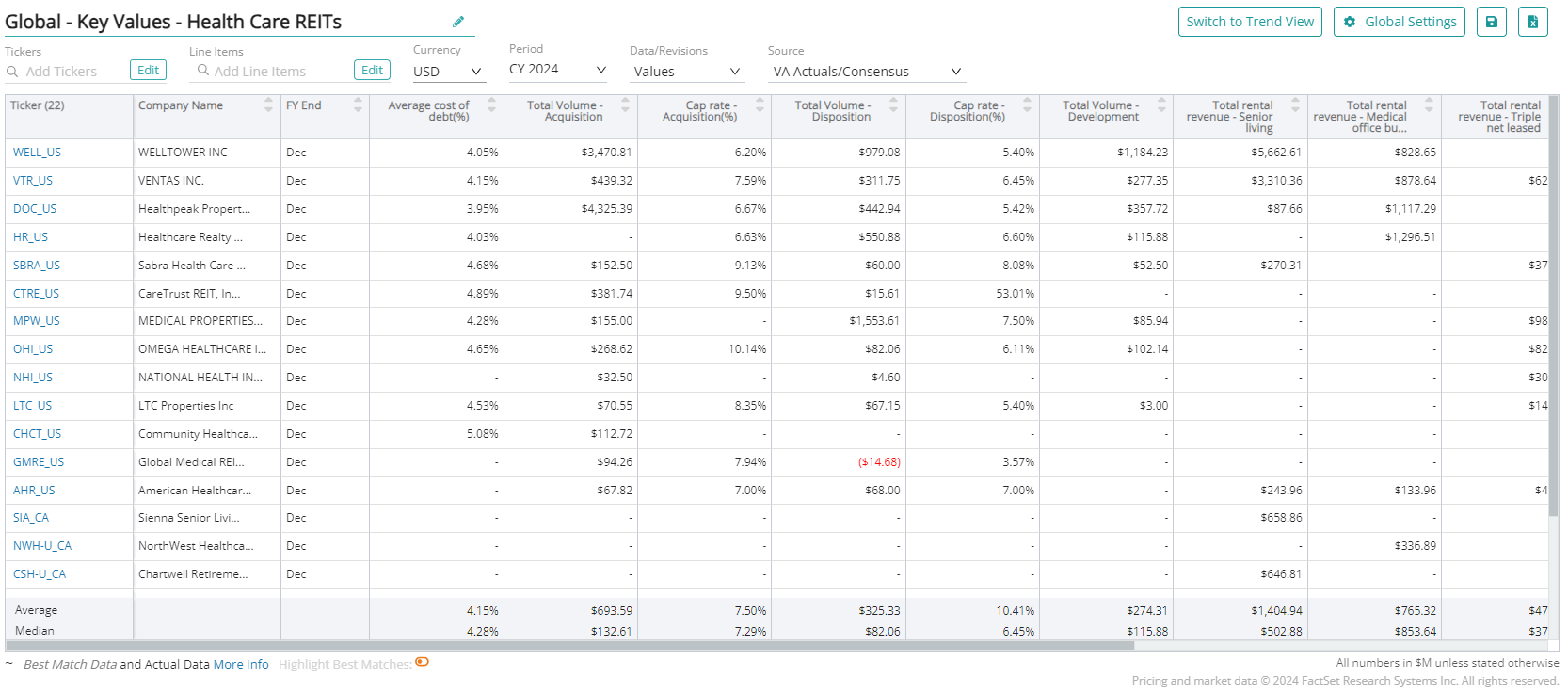
Global Financial and Operating KPIs Company Examples:
North America
- Welltower Inc (NYSE: WELL)
- Ventas Inc (NYSE: VTR)
- Healthpeak Properties Inc (NYSE: DOC)
- Healthcare Realty Trust Inc (NYSE: HR)
EMEA
- Aedifica NV (EBR: AED)
- Assura PLC (LSE: AGR)
- Primary Health Properties PLC (LSE: PHP)
- Target Healthcare REIT PLC (LSE: THRL)
APAC
- Healthco Healthcare and Wellness REIT (ASX: HCW)
- Vital Healthcare Property Trust (NZX: VHP)
Download Report
This guide highlights the key performance indicators for the healthcare REIT industry and where investors should look to find an investment edge, including:
- Healthcare REIT Industry Business Model & Diagram
- Key Healthcare REIT Industry Metrics PLUS Visible Alpha’s Standardized Industry Metrics
- Available Comp Tables
- Industry KPI Terms & Definitions