ECONOMICS COMMENTARY — 25 Nov, 2026
Developed world growth spurt cools in November amid sustained inflation

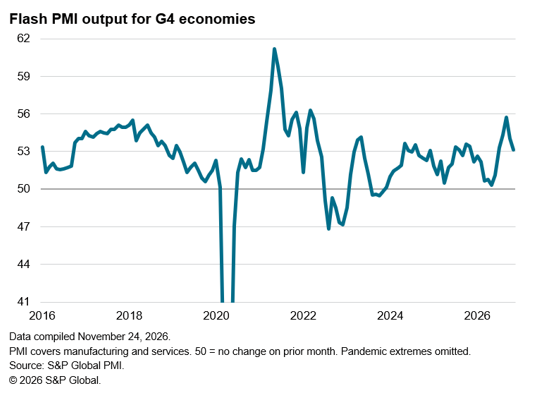
S&P Global’s flash PMI surveys showed business growth across the G4 developed economies cooling in November to the weakest since June. Activity nonetheless remains elevated by post-pandemic standards. The US again led the upturn, but solids gains were still recorded in the UK, Japan and the eurozone.
Lower oil prices meanwhile helped to ease inflation pressures, but rates remain steep, with higher costs again constraining hiring.
While high prices were a key dampener of demand, and both economic and political uncertainty likewise continued to be widely reported, higher borrowing costs were increasingly reported in November as a headwind to sales ahead of widely expected December hikes. If sustained, the demand slowdown could potentially limit the need for further increases into 2027.
Growth slows further from September peak
Growth slowed across the major developed economies for a second successive month in November, according to early survey indications.
Flash PMI data showed business activity rising across all four largest advanced economies – the US, eurozone, Japan and the UK (the ‘G4’) – but the pace of expansion cooled further from September’s recent high, to the weakest since June. Growth nonetheless remains elevated by post-pandemic standards.
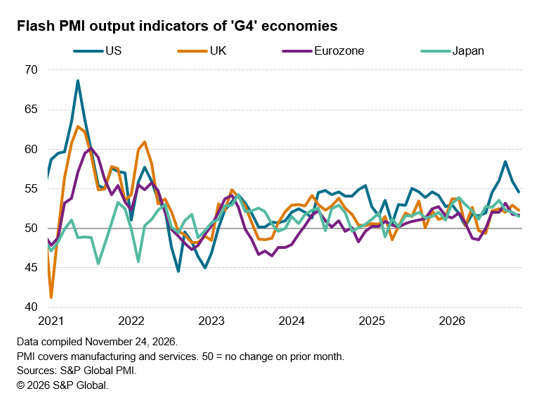
Although the recent US growth spurt lost some momentum for a second successive month in November, with the flash composite PMI at a four-month low, it remained far stronger than in the other G4 economies. The PMI data are indicative of US GDP growing by about 3% in the fourth quarter so far.
UK growth likewise remained robust – expanding at a rate consistent with fourth quarter GDP growth of 0.6% – but also slowed slightly during November.
A weaker rate of expansion was also seen in Japan, where the composite flash PMI fell to its lowest since May, pointing to fourth quarter GDP growth of just under 0.5%.
The slower US and Japanese expansions were accompanied by an unchanged flash PMI reading for the eurozone, where fourth quarter GDP growth of 0.3% is signalled.
Hence, all G4 economies showed ongoing resilience in the face of headwinds from geopolitical uncertainty and elevated cost of living pressures, with robust economic growth often linked to higher tech investment spending, but November brought further signs that the pace of growth has peaked.
Inflation pressures at three-month low, but still elevated
Demand growth – as measured by inflows of new business – slowed in all G4 economies in part due to persistent economic and political uncertainty, but also because sales were often reported as being subdued by high prices as firms sought to pass higher costs onto customers.
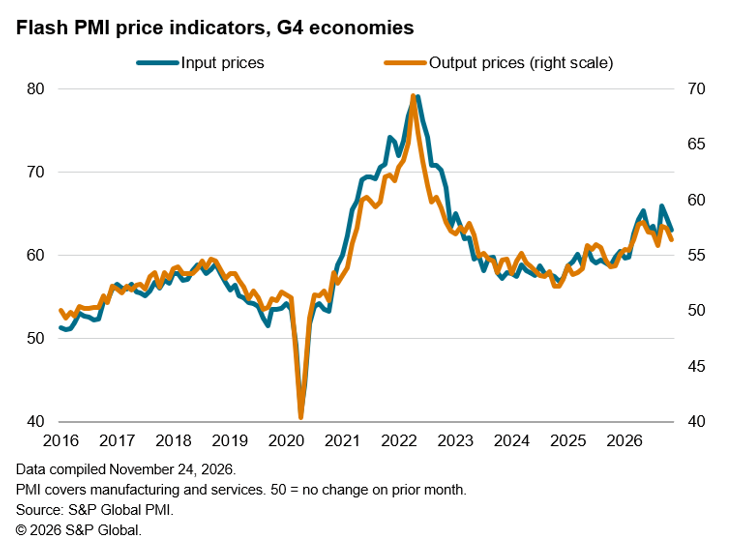
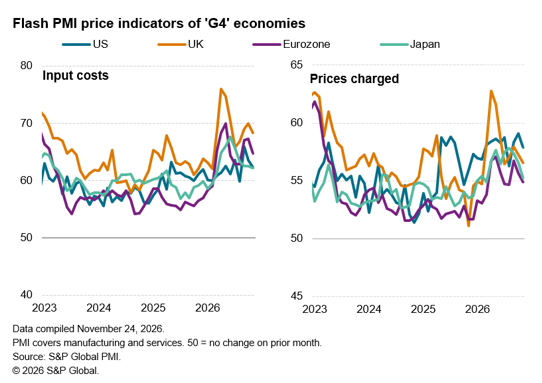
Costs continued to rise sharply across all four major advanced economies, leading in all cases to further steep rises in average selling prices across goods and services. The steepest rise in prices was again reported in the US.
However, aided by lower global oil prices, which fell during November on improved sentiment on the outlook for energy markets in the Middle East, rates of input cost and selling prices inflation cooled across the board. Measured across the G4, selling price inflation has now cooled for two successive months, with November seeing the weakest rise since August, though the rate of increase remains among the highest seen over the past three years.
Pressure on headcounts
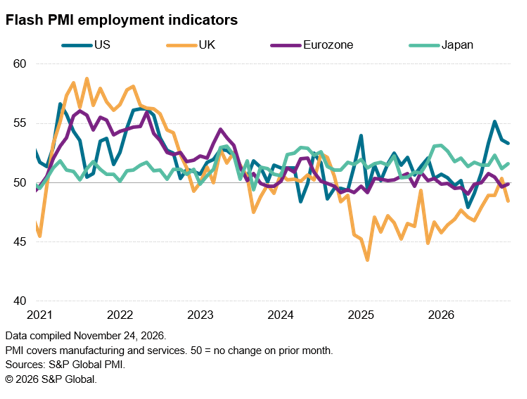
High cost growth was in turn a major factor behind pressures to keep headcounts low in November. Jobs growth consequently slowed in the US while job losses were reported in the UK and the eurozone (though the latter was only marginal). Only Japan saw faster jobs growth, but even here the rate of job creation remained low by recent standards.
Higher interest rates dampen demand
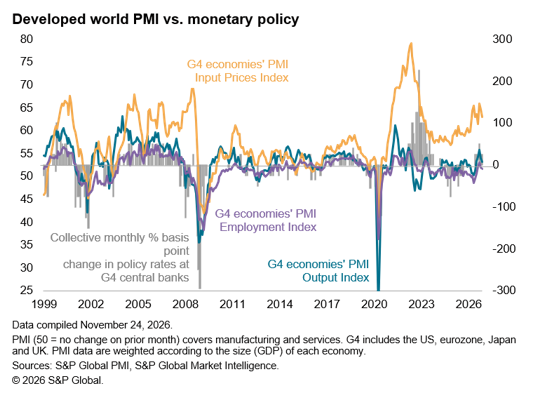
The sustained strong price growth remains a worry for the G4 central banks, which have tightened monetary policy this year. The ECB has made two 25 basis point rate hikes with the FOMC and Bank of England also having each hiked by 25 basis points, accompanying a longer-term hiking cycle from the Bank of Japan. All four are widely anticipated to hike rates by 25 basis points again in December.
However, there is less certainty over the extent to which rates will need to rise further in 2027, with all the major central banks data dependent. The PMI price gauges will therefore provide insights into how long the energy-fueled spike in inflation is likely to persist as we head into 2027.
But policymakers will also be eyeing the output, order book and employment indicators, as these provide clues as to firms’ pricing power and employee wage bargaining power, and hence the development of second round inflation effects. These indicators can react quickly to changes in interest rates, and November’s PMI data already saw increased reporting by companies of the demand dampening impact of higher borrowing costs.
Final PMI data for November will include more insights into the changing sectoral pattern of demand and the reasons cited by companies for the softening of demand evident during the month. These data will need to be scrutinized on an ongoing basis for the impact of higher interest rates in the coming months, as this could provide early clues as to the extent to which rates may need to rise further.
© 2026, S&P Global. All rights reserved. Reproduction in whole or in part without permission is prohibited.
Purchasing Managers' Index™ (PMI®) data are compiled by S&P Global for more than 40 economies worldwide. The monthly data are derived from surveys of senior executives at private sector companies, and are available only via subscription. The PMI dataset features a headline number, which indicates the overall health of an economy, and sub-indices, which provide insights into other key economic drivers such as GDP, inflation, exports, capacity utilization, employment and inventories. The PMI data are used by financial and corporate professionals to better understand where economies and markets are headed, and to uncover opportunities.
Read our latest PMI commentary here.
This article was published by S&P Global Market Intelligence and not by S&P Global Ratings, which is a separately managed division of S&P Global.
Theme
Location
Products & Offerings