ECONOMICS COMMENTARY — 23 Nov, 2026
US flash PMI indicates still elevated, but cooling, business activity growth and price pressures

US business activity continued to grow strongly in November, according to preliminary survey data, though output and order book growth moderated further from recent highs. Slower growth partly reflected constrained capacity, which lifted backlogs and prompted firms to hire more, while high prices also dampened orders.
Although both selling price and input cost inflation rates slowed in November, both remained elevated.
Concerns over affordability, supply disruptions and high inflation again weighed on business growth prospects, but confidence showed some signs of reviving thanks to hopes of reduced political instability following the midterm elections.
Growth holds close to five-year high
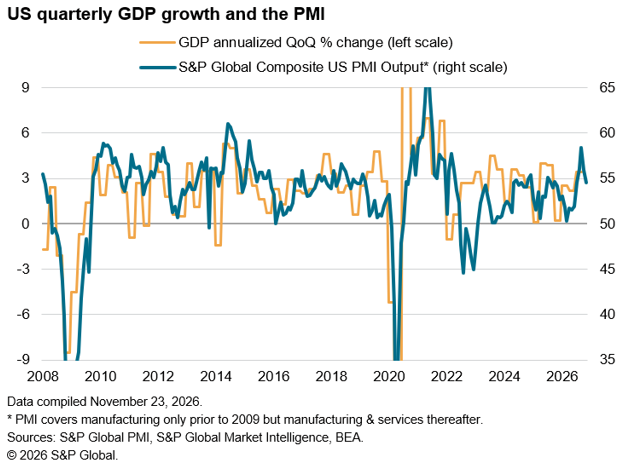
The flash S&P Global US PMI® Composite Output Index registered 54.6 in November, down from 55.9 in October, signaling strong growth but at the slowest pace since July. Services outpaced manufacturing for a fifth successive month, though growth slowed to four- and three-month lows respectively.
Recent survey readings have been impressively strong, and the PMI surveys still point to GDP rising at an annualized rate of about 3% in the fourth quarter, despite the softening of growth in November.
New orders also continued to rise, reflecting higher customer demand, new products, some tariff-related gains, and increased sales and marketing efforts, but growth here also cooled for a second consecutive month, down to its weakest since July.
Weaker demand growth was led by a marked slowing of new services business, commonly linked to customer uncertainty, high prices and some reports of higher interest rates curbing demand. Exports also dragged, falling for the first time in four months.
Employment and operating capacity
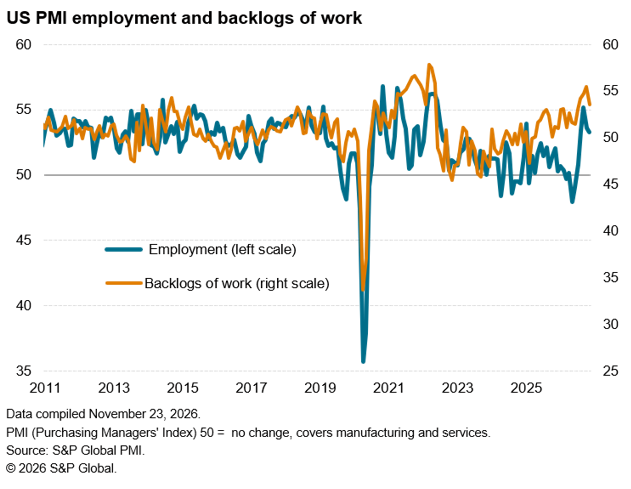
Slower output growth also reflected constrained operating capacity, which caused backlogs to rise further in both manufacturing and services. Firms took on additional staff to reduce backlogs. Although net job creation moderated for a second month, the rise in employment was the joint-third largest in over four years, with an especially strong gain in manufacturing alongside solid but slowing services jobs growth.
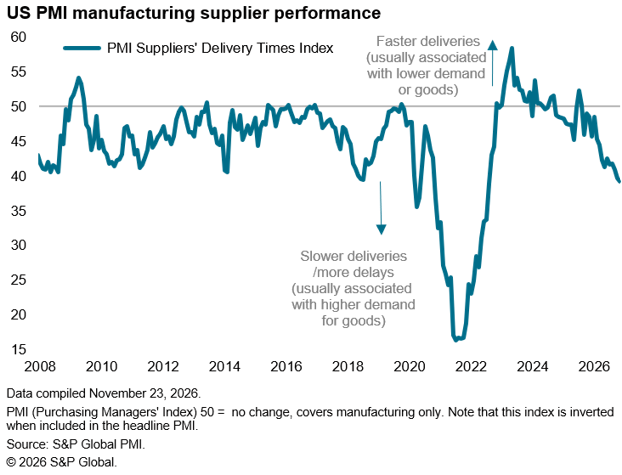
In some cases, capacity was constrained by input shortages, which in turn caused manufacturers’ suppliers’ delivery times to lengthen in November to the greatest extent since August 2022. Longer delivery times were often associated with global trade disruptions, and were especially widely cited for various metals and electronics components.
Prices
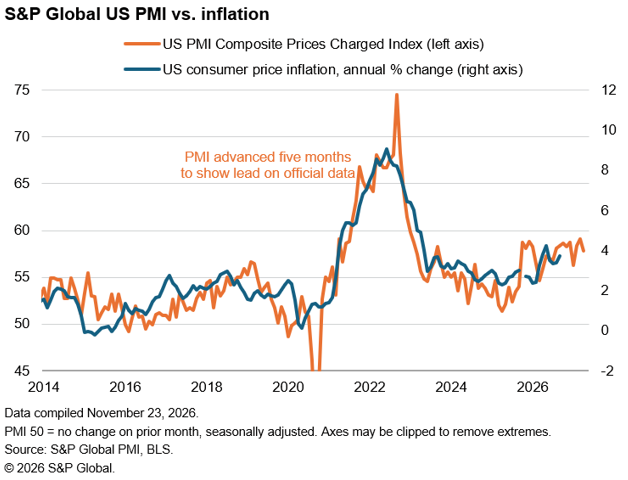
Price pressures cooled in November, helped by lower fuel prices, though rates of inflation remained elevated.
Average selling prices rose at a reduced rate, but October’s increase had been the largest since August 2022, meaning November’s rise was only slightly below the year-to-date average. Both goods and services prices kept rising rapidly, with manufacturing selling prices rising especially sharply.
Strong input cost growth was likewise again reported, with the rate of inflation remaining above the year-to-date average despite cooling for a second successive month. Firms reported higher prices for a wide variety of inputs from suppliers, as well as higher wage pressures. Manufacturing cost growth remained notably high by historical standards.
Outlook
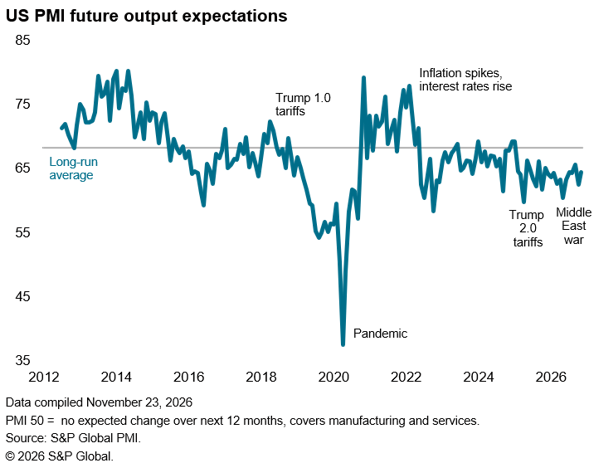
It was encouraging to see business confidence revive after the midterms from the low seen ahead of the polls in October. However, improved service sector prospects, in part reflecting hopes of a more stable business environment, were partly offset by reduced manufacturing sentiment, which was dampened by cost and supply concerns alongside persistent policy uncertainty, notably over tariffs. Overall optimism therefore remained subdued by historical standards.
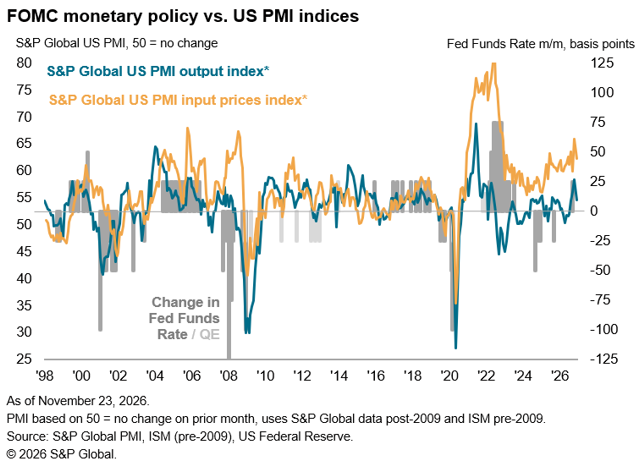
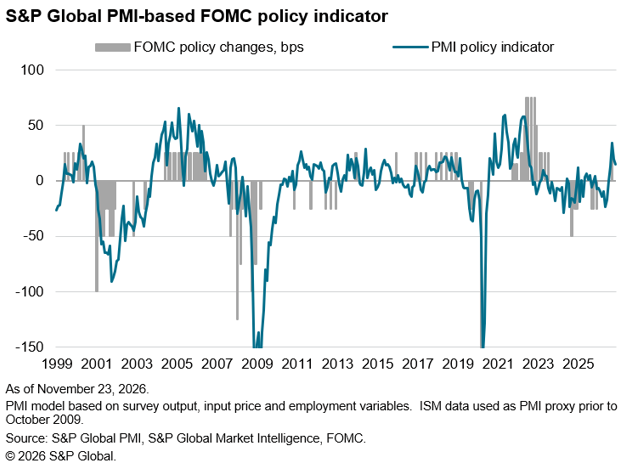
From a policy perspective, the survey price gauges remain at levels consistent with inflation running well above the Fed’s 2% target in the coming months, despite the moderation of the rate of inflation in November. Supply disruptions, having become more widespread and constraining firms’ abilities to fulfil orders, will only add further to underlying price pressures in the coming months.
A further 25 basis point rate hike from the FOMC is hence widely anticipated for November, with a 50-point rise also not ruled out.
Access the latest PMI press release here.
© 2026, S&P Global. All rights reserved. Reproduction in whole or in part without permission is prohibited.
Purchasing Managers' Index™ (PMI®) data are compiled by S&P Global for more than 40 economies worldwide. The monthly data are derived from surveys of senior executives at private sector companies, and are available only via subscription. The PMI dataset features a headline number, which indicates the overall health of an economy, and sub-indices, which provide insights into other key economic drivers such as GDP, inflation, exports, capacity utilization, employment and inventories. The PMI data are used by financial and corporate professionals to better understand where economies and markets are headed, and to uncover opportunities.
Read our latest PMI commentary here.
This article was published by S&P Global Market Intelligence and not by S&P Global Ratings, which is a separately managed division of S&P Global.
Theme
Location
Products & Offerings