ECONOMICS COMMENTARY — 23 Nov, 2026
Steady Eurozone flash PMI masks widening growth disparities

The November flash eurozone PMI signalled steady GDP growth of around 0.3% in the fourth quarter. Performance has diverged sharply, however, as Germany’s manufacturing-led expansion has gained further momentum while France faces a deepening downturn and the rest of the region slows. Elevated price pressures, de-spite lower oil costs, and higher borrowing costs, strengthen the case for a further ECB rate hike in December, but are contributing to the weakness of demand outside the tech and defence sectors.
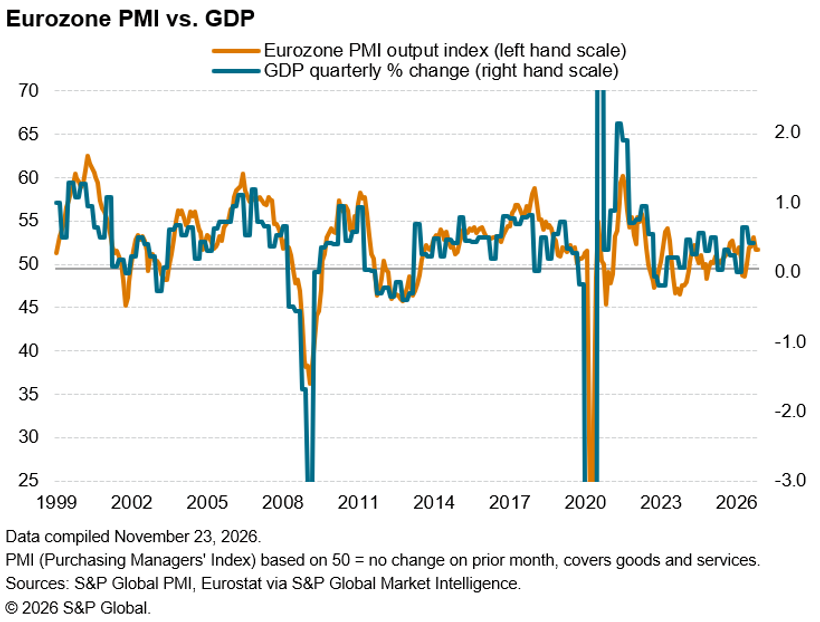
Steady eurozone growth
Unchanged at 51.7 in November, the S&P Global flash eurozone PMI signals sustained steady growth for the eurozone, consistent with the economy growing at a near 0.3% pace in the fourth quarter.
Widening divergence
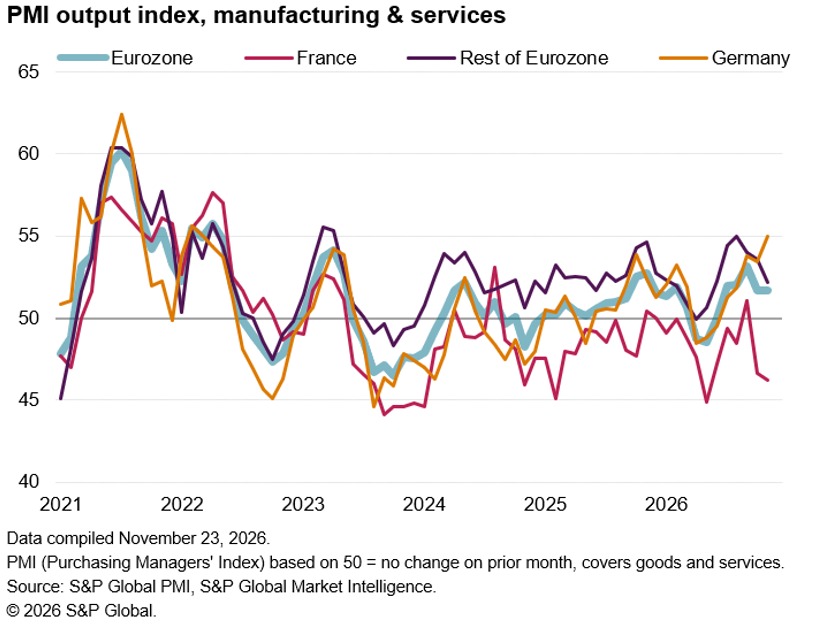
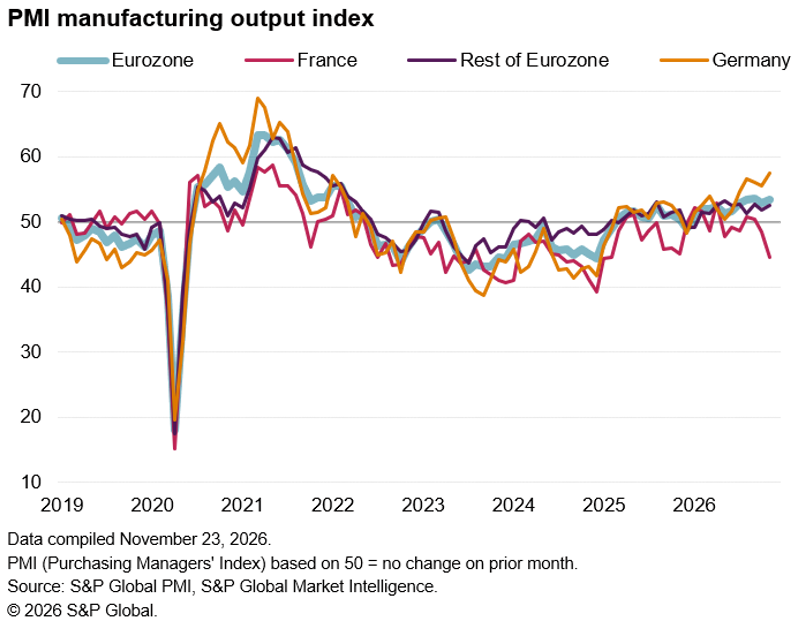
But this overall picture of continuing economic resilience masks worrying divergences in performance within the euro area. While growth in Germany has accelerated to the fastest for over four-and-a-half years, as its manufacturing sector enjoys a growth spurt of the likes not seen for over five years, France is suffering a deepening downturn of business activity.
The flash PMI for Germany is broadly indicative of GDP rising at a 0.6% quarterly rate, while, the flash PMI for France is consistent with a largely stalled economy.
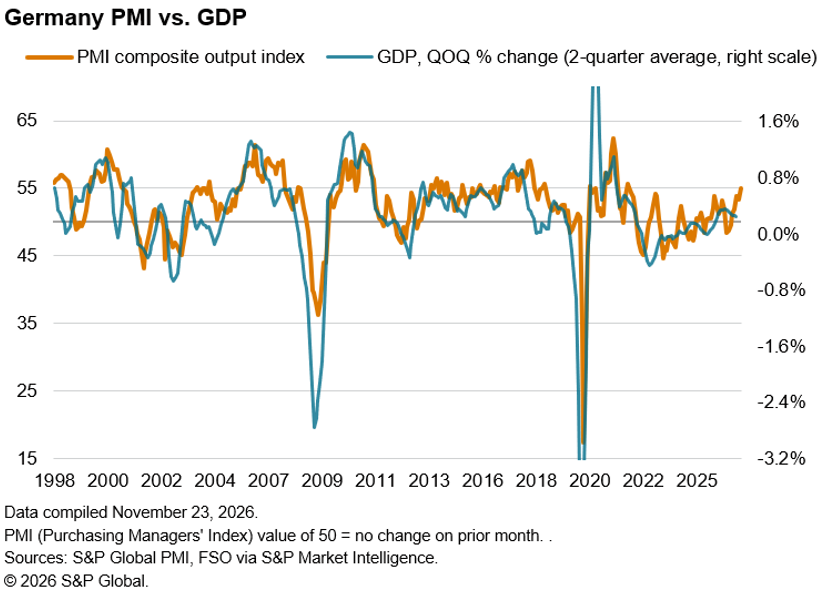
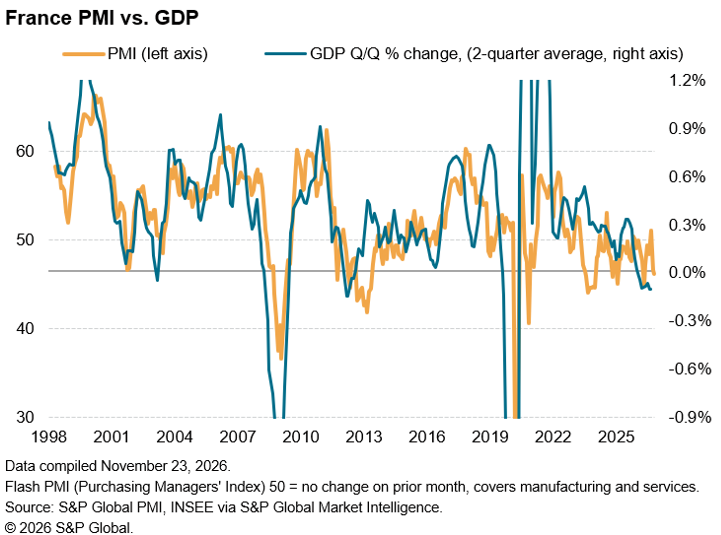
The divergence between the French and German composite PMIs is now the largest recorded for six years, underscoring the marked variation in growth trends within the euro area.
However, Germany’s divergence is not limited to France, as November has also seen growth weaken further across the rest of the region as a whole to the slowest since May (the flash PMI includes data from Spain, Italy, the Netherlands, Ireland, Austria and Greece, but presents the data for these other economies as a ‘rest of eurozone’ data set).
Germany’s factory growth spurt spills over to services
Sector trends help to explain some of this divergence. Manufacturers of business equipment and machinery are enjoying their day in the sun amid surging investment spending on defence and AI-related technologies, boosting Germany’s economy in particular.
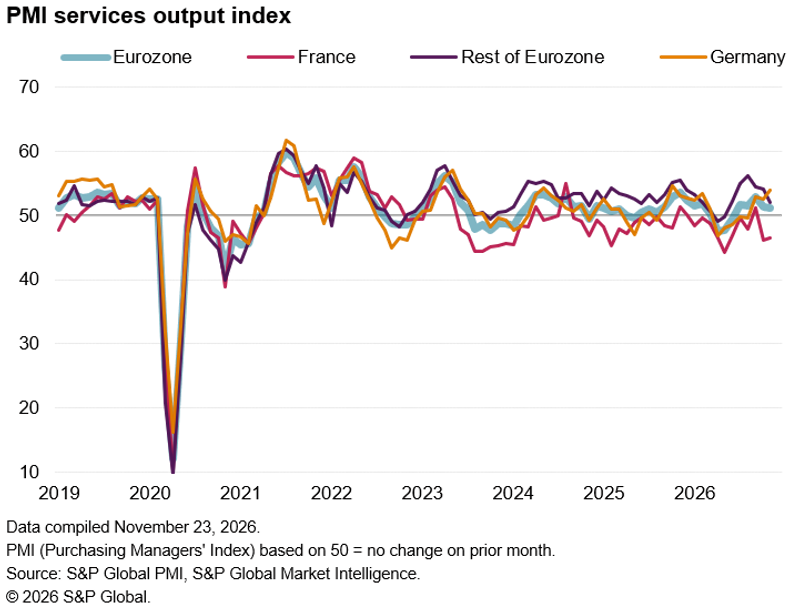
But uncertainty about the political environment, social unrest and the high cost of living are hitting service providers especially hard, particularly for consumer-facing businesses, dampening growth both in France and across the rest of the region as a whole. Spain, for example, saw a general strike during November following cost-of-living protests.
In Germany, however, the strong growth spurt seen in its manufacturing sector appears to be spilling over to services via sectors such as transport, business services and IT, which tend to be highly correlated with factory growth. This has likely helped offset some of the cost-of-living pressures in the services economy.
Inflation and interest rates dampen demand
Higher interest rates are also starting to show up as an increasing drag, notably in the service sector via property markets, construction-related activities, and broader financial services, according to survey contributors.
Not only has the ECB hiked interest rates twice so far this year, but bond yields have also risen sharply in re-cent months for many markets, raising borrowing costs for sovereign and corporate credit.
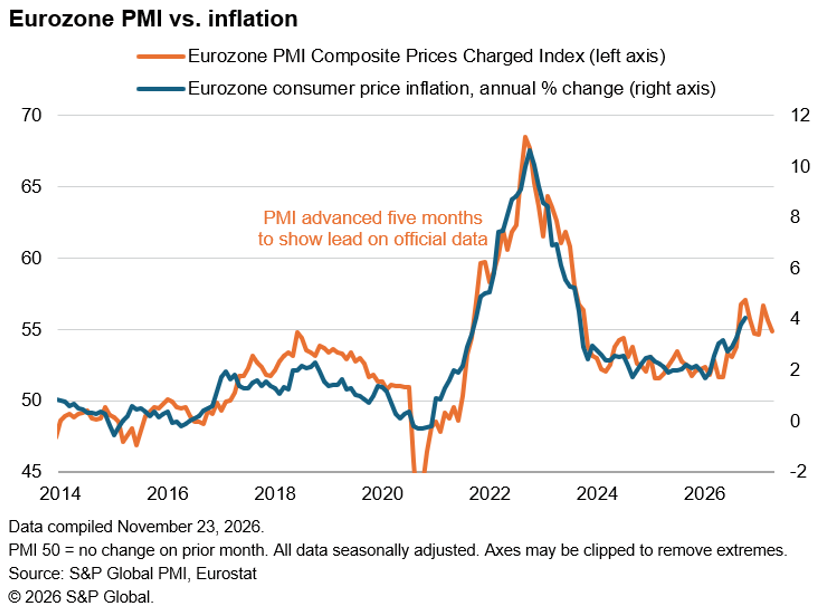
The demand-dampening effect of higher borrowing costs is likely to intensify, as sustained elevated price signals from the PMI in November – alongside the broad message of steady economic growth across the eurozone – will support calls for a further rate hike from the ECB in December.
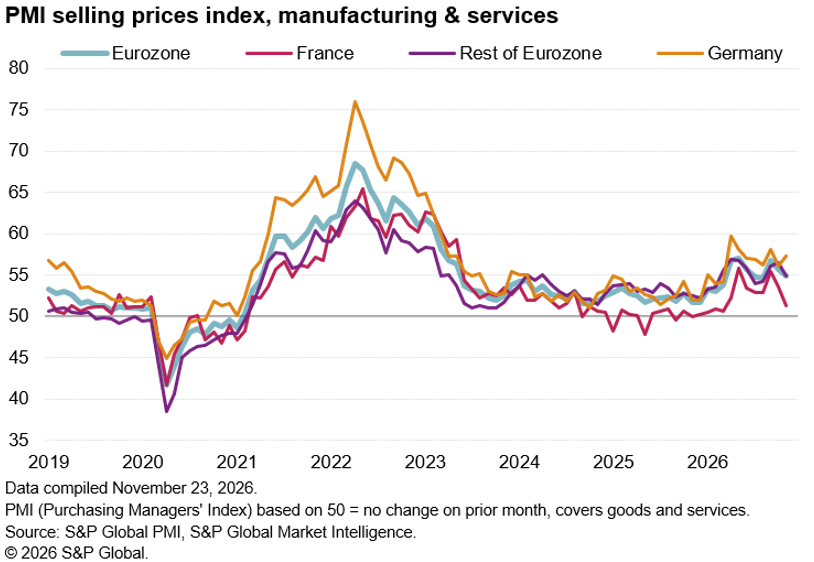
Encouragingly, from the inflation perspective, lower oil prices have helped tame inflationary pressures some-what in November, leading to slower growth of costs in both manufacturing and services, and slumping demand is reducing sellers’ pricing power in many cases, most notably in France’s service sector, where prices barely rose.
Alongside the soft-looking labour market indicators from the survey, with employment largely stalled in November despite resilient output, the slower price growth could ease some concerns about the persistence of elevated inflation if it continues. But, for now, the surveys send a clear hawkish signal of inflation still running well ahead of the ECB’s 2% target in the coming months.
© 2026, S&P Global. All rights reserved. Reproduction in whole or in part without permission is prohibited.
Purchasing Managers' Index™ (PMI®) data are compiled by S&P Global for more than 40 economies worldwide. The monthly data are derived from surveys of senior executives at private sector companies, and are available only via subscription. The PMI dataset features a headline number, which indicates the overall health of an economy, and sub-indices, which provide insights into other key economic drivers such as GDP, inflation, exports, capacity utilization, employment and inventories. The PMI data are used by financial and corporate professionals to better understand where economies and markets are headed, and to uncover opportunities.
Read our latest PMI commentary here.
This article was published by S&P Global Market Intelligence and not by S&P Global Ratings, which is a separately managed division of S&P Global.
Theme
Location
Products & Offerings