ECONOMICS COMMENTARY — 23 Nov, 2026
UK flash PMI points to slower growth in November as service sector expansion cools amid persistent inflation

November sees sustained UK business growth, according to the preliminary flash PMI surveys, pointing to a robust 0.6% increase in GDP during the fourth quarter.
Encouragingly, business confidence has improved, with optimism about the year ahead recovering to the level seen prior to the outbreak of war in the Middle East back in February, indicating that the Autumn Budget has been generally well received by the business community. However, an exception is employment, which showed a renewed fall as companies continue to worry over rising costs and seek to boost productivity. The impact of elevated energy prices was again exacerbated by high staffing costs, the latter partly blamed by business on government policy.
The combination of resilient output growth and stubbornly strong inflation meanwhile make another rate hike by the Bank of England at its December meeting a near certainty, and raise the likelihood of another hike in February. However, policymakers will remain data dependent, as not only did the PMI price gauges signal some cooling of inflationary pressure, but service sector growth also weakened, in part due to the impact of rising interest rates, leaving manufacturing – which is enjoying an AI-related investment led growth spurt – as the main driver of the economic upturn.
Economy set for robust fourth quarter
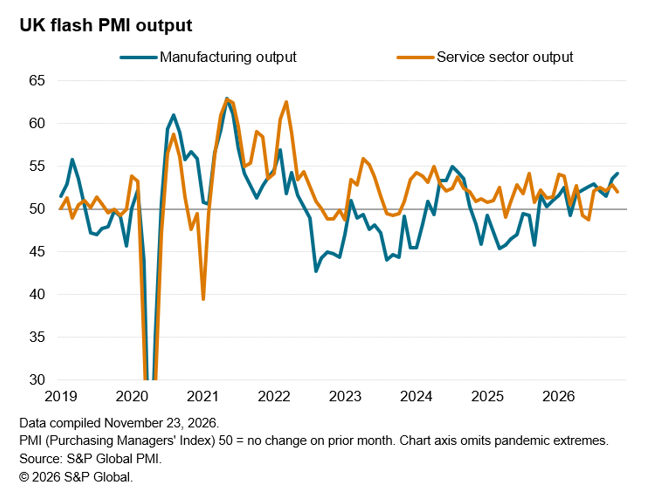
UK business activity continued to grow at a solid pace in November, according to the preliminary PMI survey data. The flash S&P Global PMI Output Index registered 52.3. While down from 52.9 in October, the latest reading is among the strongest seen since growth weakened on the onset of war in the Middle East, and is broadly consistent with GDP growing at a robust 0.6% quarterly pace (based on historical comparisons of the PMI against GDP since 2021).
Combined, the October and November PMI readings indicate that the economy is on course to grow by 0.6% in the fourth quarter, barring any major shift in growth momentum in December.
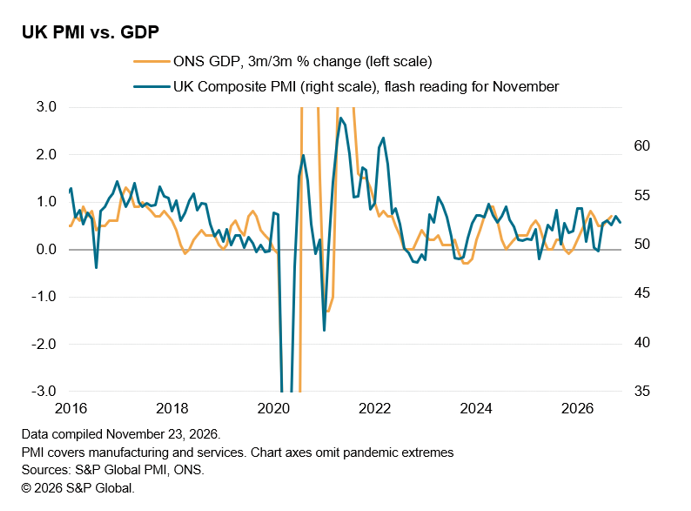
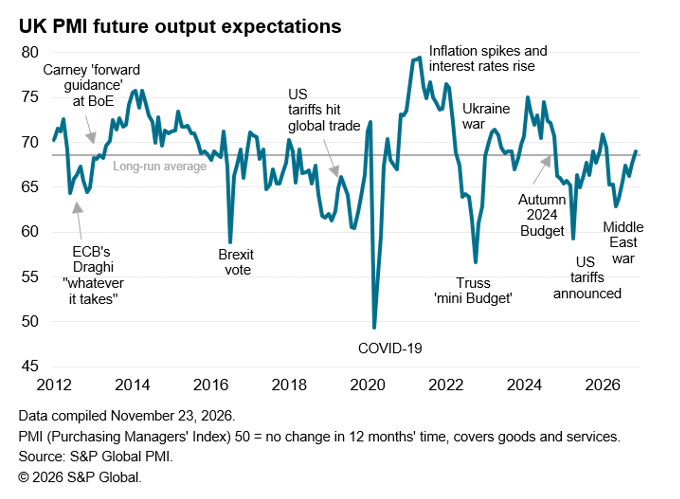
The sustained growth in November was fuelled by a further rise in new orders and was accompanied by a brightening of business optimism about the year ahead to its highest since February. The improvement in sentiment notably also took business confidence above its long-term average for the first time since February.
Cost concerns weigh on hiring
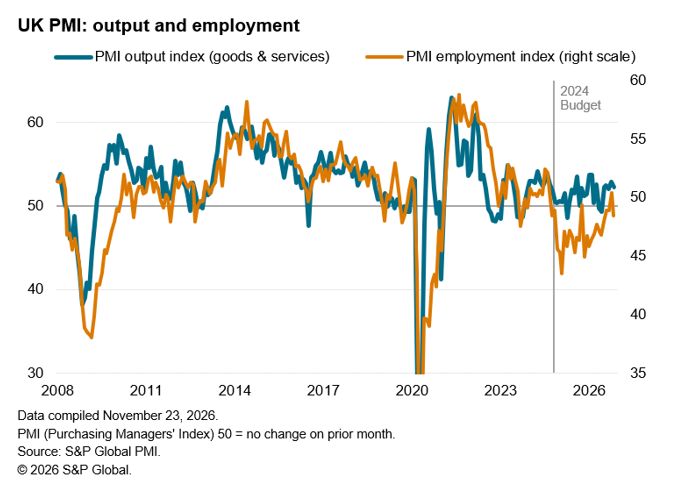
Despite the ongoing improvements in output, new orders and business confidence, employment fell in November, showing a renewed decline after the tentative return to growth seen in October. Although far less severe than the declines seen over much of the past two years, the latest drop in employment again reflected concerns over high costs, inhibiting hiring and often encouraging the non-replacement of leavers, in some instances prompted by improved automation and AI adoption.
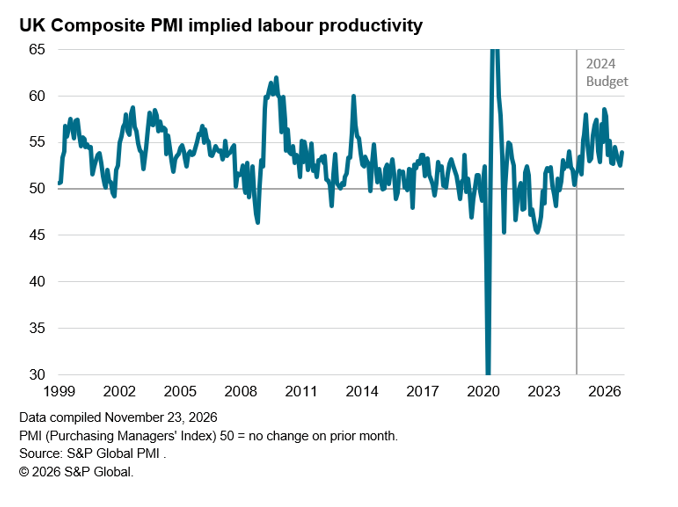
Companies’ concerns over costs in part reflect high energy prices and fuel surcharges, but November again saw employment reportedly hindered by government policy such as higher national insurance contributions and the rising minimum wage. Tellingly, the PMI’s employment index has diverged from the output index following the Autumn 2024 Budget, in which additional labour cost measures were introduced. However, this divergence has implied a marked improvement in labour productivity over this period.
Inflation remains elevated, but shows signs of cooling
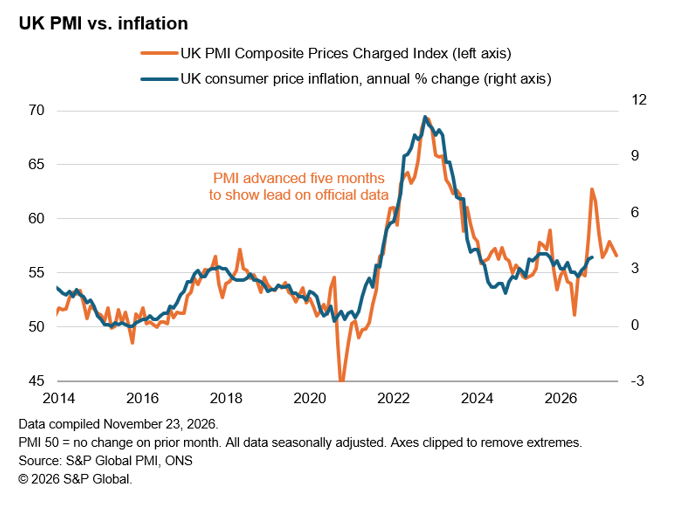
Measured across goods and services, input cost growth remained among the highest seen since early 2023, though the overall rate of inflation was indicated to have moderated to the lowest since August. This slower cost growth helped to cool selling price inflation to its weakest since July but, even at this reduced rate, output charge inflation continued to run at a level consistent with consumer price inflation running well above the Bank of England’s 2% target in the coming months.
Bank of England to tighten policy further
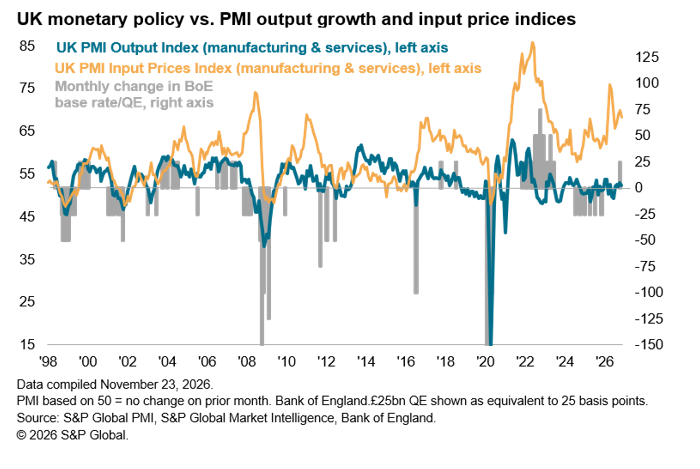
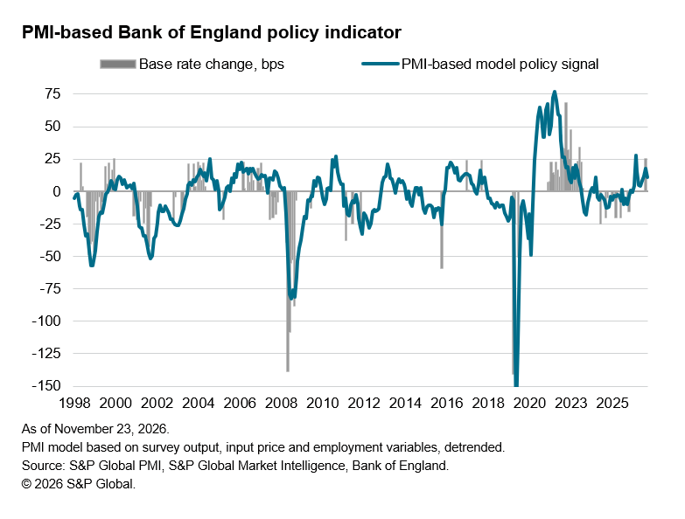
The combination of resilient economic growth and still-elevated price pressures from the flash PMI data for November will help cement a further rate hike by the Bank of England at its December meeting, having hiked rates for the first time in over three years at its November meeting. The survey data also support the likelihood of a further hike in February, given the stubbornness of the inflation picture portrayed by the survey respondents.
Rate hike dampens services activity as manufacturing enjoys growth spurt
November saw a divergence of business trends by sector, however, which needs to be monitored going forward, especially in terms of the impact of higher borrowing costs. While manufacturing output growth accelerated in November, climbing to its highest since August 2024 amid the ongoing boost from tech spending on AI, service sector growth weakened to its slowest since June. The high cost of living was again widely reported as having dampened demand for many services alongside uncertainty, but November saw companies also report the impact of higher borrowing costs, notably via the residential and commercial property markets and the construction industry.
Read the press release here.
© 2026, S&P Global. All rights reserved. Reproduction in whole or in part without permission is prohibited.
Purchasing Managers' Index™ (PMI®) data are compiled by S&P Global for more than 40 economies worldwide. The monthly data are derived from surveys of senior executives at private sector companies, and are available only via subscription. The PMI dataset features a headline number, which indicates the overall health of an economy, and sub-indices, which provide insights into other key economic drivers such as GDP, inflation, exports, capacity utilization, employment and inventories. The PMI data are used by financial and corporate professionals to better understand where economies and markets are headed, and to uncover opportunities.
Read our latest PMI commentary here.
This article was published by S&P Global Market Intelligence and not by S&P Global Ratings, which is a separately managed division of S&P Global.
Theme
Location
Products & Offerings