Research — AUGUST 17, 2026
The Visible Alpha AI Monitor H1 2026 update: What’s next for AI?

By Melissa Otto, CFA
The Visible Alpha AI Monitor aggregates publicly traded US technology companies, providing a comprehensive measure of the current state and projected growth of the core AI industry. This encompasses the AI-exposed revenues for companies that are building AI infrastructure and capabilities for both enterprises and consumers.
Investors may use the Visible Alpha AI Monitor to generate new ideas to capture growth emanating from the core AI industry, as well as to evaluate the potential AI exposure of technology stocks in their existing portfolios. We have identified specific line items that capture potential growth of AI-related revenues that are available on the Visible Alpha Insights platform.

Key questions for H2 2026 and beyond:
Memory demand has driven price hikes in the first half of 2026. Will this continue?
Will AI agents help drive broader adoption in the second half of 2026 and 2027?
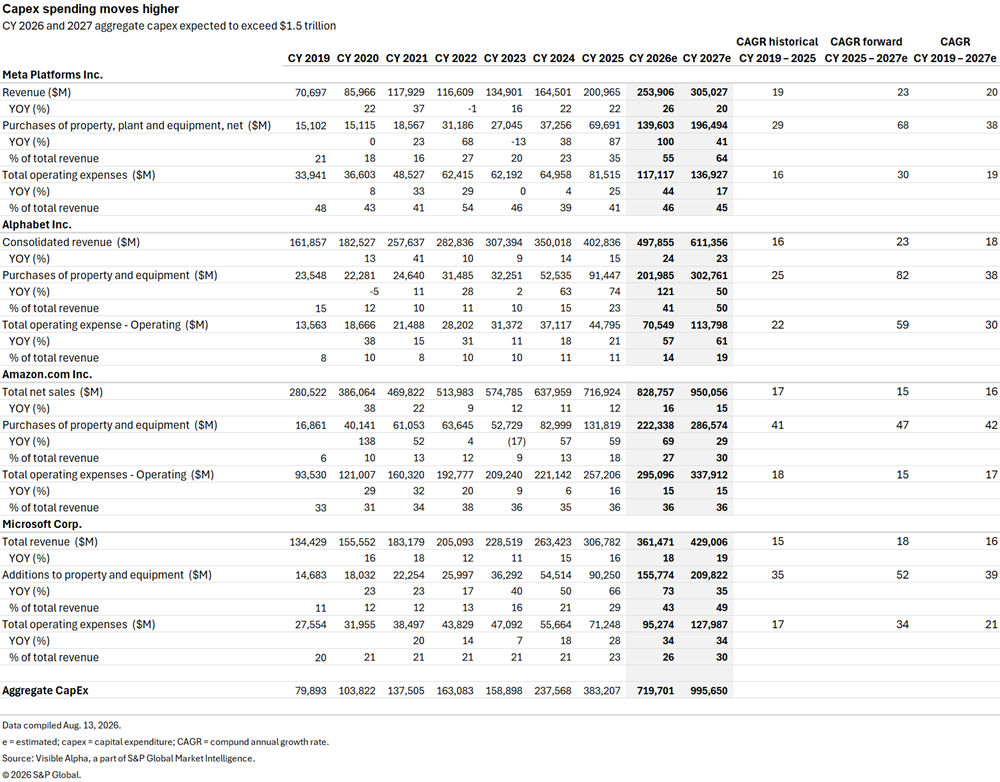
Will capital expenditure spending by hyperscalers continue to exceed expectations this year and next?
What will be the impact of data center build-out to energy and metals prices?
Introduction
The generative AI trend gained further momentum in the first half of 2026, as cloud service providers continued to invest heavily in capex to transition data centers to accelerated computing. The AI theme continued to evolve and expand. Visible Alpha observed that companies made a greater push to integrate AI into their organizations, hoping to improve efficiency and enhance the client experience. The usage of AI models also improved, as hyperscalers remain focused on enhancing compute and reducing costs for users. Optimizing cost and compute is expected to drive broader adoption and applications.
Over the past few years, significant innovation in the chip and model has benefited NVIDIA Corp. and, more recently, memory stocks. However, there has not been as much innovation at the application level to drive broader adoption of AI with end users due to the cost per inference or token.
The cost of power and compute are two key bottlenecks that require more efficiency to scale and drive adoption. As the hyperscalers race to expand their infrastructure and provide this optimization, the verdict is still out on the impact to enterprises. The productivity impact AI may yield for businesses remains an open question. The productivity impact AI may yield for businesses remains an open question. When will this potential productivity and innovation help to deliver stronger fundamentals and earnings growth?
This year so far has shown signs of broader AI adoption in enterprises, driven by the introduction of AI agents into role-specific workflows. AI agents seem to enable domain- and persona-specific workflows to complement human roles in an organization. For example, a firm may have a unique AI agent for research, security, analytics, sales, and customer service to complement the human work done in these functions.
The key question is how companies will leverage these agents and what may be the direct or indirect impact on revenues and costs over the longer term. The primary challenge is generating accurate persona- and domain-specific output at a low cost.
H1 2026 performance summary
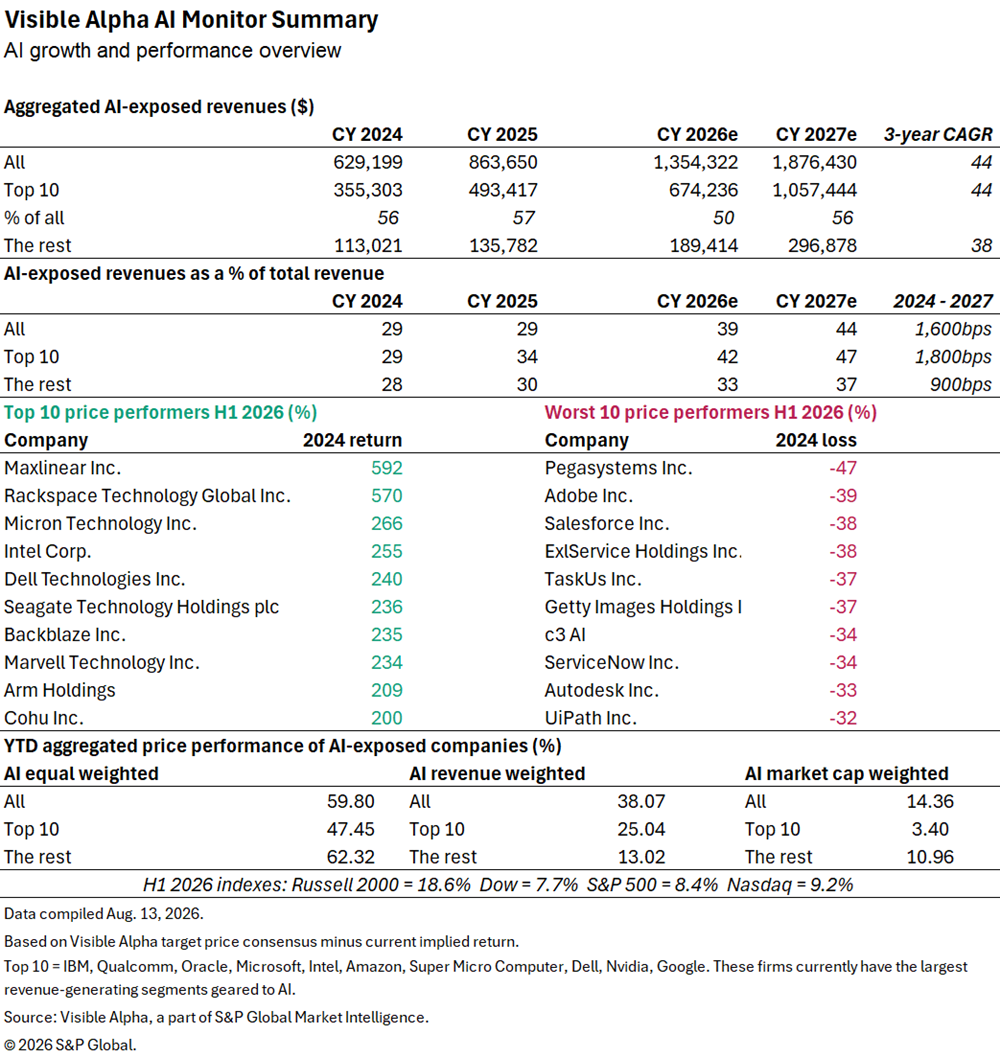
Currently, the Visible Alpha AI Monitor universe of 58 publicly traded US companies is 78% weighted to the 10 largest companies, with the remaining 22% dispersed among 47 companies. On a market capitalization-weighted and AI-exposed revenue-weighted basis, the Visible Alpha AI Monitor continued to be driven by stock price outperformance (versus the S&P 500 index) of the largest companies this year. In addition, performance in the smaller companies (versus the S&P 500 index), especially on an equal-weighted basis, has outperformed in 2026 with the performance broadening out on a stock-specific basis. On an equal-weighted basis, the AI Monitor generated an overall higher return when compared to the market cap-weighted and AI-exposed revenue-weighted aggregations this year, driven by the drag of a lower return generated by the largest names. This broader outperformance is a shift in 2026, as the larger market cap names drove outperformance in 2025.
AI Monitor stock returns for the 58 companies are aggregated based on three weighting scenarios: weighted by the size of the AI-exposed revenues, equal-weighted and market cap-weighted. Market cap-weighted returns show the direction of change year over year.
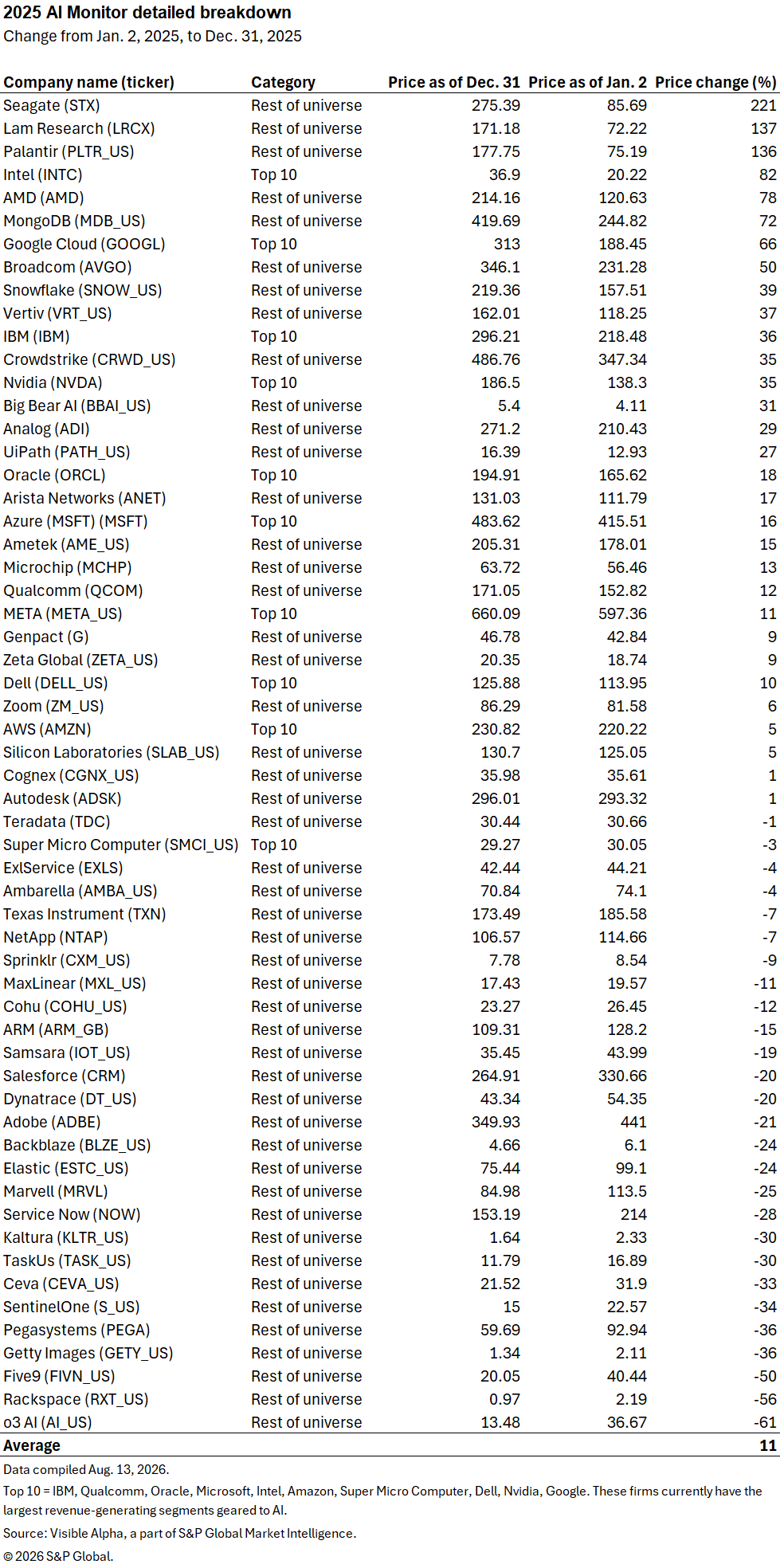
What is moving the AI Monitor: Smaller stocks gain momentum
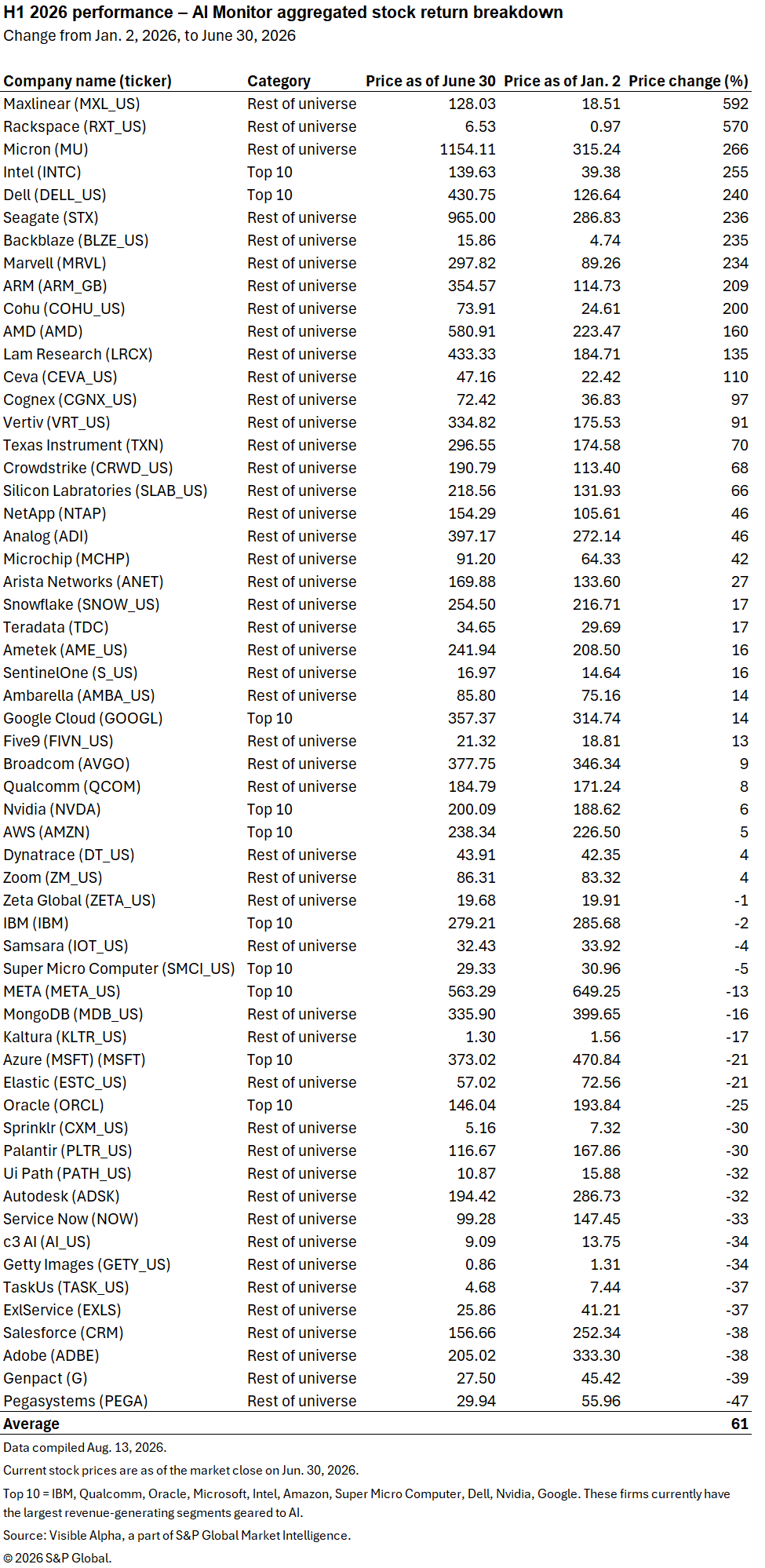
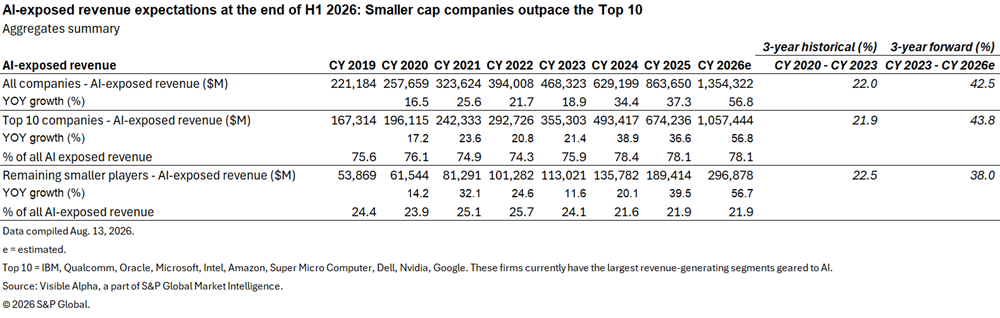
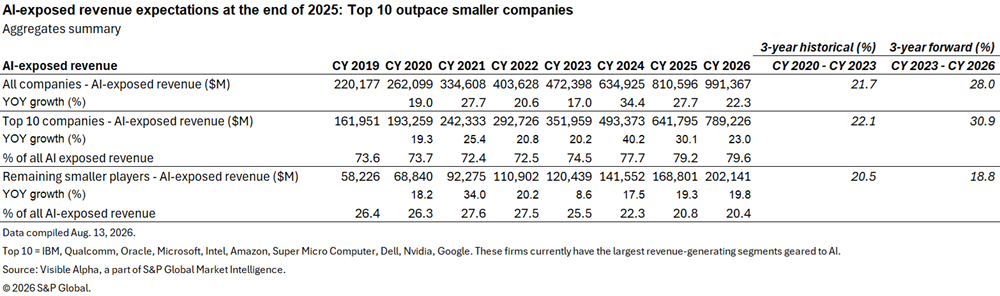
From January to July 2026, only three out of the 10 largest AI-exposed revenue generators delivered strong outperformance, while 56% of the smaller-cap AI stocks outperformed the S&P 500 index. Total AI-exposed revenue is expected to increase by nearly $886 billion, rising from $468 billion at the end of 2023 to $1.354 trillion at the end of 2026. This growth is anticipated to be driven overwhelmingly by the top 10 largest companies in the AI Monitor. The expected 2026 AI-exposed revenue has increased by more than $350 billion since last year, due to continued upward revisions by Nvidia.
The list of 58 companies may serve as a good place for investors to discover new ideas by surfacing expanding new players. While smaller companies in aggregate have not performed as well as the top 10 the past few years, there have been some clear outperformers relative to the composite. Among the smaller companies, revenue growth expectations are very mixed. Some companies are expected to deliver strong double-digit revenue growth, while others are seeing estimates decline. These dynamics may help investors identify emerging trends in the space.
In the first seven months of 2026, this trend has been evident in MaxLinear Inc., Rackspace Technology Inc. and Backblaze Inc. These companies were poor performers in 2025 but rebounded this year and delivered strong outperformance (versus the Russell 2000).
In the larger-cap arena, Micron Technology Inc., Dell Technologies Inc. and Seagate Technology Holdings PLC drove outperformance. Given the sizable moves in these companies, the composition of the top 10 could shift next year. Micron, in particular, has benefited from the surge in demand for dynamic random access memory (DRAM) and high-bandwidth memory (HBM). Based on its revenue growth trajectory, the company may enter the top 10 in 2027.
Micron and memory
One of the most dramatic market moves around the AI story has been the weakness in software companies ServiceNow Inc., Salesforce Inc. and Adobe Inc. and the strength in memory stocks. Memory, especially HBM, plays an important role in ensuring AI workloads run efficiently and fast, reducing latency. The strength of HBM is that it increases performance by stacking traditional DRAM layers vertically, while decreasing the amount of power consumed. As investment in data centers for AI has exploded, demand for memory has become a critical component of AI accelerators, like Nvidia’s Blackwell GB200/B200.
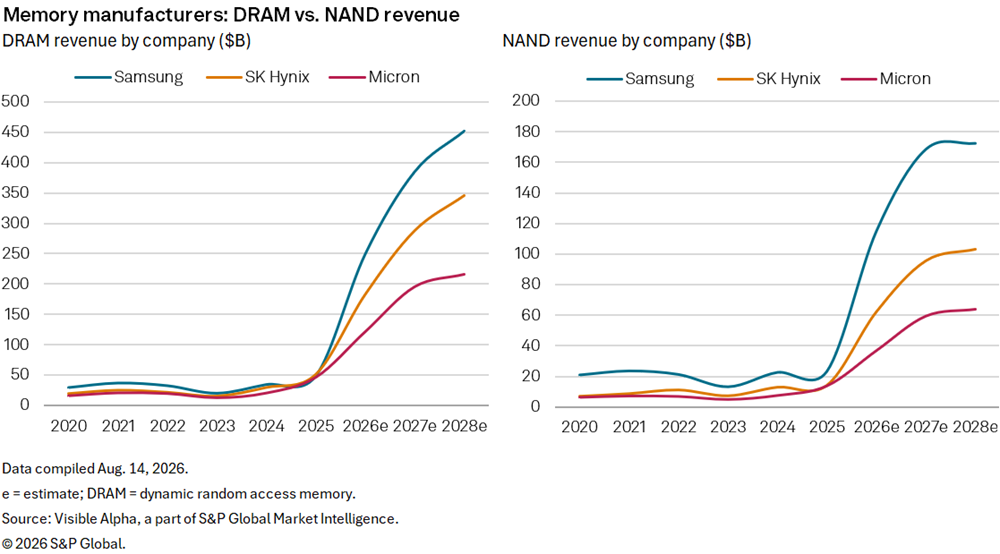
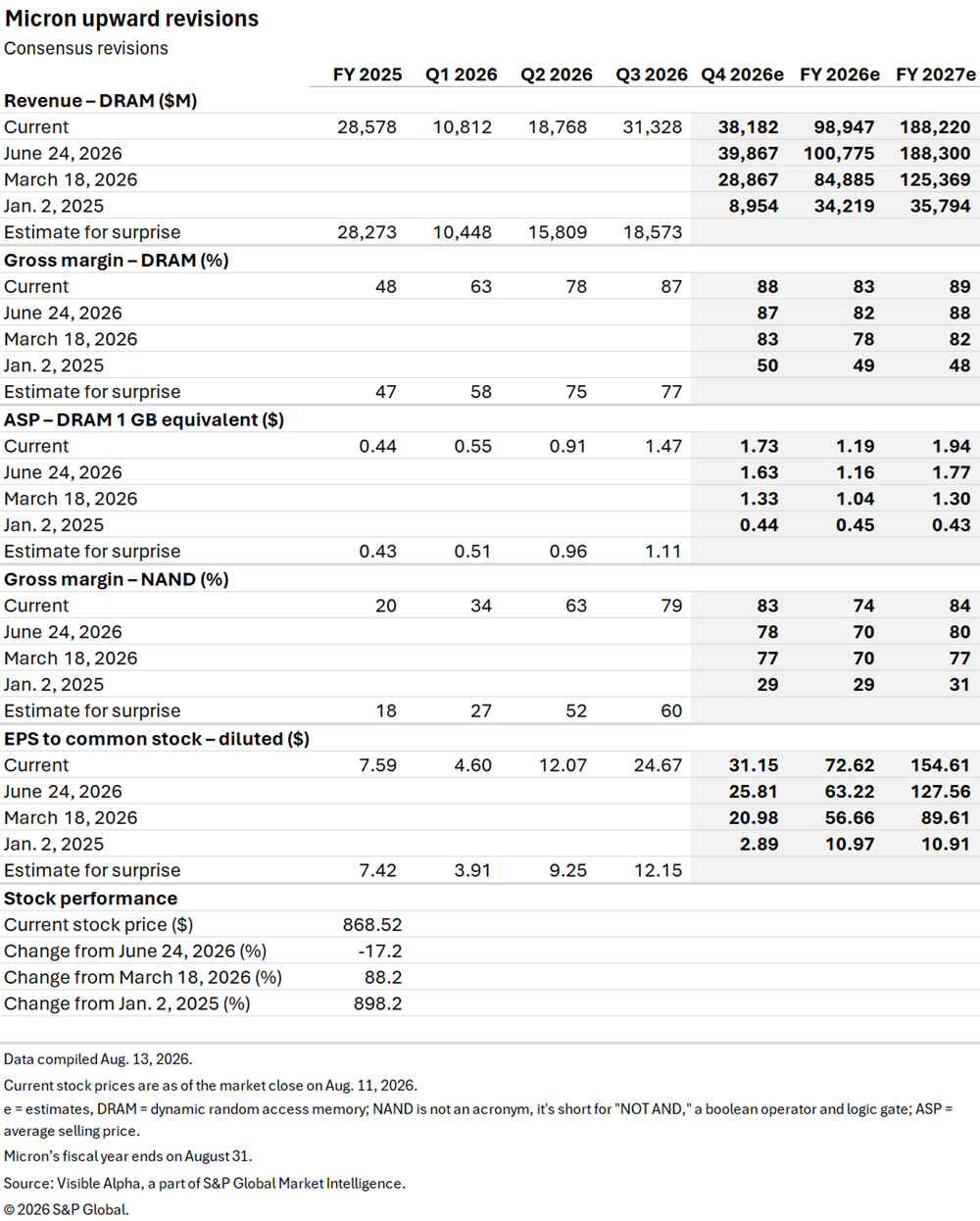
Fiscal fourth-quarter 2026 and full-year 2027 consensus estimates for Micron's DRAM and NAND flash memory sales and gross profit have increased substantially since March 2026. DRAM revenues are now 16.5% higher for fiscal year 2026 and 50% higher for fiscal year 2027. Gross profit consensus for DRAM has increased more, reflecting higher prices and driving fiscal 2027 consensus earnings per share to $155, implying a price-to-earnings multiple of 6x and supporting a consensus target price of $1,500.
The pace of these upward revisions is reminiscent of the significant forecast increases seen in 2023 for Nvidia's 2024 and 2025 data center revenue, when estimates kept going higher on the back of extraordinary demand by the hyperscalers.
Dell, Nvidia drive 2026 upward revisions
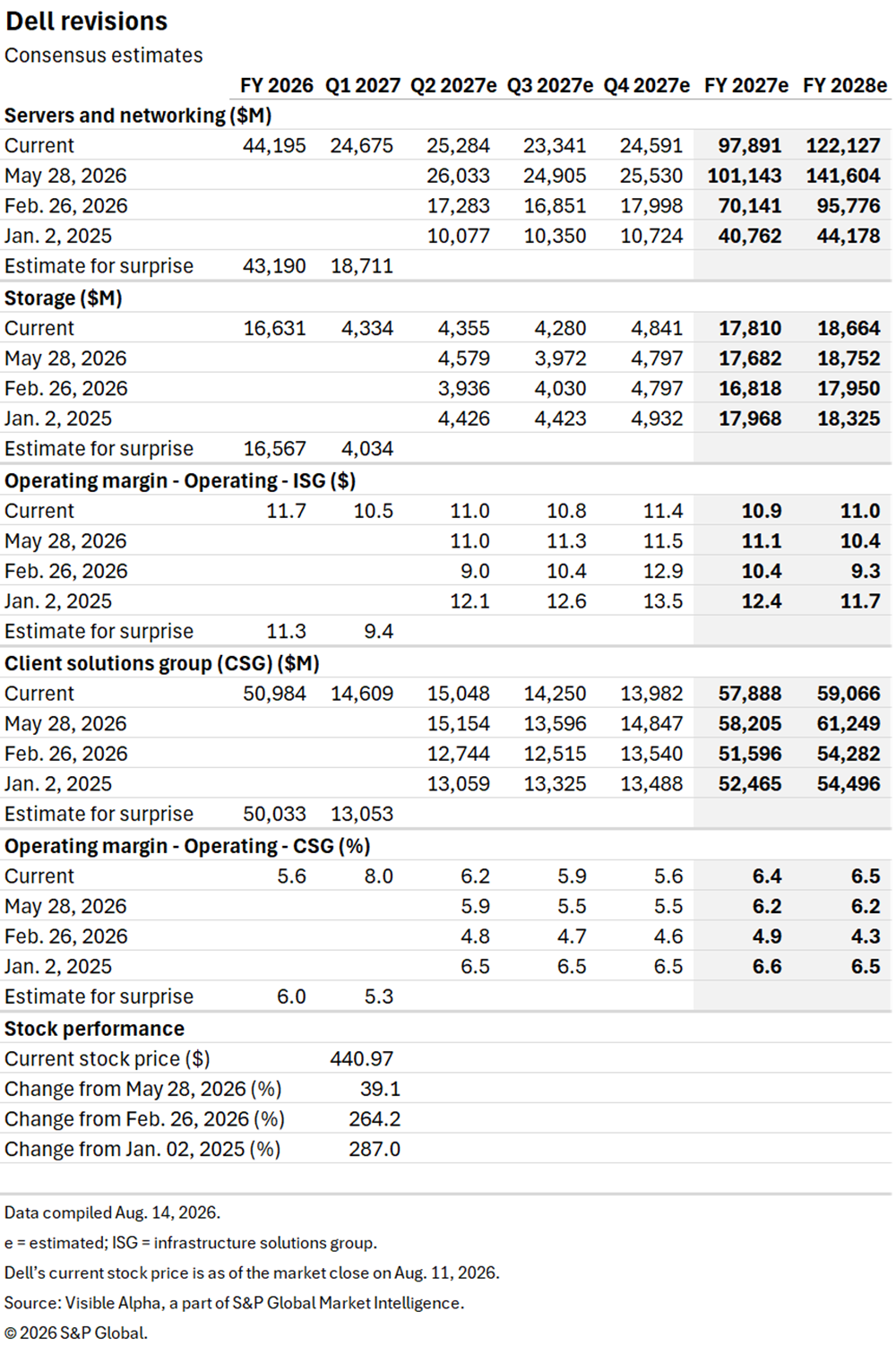
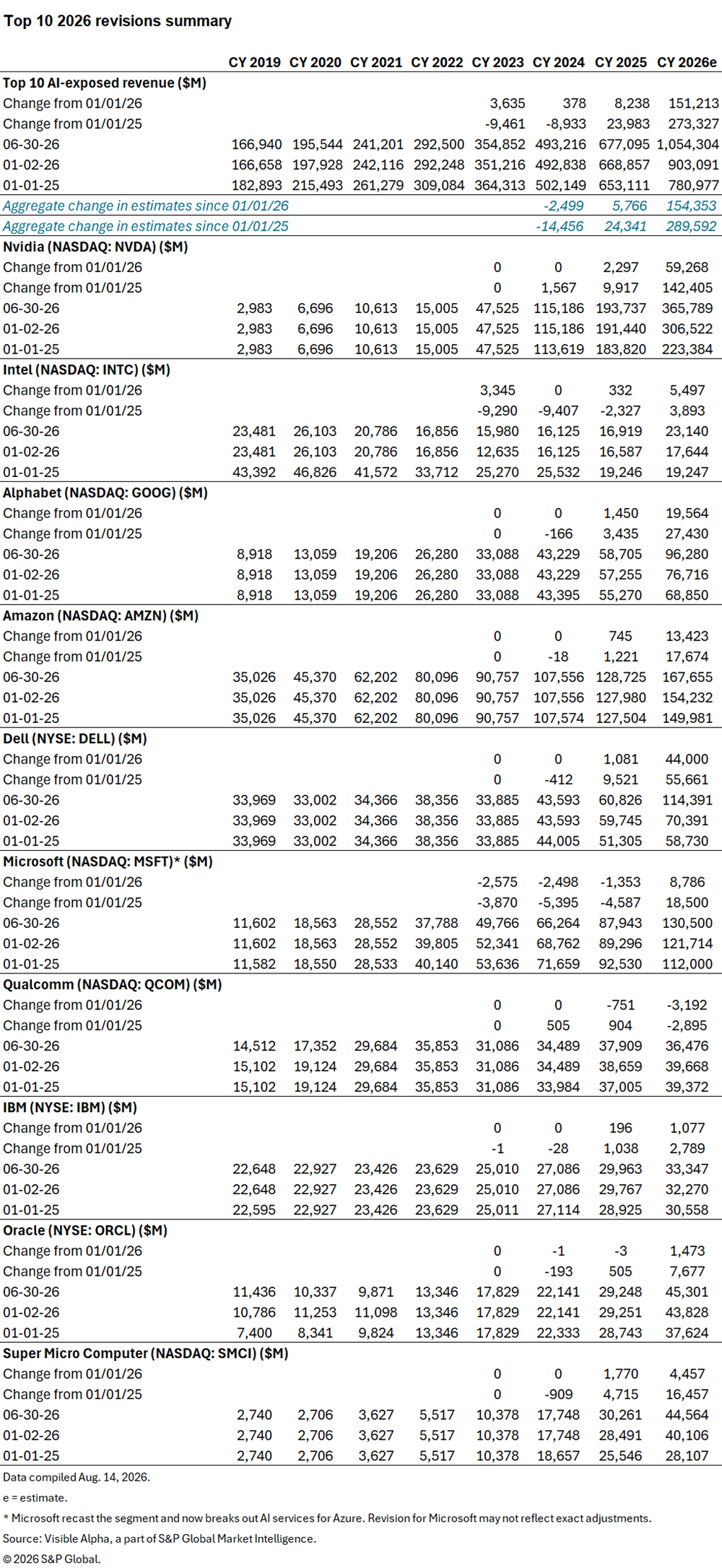
Between the end of 2025 and the end of 2026, consensus expectations for Nvidia’s and Dell’s combined AI-exposed revenues were revised upward by nearly $200 billion. These revisions contributed significantly to the AI-exposed revenue concentration of the AI Monitor. The optimism has been driven by cloud service providers' continued heavy capex investment to support the transition of data centers to accelerated computing for AI applications.
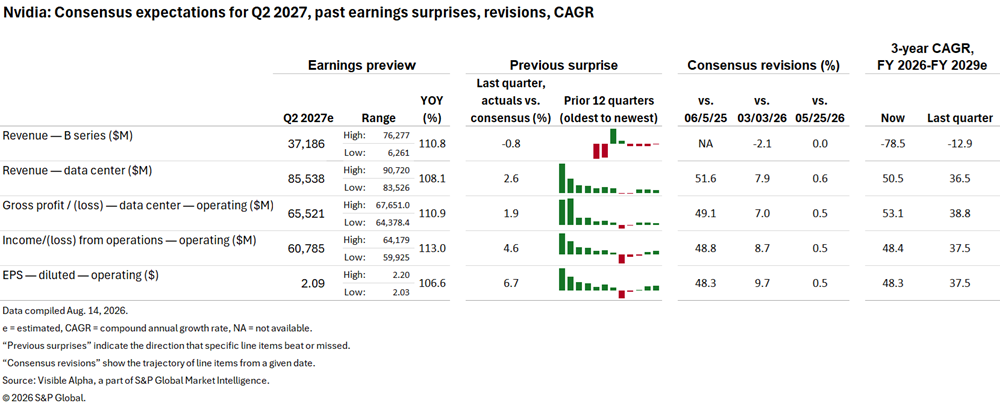
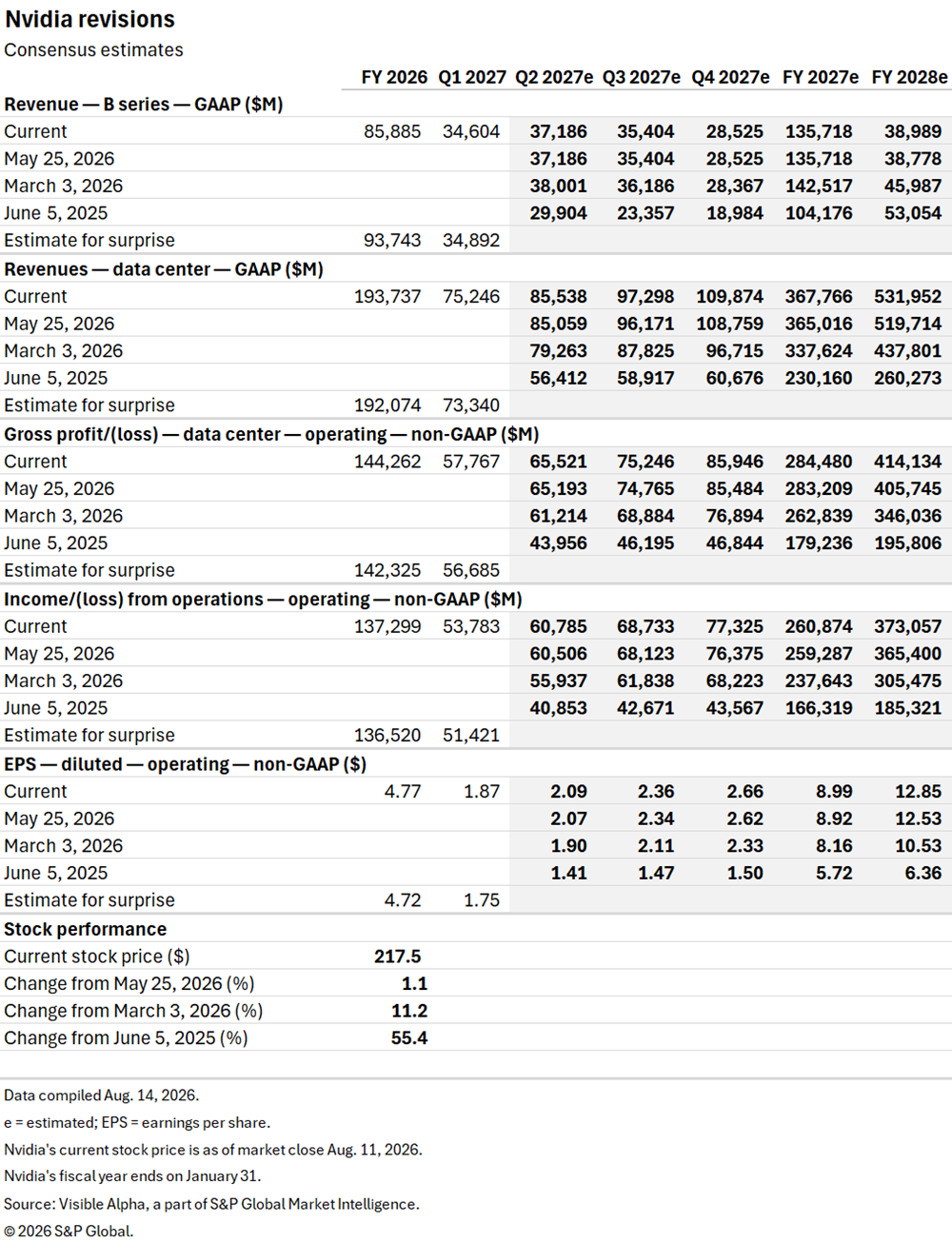
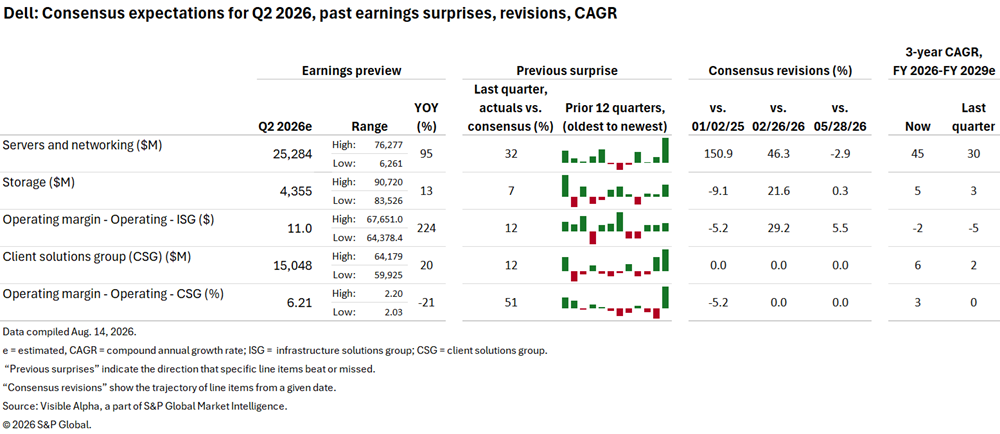
In the first half of 2026, upward revisions for Nvidia continued to increase further, but at a slower pace and smaller magnitude than previous years. There are concerns that the growth momentum may be slowing for Nvidia. Dell’s expected revenue growth from AI accelerated and its stock performance meaningfully expanded its projected valuation.
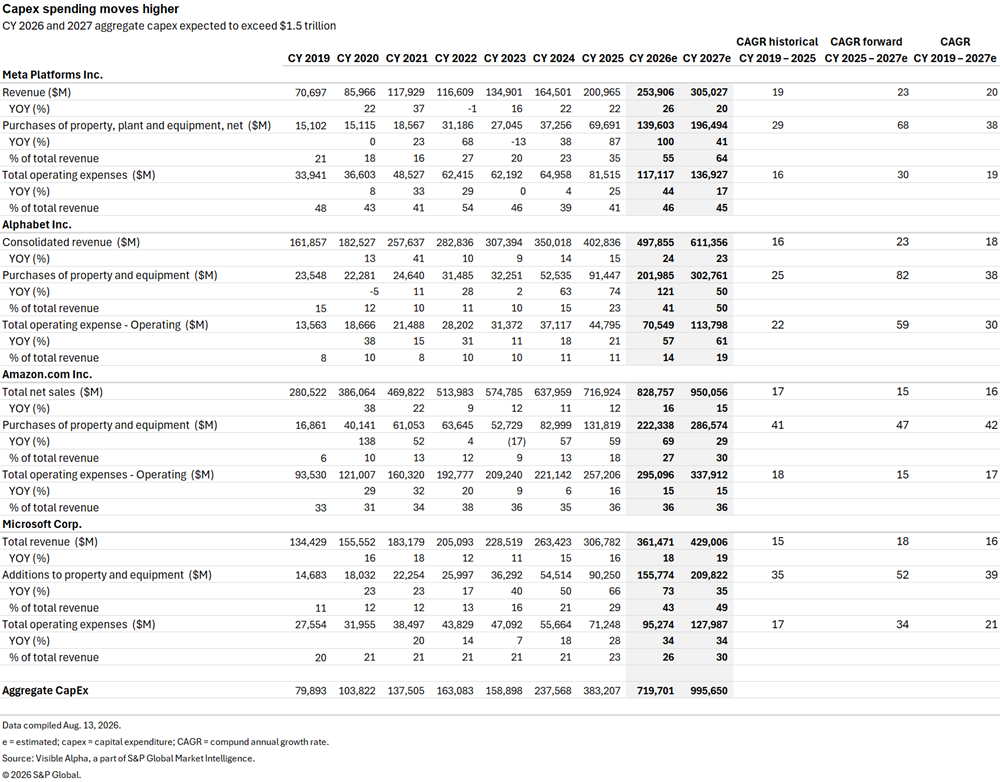
While capex continues to increase at the four main cloud service providers and to benefit chip stocks, evidence of increasing returns to Microsoft Corp. and Amazon.com Inc. is emerging.
Microsoft's Azure business has also started to gain momentum. It is expected to ramp up growth and to generate over $130 billion by the end of fiscal 2027, based on Visible Alpha consensus. The company guided for fiscal first-quarter 2027 Azure revenue to accelerate. Consensus expects year-over-year revenue growth for the fiscal year to hit 45%, up from 41%.
Amazon's AWS revenue expectations have increased by $13 billion. It is expected to ramp up growth and to generate over $167 billion by the end of 2027, based on Visible Alpha consensus.
The 2026 Google Cloud revenue expectations have been revised up by $20 billion this year, implying a strengthening outlook. However, the company delivered negative free cash flow in the second quarter, leading to concerns about future cash burn and weaker return on invested capital (ROIC). Meta too has faced concerns about competitive positioning and its ability to generate growth from its large-scale AI infrastructure investments.
Data centers, energy and metals
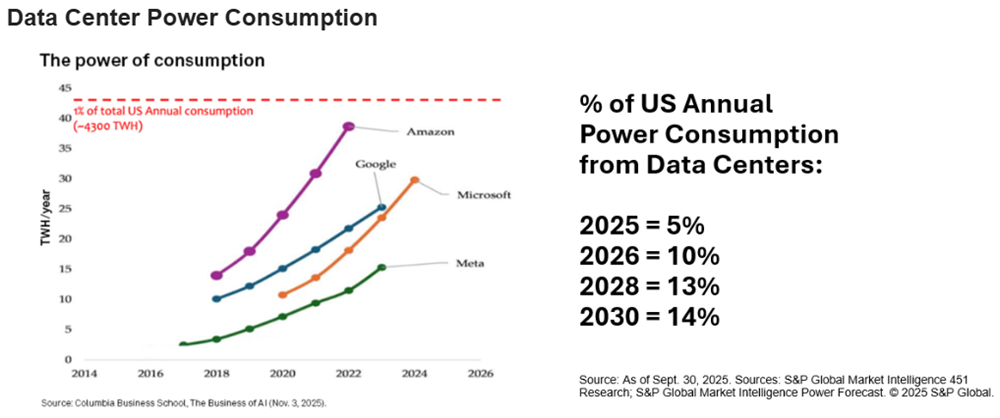
With a likely surge in demand for power and metals to increase compute within data centers, questions are emerging about the impact to both local and broader economies from this massive expansion to support AI. According to S&P Global Market Intelligence Inc., US annual power consumption from data centers is expected to exceed 14% of total consumption. This energy surge has potentially significant ramifications longer-term for inflation and geopolitical challenges.
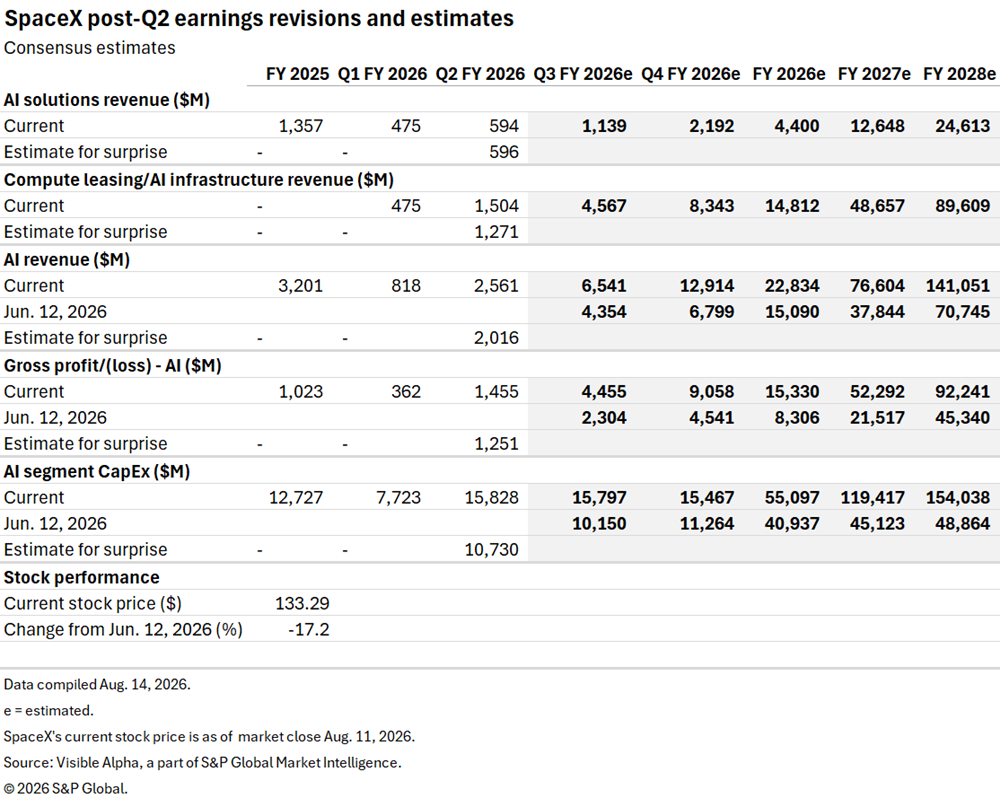
Given this backdrop, the $1.9 trillion market cap of the recently listed Space Exploration Technologies Corp. (SpaceX) stock may provide compelling solutions long-term by moving data centers to space and leveraging solar energy to power them. SpaceX released its first earnings report as a public company and guided significant capital expenditure to support an AI infrastructure build-out. SpaceX will be added to the AI Monitor in 2027.
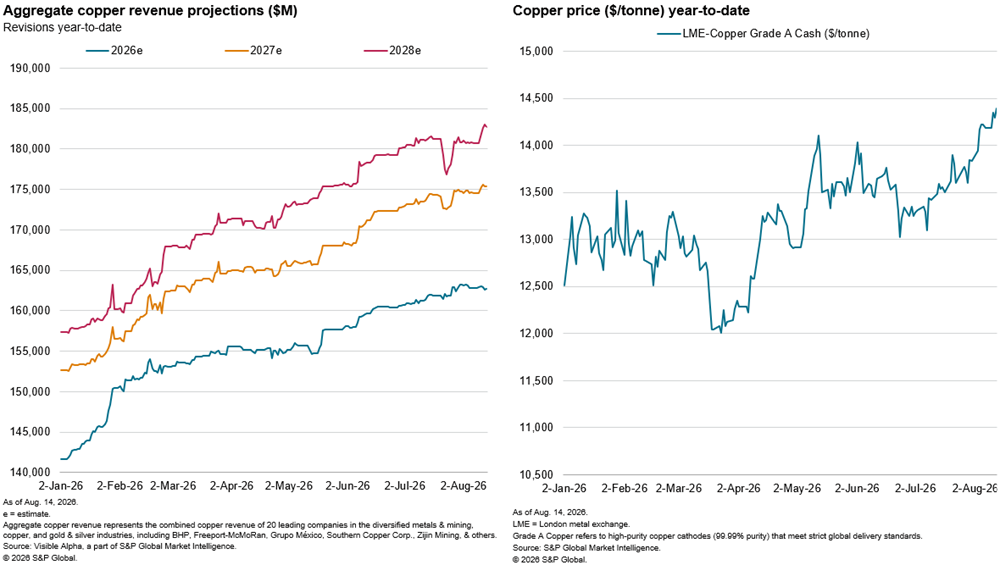
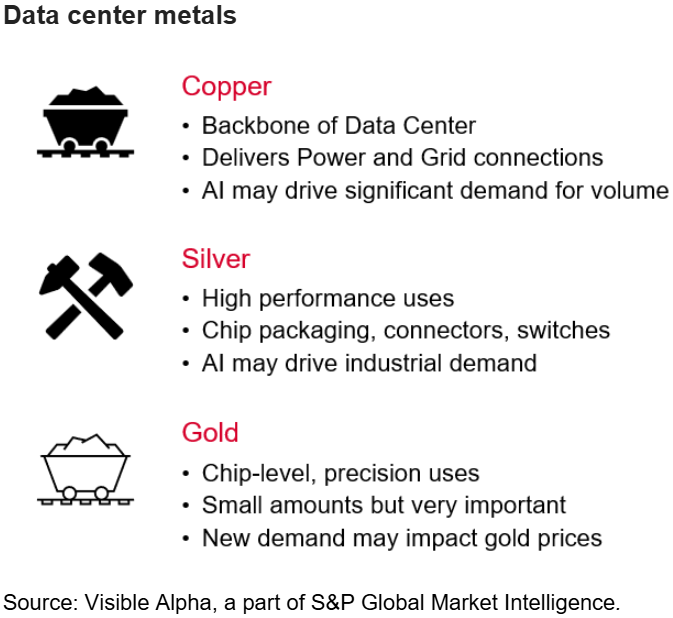
AI and data center growth is creating differentiated demand for copper and silver, with each metal serving a distinct function in the infrastructure stack. As data centers amplify their compute, they will require increasing amounts of copper to both power and cool the data center and connect to an energy source or grid. The power infrastructure surrounding the servers is copper-intensive and needs to be set up before the graphics processing units (GPUs) can operate.
Chip packaging, connectors and switches are important as GPU clusters get larger and faster in a data center and will require incrementally more silver. The package is what allows an AI accelerator to connect to HBM and the rest of the system. In addition, if the data centers move to solar power, solar cells use silver across large volumes of cells. If solar capacity ultimately grows faster than the amount of silver used per watt falls, then silver pricing may gain.
What about Apple?
In addition to the Top 10, we are monitoring the potential AI revenue trends at Apple Inc. The company released Apple Intelligence and has embedded many new AI capabilities in its latest iPhone models. These product updates have not garnered much excitement with users, and there are concerns that the new AI functionality has not been enough to make users want to upgrade their older phones. There are questions about the strategy and whether Apple may opt for a large acquisition in the space under the new CEO.
For 2026 iPhone units, expectations have increased from 240 million last year to now 262 million, due to improved upgrade expectations. However, supply constraints put the guidance below expectations and generated concerns around the outlook. Longer-term continued supply chain bottlenecks and constraints may limit Apple's ability to benefit from an upgrade cycle.
Regulatory backdrop
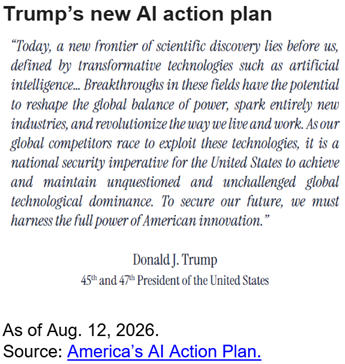
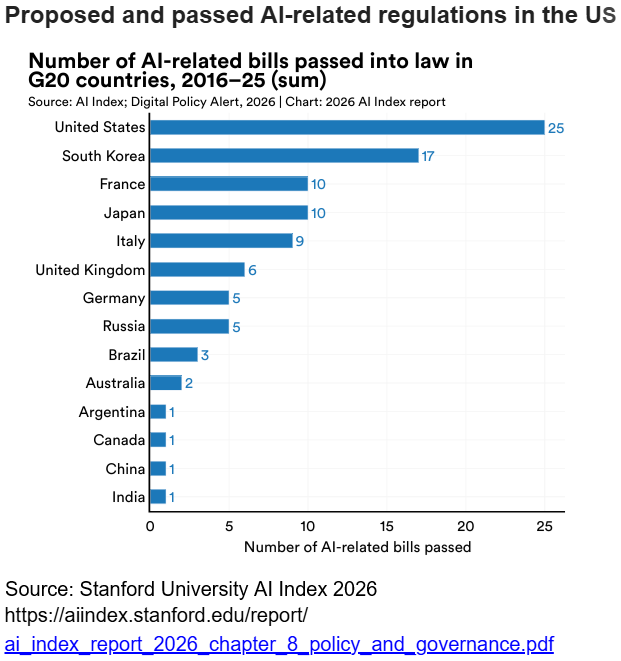
Under the current US administration, the focus has been on accelerating AI innovation and infrastructure in the US by removing red tape and too much oversight. In July 2025, the approach was replaced on the ai.gov site with President Donald Trump's AI Action Plan. There has been a clear change in direction on a few key initiatives. As the government continues to focus on AI and its implications for the US, the administration now seems to be more focused on building and securing the infrastructure, instead of trying to regulate AI.
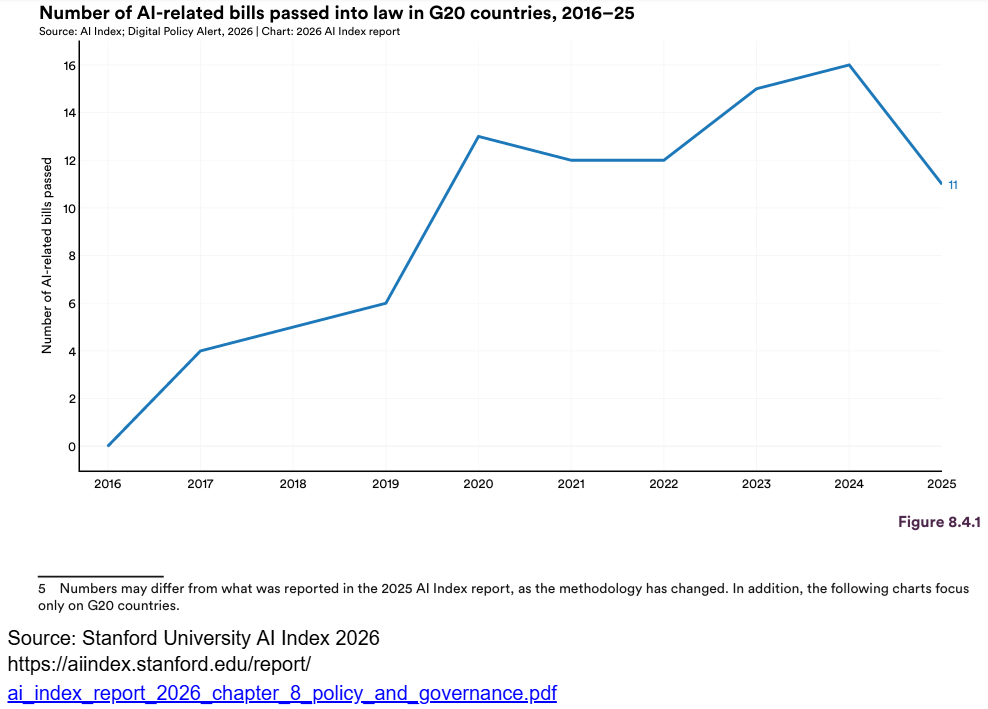
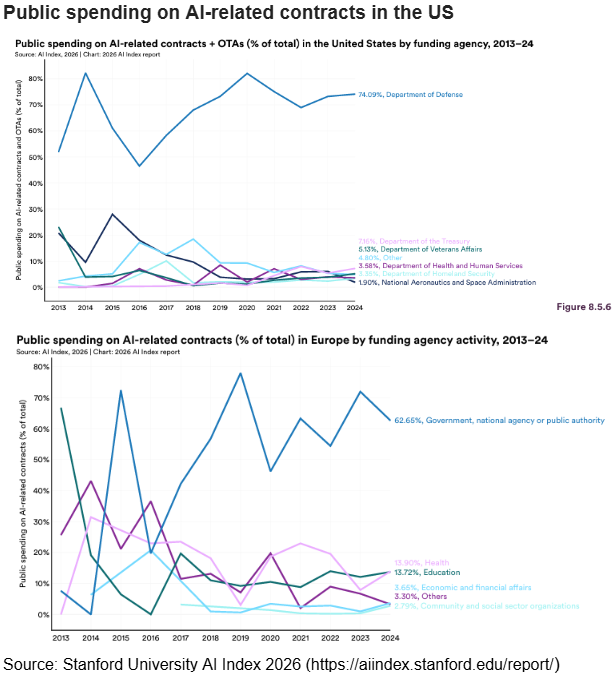
Stanford University released an update to its AI Index. The trajectory of the passed US AI regulations suggests we are likely to see further declines or flattening in 2026. In addition, the regulatory backdrop has become much more global with more focus on national AI-related issues. Most of the global AI spending also seems to be at the national or sovereign level.
In early 2025, the administration launched the Stargate Project, an AI infrastructure company that has started to build out new AI infrastructure in the US. Stargate will initially be financed by SoftBank Group Corp.; OpenAI LLC (Microsoft); Oracle Corp.; and MGX, an Abu Dhabi-based investment company backed by the government's investment ecosystem. Speaking with President Trump, Oracle Chief Technology Officer Larry Ellison, Softbank CEO Masayoshi Son and OpenAI CEO Sam Altman outlined the ambitious goals of Stargate and their initial commitment of $100 billion and the subsequent $400 billion of financing.
Final thoughts
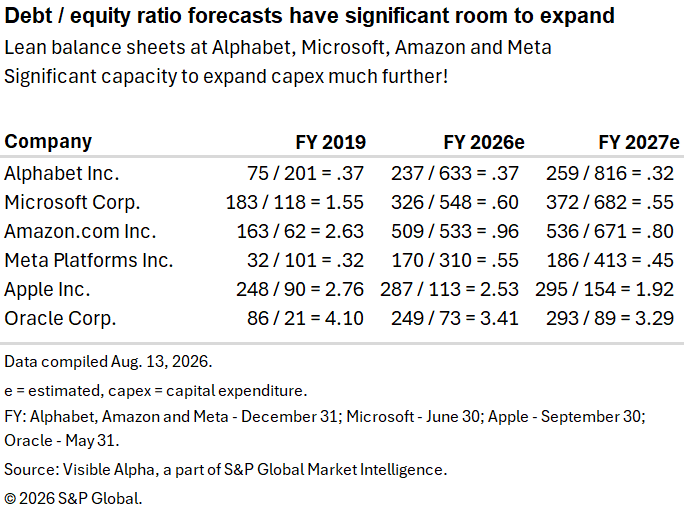
The Visible Alpha AI Monitor suggests that the AI investment cycle is entering a more mature and discerning phase. The market remains supported by extraordinary infrastructure spending, with aggregate 2026 and 2027 capex expectations exceeding $1.5 trillion and hyperscalers continuing to fund the transition toward accelerated computing. Balance sheets among the largest technology platforms still appear to have capacity to support further investment, suggesting the AI infrastructure build-out is not yet constrained by leverage. However, investor focus is increasingly shifting from "build at any cost" toward evidence of monetization, productivity gains, and sustainable earnings growth.
In 2026, AI leadership has started to broaden beyond the largest technology companies. While the Top 10 AI-exposed revenue generators continue to dominate the AI Monitor by revenue weight, smaller-cap companies have shown stronger relative stock performance in several areas, indicating that the market is beginning to reward more specific AI exposure across the supply chain. This broadening is particularly visible in memory, storage, AI servers, and data center infrastructure, where companies such as Micron, Dell and Seagate have benefited from stronger demand and upward estimate revisions.
Memory has emerged as one of the most important incremental AI themes. Demand for DRAM and HBM has intensified as AI workloads require faster, more efficient data movement between accelerators and memory. This has driven meaningful price increases and substantial upward revisions for Micron, echoing earlier revision cycles seen in Nvidia's data center business. As AI models scale and GPU clusters become larger, memory is likely to remain a critical bottleneck and a key determinant of system performance.
At the same time, the next stage of AI adoption will depend on whether enterprises can convert AI usage into measurable revenue growth, cost savings, and productivity improvements. AI agents may represent an important bridge between infrastructure investment and enterprise adoption by embedding AI into function-specific workflows across research, security, sales analytics, and customer service. However, the economic case remains dependent on reducing inference costs, improving accuracy, and proving that AI can enhance business outcomes at scale.
The AI build-out is also expanding the investment implications beyond semiconductors and software into energy, metals and physical infrastructure. Data center power demand is rising rapidly, creating potential pressure on grids, electricity prices, and commodity markets. Copper should remain a major beneficiary of large-scale power, cooling and connectivity needs, while silver demand may rise through advanced chip packaging, connectors, switches and, potentially, solar infrastructure. These second-order effects are becoming increasingly important as AI infrastructure moves from a digital theme to a physical, resource-intensive industrial cycle.
The regulatory and policy backdrop may further support this expansion. A more deregulatory US approach, combined with national and sovereign AI initiatives, is likely to accelerate domestic infrastructure investment and intensify competition around compute capacity, energy access, and strategic supply chains. Projects such as Stargate underscore the scale of public-private ambition behind AI infrastructure development.
Overall, the Visible Alpha AI Monitor points to a market that remains highly constructive on AI but increasingly selective. The first phase of the AI boom was defined by hyperscaler capex and semiconductor demand. The next phase will likely be defined by broader supply chain participation and power constraints, enterprise adoption, and measurable returns on invested capital. For investors, the key opportunity is no longer simply identifying companies exposed to AI but distinguishing those that can translate AI demand into durable revenue growth, margin expansion, and stronger long-term fundamentals.

AI Monitor goals and objectives
The objective of the Visible Alpha AI Monitor is to show the investment community which companies are likely to drive AI going forward. As the world embraces AI and its applications to enterprise workflows and our daily lives, big questions exist about how AI’s impact on company business models will unfold over the next three to five years. AI can potentially free people from tedious grunt work to enable more focus on critical workflows that require human creativity and analysis.
A primary goal of the Visible Alpha AI Monitor is to show which US companies and specific line items we are keeping an eye on as the embryonic AI theme emerges across company fundamentals and begins to scale broadly across the economy. We are monitoring how AI may be reflected in the numbers and which companies may be benefiting more or less. This universe attempts to be comprehensive and to show investors the dynamics of both the large and smaller US players. Additionally, it aims to help investors identify new names that may be smaller and less covered, but potentially growing and emerging more quickly.
AI Monitor methodology
Using Visible Alpha's comprehensive database of detailed estimates pulled directly from sell-side analysts' spreadsheet models, we have assembled an aggregation with a universe of 58 publicly traded companies that are contributing to the infrastructure and broad scaling of AI capabilities. This monitor aims to provide a current and future snapshot as to where AI-related revenues are and is not growing across each of these 58 companies, particularly the 10 largest.
We have aggregated the revenues of specific business segments at firms that are driving the wider AI trend. For larger firms, we have attempted to pinpoint where in their revenue model AI is driving growth. For some smaller firms, we are simply incorporating 100% of revenues. The AI-exposed revenue lines we identify are intended to be used as a proxy for monitoring the growth of each company’s AI business. Given both the lack of discrete company disclosures and how intertwined AI and conventional technologies and services can be, these lines should not be taken as exact quantifications of AI revenues, but are, we believe, the best systematic approximation available.
The AI Monitor provides three measures of stock performance for its universe. These metrics are meant to show the returns of various weighting schemes. The returns are calculated on both an equal-weighted and market cap-weighted basis. The universe performance of the AI Monitor is also weighted based on AI-exposed revenues and calculated in aggregate. From 2024, the return calculations were standardized, and market cap-weighted now reflects year-over-year changes.
For Visible Alpha subscribers, details of these companies can all be found within the Visible Alpha Insights platform. Each company included in the monitor has coverage by at least four sell-side analysts. In addition, given the quickly evolving state of the AI space, these line items are subject to change and may shift significantly over time. We plan to refresh the data on an ongoing basis and provide regular updates.
This article was published by Visible Alpha, part of S&P Global Market Intelligence and not by S&P Global Ratings, which is a separately managed division of S&P Global.
Content Type
Products & Offerings
Segment

