
Guide to Semiconductor Industry KPIs
This guide highlights the key performance indicators for the Semiconductor industry and where investors should look to find an investment edge.
Industry Overview
Semiconductors are materials with an electrical conductivity greater than an insulator and less than a conductor. Most semiconductors today are integrated circuits (ICs). An IC is a pint-sized electronic circuit on which thousands or millions of tiny resistors, capacitors, and transistors, are fabricated. Also known as chips, they are used in almost all electronic devices, including temperature sensors, 3D printing machines, autonomous vehicles, computers, smart appliances, solar plates, calculators, medical equipment, and LEDs, to name a few. In addition, the semiconductor industry benefits from advancements driven by artificial intelligence, 5G, the Internet of Things (IoT), and Metaverse.
In this guide, we focus not only on the semiconductor industry as a whole but also dive into the different sub-industries that are crucial to this industry’s value chain
-
Semiconductor Fabrication
-
Broadline and ICs Semiconductors
-
Other Semiconductors
-
Semiconductor Equipment
-
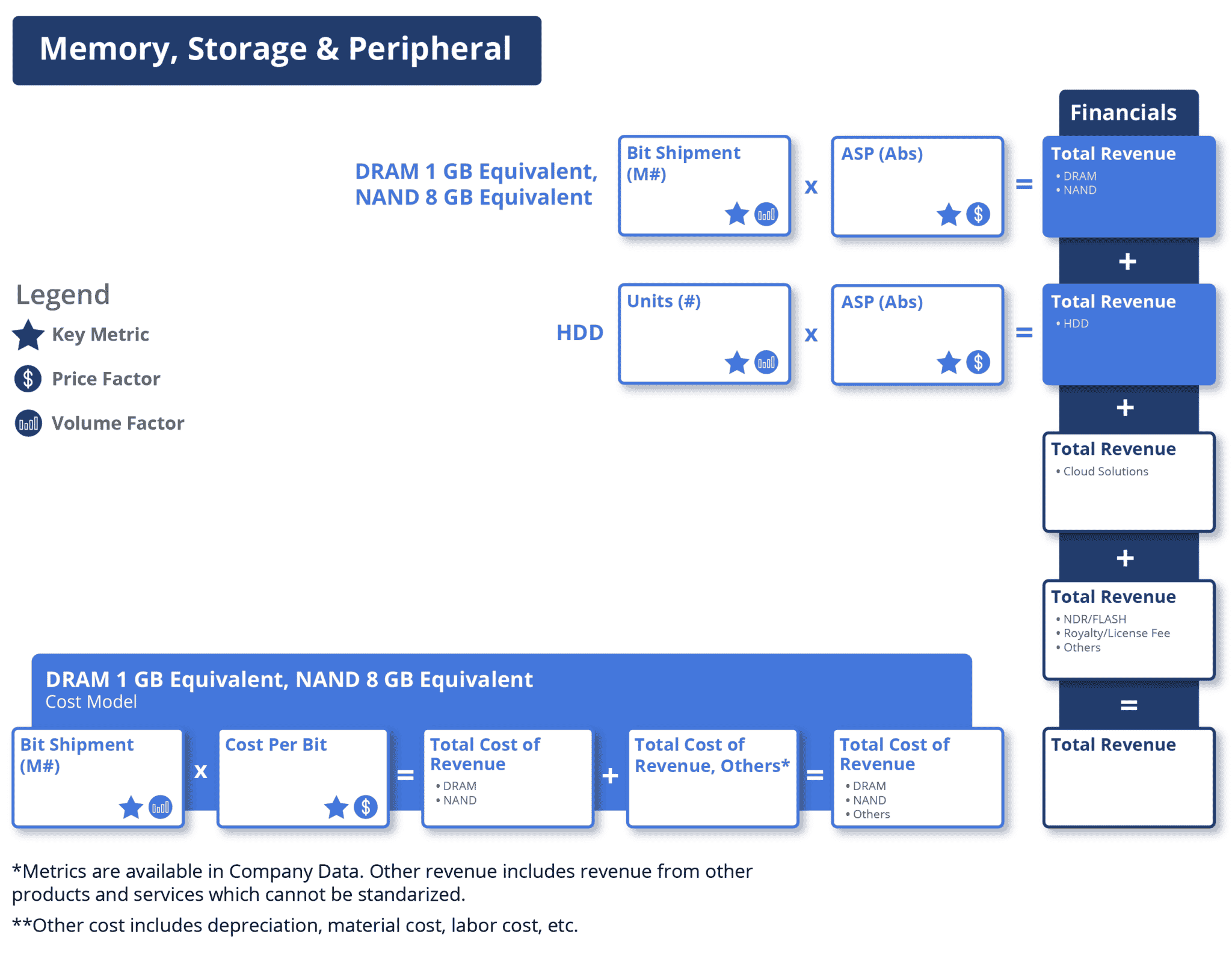
Memory, Storage & Peripheral
Fabrication is the process of manufacturing semiconductor chips. Simply put, the fabrication industry comprises semiconductor fabrication plants, also known as foundries or wafer fabs, that manufacture devices such as wafers and integrated circuits (IC), using a process known as wafer processing, wafer fabrication, or front-end manufacturing.
The broadline semiconductor industry comprises integrated device manufacturers (IDMs). IDMs design, manufacture, assemble and test ICs in-house. However, many IDMs now outsource parts of their production to external foundries. As the cost and complexity associated with designing and fabricating ICs increase, many semiconductor companies are now specialists focusing on distinct stages of semiconductor manufacturing. This includes ICs that comprise fabless companies focusing only on the R&D and designing of semiconductors while outsourcing the manufacturing to fabrication plants.
The other semiconductor industry includes a wide range of semiconductor goods and services that do not fit into any other sub-sectors of the larger semiconductor industry. The industry also comprises companies that offer semiconductor testing, assembly, and packaging services. This includes outsourced semiconductor assembly and test (OSAT) vendors that provide third-party IC-packaging and testing services. Fabrication plants, IDMs, and fabless companies often outsource their IC packaging, testing, and assembly to OSAT vendors.
The semiconductor equipment sector is closely intertwined with the semiconductor market. In theory, if the semiconductor market experiences flat growth, the semiconductor equipment manufacturing market will also experience a flat growth rate.
The semiconductor equipment industry manufactures wafer processing equipment, semiconductor assembly, packaging equipment, and other machinery used to produce semiconductors. Semiconductor device manufacturers and foundries are the main customer base for the semiconductor equipment industry.
Memory semiconductors are electronic devices used as computer memory for storing digital information using IC (integrated circuit) technology. Computer memory used in desktops and laptops, smartphones, cameras, commercial IT applications such as data centers, the telecom industry, traditional industrial applications, and connected/IoT applications are all examples of semiconductor memory devices. Computer memory consists primarily of volatile memory and non-volatile memory. Volatile memory mainly includes dynamic random-access memory (DRAM) and static random access memory (SRAM). Non-volatile memory includes NAND flash. DRAM is short-term memory, in that it temporarily stores data processed in personal computers, servers, and mobile devices. On the other hand, NAND is the long-term memory used in most computing devices today.
Key Semiconductor Industry Metrics
Key performance indicators (KPIs) are the most important business metrics for a particular industry. When understanding market expectations for semiconductors, whether at a company or industry level, some semiconductor KPIs to consider include:
Semiconductor Industry
- Gross Margin
- Capex to Sales
Semiconductor (Including Fabrication, Broadline & ICs, and Other Semiconductors)
- Total revenue - Automotives
- Total revenue - Industrials
Semiconductor Equipment
- Total Revenue - Front-end Equipment
- Total Revenue - Back-end Equipment
Memory, Storage & Peripheral
- Bits Shipment
- Average Selling Price (ASP) - NAND, DRAM, HDD

Semiconductor Industry Business Model
-
Profitability and Business Performance
As technology continually evolves, investment in research and development (R&D) is crucial for companies in the semiconductor industry. Capital expenditure covers investments in R&D, research infrastructure, plant and equipment, fabrication facility setups, and other areas in the semiconductor industry. Each semiconductor sub-industry has a different level of capital expenditure requirement. Fabrication plants and IDMs or in-house chip manufacturers require a relatively high level of capital expenditure budget to upgrade production capacity and stay ahead of the competition. Fabless companies focus on research and design of chips and outsource the entire production process function to foundries, thus avoiding high capital expenditure requirements.
Gross margin remains an important metric for semiconductor companies. A hefty portion of the cost of revenue is driven by the depreciation of plant and equipment, with the remainder being fixed and variable labor and material costs. Companies with differentiated and proprietary products tend to have higher margins.
The two most popular valuation multiples used for semiconductor stocks are the price-to-earnings (P/E) ratio and the enterprise value-to-sales (EV/Sales) ratio. P/E is generally a more volatile metric; as the semiconductor industry matures, the industry shows a declining P/E trend. In contrast, EV/Sales is a more consistent metric.
Investors may also consider enterprise value to free cash flow (EV/FCF) due to the differences in capital structures between integrated device makers and fabless companies. Some additional ratios that are relevant when analyzing companies in the industry are Debt/EBITDA, return on assets, and inventory turnover ratio.
Available Comp Tables - Consensus Estimates
Visible Alpha offers 55 semiconductor-related comp tables, across six semiconductor sub-industries, comparing forecasts for key financial and operating metrics, to make it easy to quickly conduct relative analysis, whether you are interested in looking at key values for broadline semiconductors, ICs semiconductors, memory semiconductors, other semiconductors, semiconductor equipment, or semiconductor fabrication. Every pre-built, customizable comp table is based on region, sub-industry, or key operating metrics.

Global Financial and Operating KPIs Company Examples:
North America
- NTEL CORPORATION (INTC)
- Micron Technology, Inc. (MU)
- Broadcom Limited (AVGO)
- Applied Materials, Inc. (AMAT)
- TEXAS INSTRUMENTS INCORPORATED (TXN)
ASIA
- TAIWAN SEMICONDUCTOR MANUFACTURING CO LTD (2330_TW)
- SK Hynix (000660_KR)
- ASE Technology Holding Co. Ltd. (3711_TW)
- MediaTek (2454_TW)
- Tokyo Electron Ltd (8035_JP)
EMEA
- ASML Holding N.V. (ASML)
- Infineon Technologies AG (IFXGN_DE)
- STMicroelectronics N.V. (STM)
- NXP Semiconductors N.V. (NXPI)
- SEAGATE TECHNOLOGY PUBLIC LIMITED COMPANY (STX)
Download Report
This guide highlights the key performance indicators for the semiconductor industry and where investors should look to find an investment edge, including:
- Semiconductor Business Model & Diagram
- Key Semiconductor Industry Metrics PLUS Visible Alpha’s Standardized Industry Metrics
- Available Comp Tables
- Industry KPI Terms & Definitions