Research — July 28, 2026
Tesla postQ: Revenue beat overshadowed by margin pressure

By Dharmang Sapariya
Tesla Inc. (NASDAQ: TSLA) delivered a mixed second quarter of 2026, with stronger-than-expected revenue and vehicle deliveries offset by weaker profitability.
Revenue exceeded Visible Alpha consensus expectations, supported by higher vehicle deliveries and continued growth in energy storage and services. However, profitability metrics missed expectations across key lines, reflecting pressure from pricing, product mix, and continued spending on AI, robotics, and manufacturing capacity.
Looking at earnings summaries compiled by S&P Global Pronto NLP, along with Visible Alpha pre-quarter consensus expectations and revised outlook, here are some key takeaways.
Key takeaways
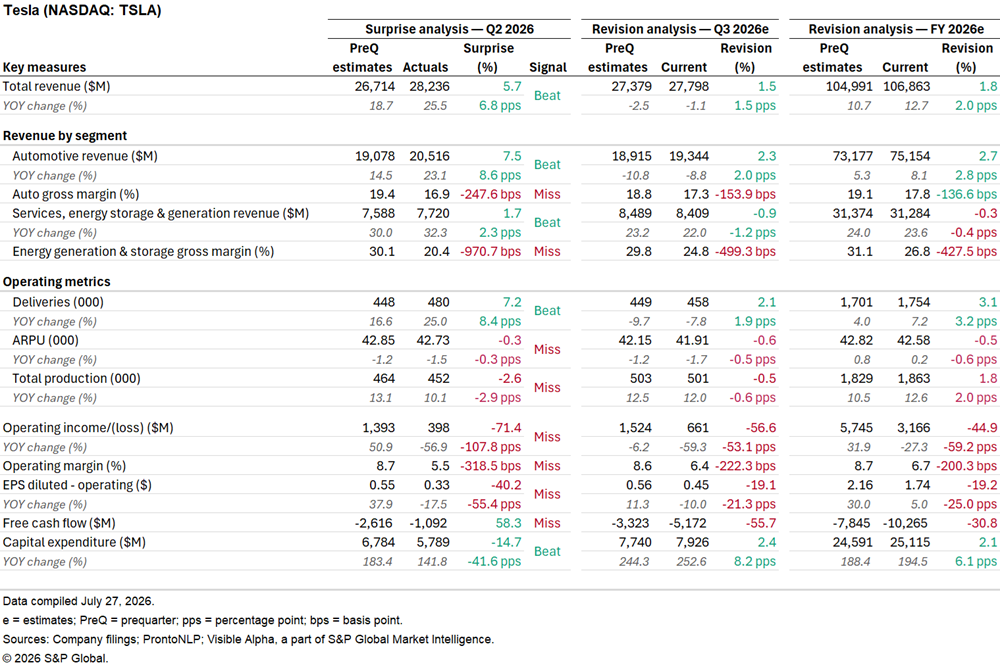
Tesla reported Q2 revenue of $28.24 billion, up 25.5% year-over-year and 5.7% above Visible Alpha consensus expecatations.
Automotive revenue increased 23.1% year-over-year to $20.52 billion, exceeding expectations by 7.5%, while Services, Energy Storage and Generation revenue rose 32.3% to $7.72 billion, 1.7% ahead of consensus.
The automotive revenue outperformance was supported by stronger vehicle deliveries. Tesla delivered 480,000 vehicles in the quarter, up 25% year-over-year and 7.2% above consensus. However, production growth was more modest, with output rising 10.1% year-over-year to 452,000 units, 2.6% below expectations, as higher deliveries were partly supported by inventory reductions rather than a significant acceleration in manufacturing.
Despite stronger sales, profitability weakened. Automotive gross margin declined to 16.9%, missing consensus by 248 basis points, while Energy Storage and Generation gross margin fell to 20.4%, 971 basis points below expectations. The margin pressure translated into weaker operating performance, with operating margin of 5.5% missing consensus by 197 basis points. Operating income came in at $398 million, 71.4% below consensus expectations, while adjusted diluted EPS of $0.33 missed consensus by 40.2%.
Cash generation remained under pressure as Tesla continued investing heavily in future growth initiatives. Free cash flow was negative $1.09 billion, although better than expected, while capital expenditures reached $5.79 billion, up 141.8% year-over-year but below consensus.
Guidance
Management reiterated that 2026 capital expenditures are expected to exceed $25 billion, broadly in line with the pre-quarter Visible Alpha consensus estimate of $24.6 billion. The company highlighted continued investment across autonomous driving, Optimus humanoid robots, Cybercab, AI infrastructure, battery manufacturing, semiconductor capacity, and solar manufacturing.
Consensus revisions
Following the earnings release, Visible Alpha consensus estimates have been revised to reflect stronger revenue expectations but weaker profitability assumptions.
Analysts have raised Q3 revenue estimates by 1.3% to $27.73 billion, while full-year 2026 revenue forecasts are up 1.9% to $106.94 billion.
Investment expectations also moved higher, with FY2026 capital expenditure estimates rising 1.6% to $24.99 billion, reflecting continued spending on AI infrastructure, robotics, and manufacturing capacity.
However, profitability expectations have been lowered. Q3 operating income estimates are down 56% to $661 million, with operating margin expectations reduced to 6.4% and diluted operating EPS estimates lowered 19% to $0.45. For FY2026, analysts have reduced operating income estimates by 44.9% to $3.16 billion, lowered operating margin expectations to 6.7%, and cut diluted operating EPS forecasts by 19.2% to $1.74.
Analysts Q&A highlights
Management highlighted progress in autonomous driving, noting that Tesla’s robotaxi fleet has completed more than 380,000 unsupervised miles across six cities without notable incidents. The company expects the fleet to expand at a double-digit weekly pace as improvements in Full Self-Driving (FSD) technology continue.
Tesla reiterated its long-term focus on AI and robotics, including Optimus, AI training capabilities, and vertical integration. Management highlighted collaboration with key suppliers, including Samsung Electronics Co. Ltd., Taiwan Semiconductor Manufacturing Co. Ltd., Panasonic Holdings Corp., and Micron Technology Inc., to support future technology development.
The company also noted strong Megapack demand from utilities and AI data centers, while regulatory discussions around autonomous driving have remained constructive. Tesla maintained expectations for autonomous capabilities in the Semi by late 2026 or early 2027 and highlighted deeper collaboration with Space Exploration Technologies Corp. to support AI and mobility initiatives.
Share price reaction
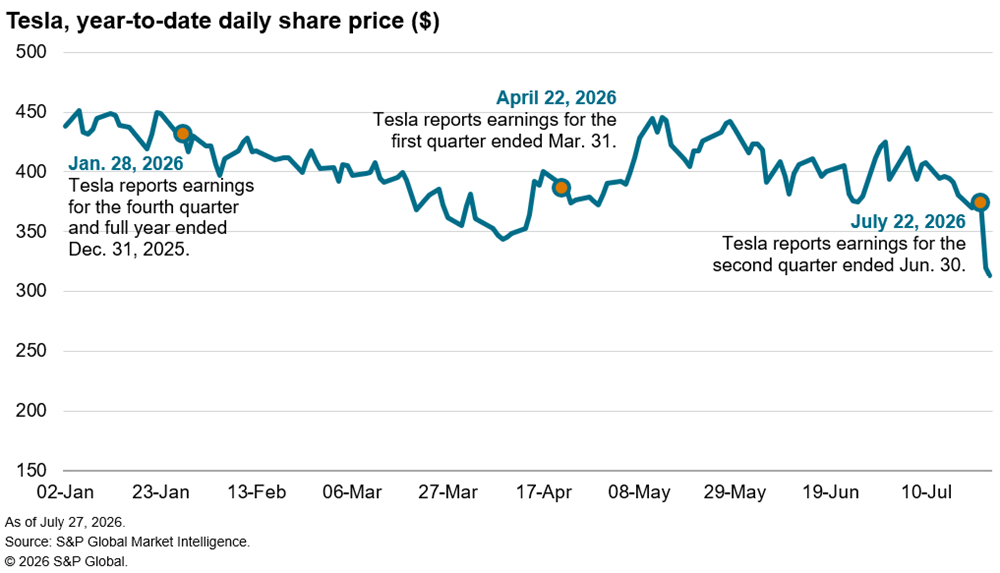
Tesla shares declined following the Q2 2026 earnings release driven by the sharp EPS miss, margin compression, and negative free cash flow.
This article was published by Visible Alpha, part of S&P Global Market Intelligence and not by S&P Global Ratings, which is a separately managed division of S&P Global.
Content Type
Products & Offerings
Segment