Research — May 7, 2026
Media Quick Take: Comcast Q1 2026: Versant out, new broadband era in
By Scott Robson, John Fletcher, Michael Johnson, Mike Reynolds, and Wade Holden
Comcast Corp.'s top line shrank 5% without Versant Media Group Inc. — the company's cable network spinoff, which went public in early January — creating a quarterly revenue reduction of about of $1.43 billion in the fourth quarter of 2025 (the most recent quarter both figures are available).
Comcast also shifted some of its reporting line-items: offering more details on wireless equipment revenue, no more details on broadband and VoIP subscribers and moving Xumo revenue into the broadband revenue line.
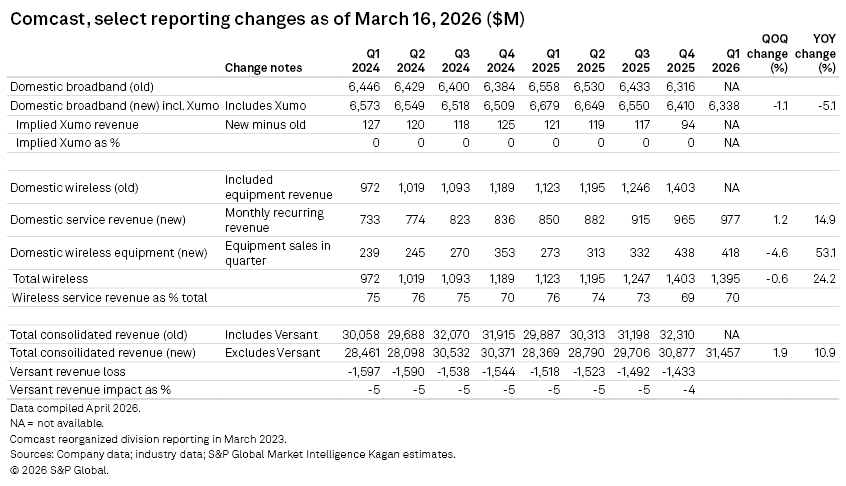
Access full data in Excel format.
But it was concerns about its broadband business that seemed to spook investors.
In a recent first, CEO Michael Cavanagh mentioned "satellite" broadband competition in the first quarter's earnings call intro, not only reminding investors about Starlink's strong 2025, but also perhaps of the Amazon low Earth orbit (LEO) launch this summer.
All-in, the slightly smaller top-line was up 11% annually to $31.46 billion, boosted by 61% annual growth in the media segment (thanks to the "Legendary February" trifecta of Super Bowl, Olympics and NBA all-stars), 21% growth in studios and 24% revenue upside in theme parks. However, Comcast's consolidated EBITDA margin was 25.2%, the second lowest in the last nine quarters.

➤ Cable network spinoff Versant, which went public on Jan. 5, at $47 per share, is now down 18% to $38.74.
➤ Despite record-high mobile phone adds of 434,000, convergence revenue (broadband and mobile recurring revenue) was down 3% annually, pulled down by a still-shrinking broadband business.
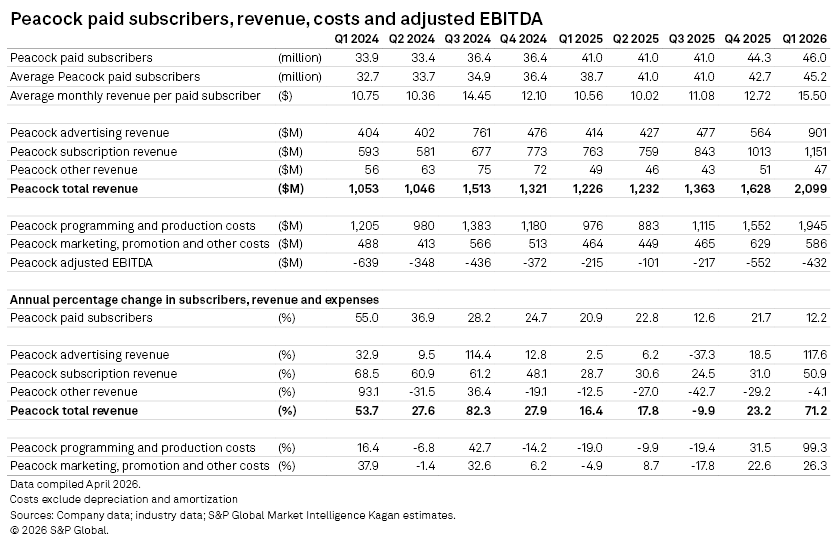
➤ Peacock subs topped $2 billion in revenue and added 1.7 million subscribers to reach a total of 46 million at the end of March.

Connectivity and platforms
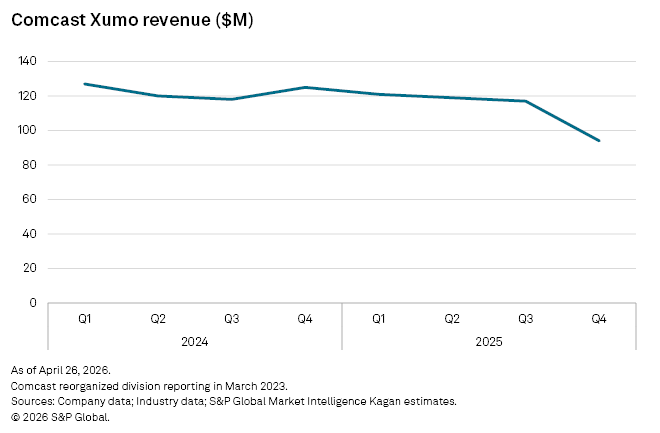
Moving Xumo revenue from "Corporate and other" into the broadband revenue line provided some details on the streaming Xumo business revenue through the fourth quarter by subtracting the new revenue figure from the old one to isolate Xumo. Unfortunately, the trend is not up, with Xumo revenue dropping to $94 million in the last quarter of 2025 compared to $127 million in the first quarter of 2024.
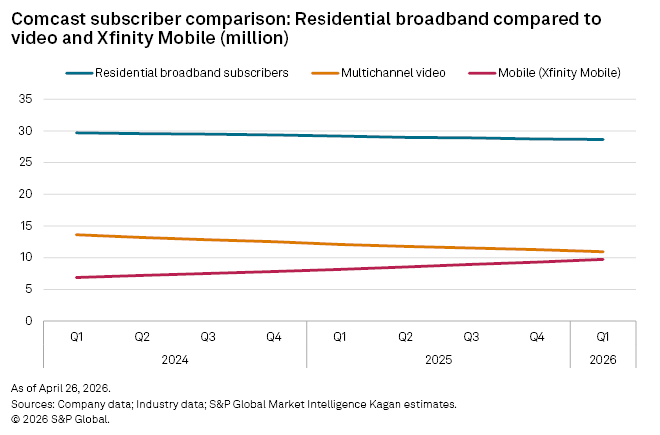
Residential broadband subs were down 65,000 in the quarter to 31.3 million, with video down 10% annually and mobile up 20%. Video and mobile are poised to cross each other at the 10 million mark.
Speaking on broadband, Cavanagh noted "the competitive environment remains intense," and "we're not assuming this gets easier anytime soon." The CEO noted aggressive marketing from both fixed wireless and fiber overbuilders and again, for the first time in recent memory, mentioned satellite as another "alternative." Domestic broadband revenue was down 5% annually, and the competition is also making a mark on the bottom line with residential connectivity and platforms EBITDA down 6% annually to $6.43 billion.
Content and experiences
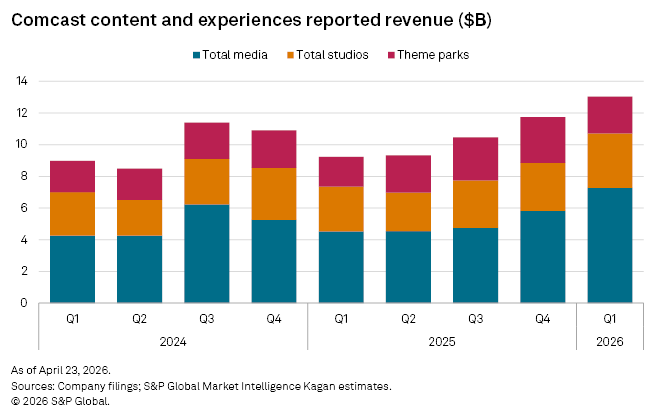
Content and experiences, Comcast's other primary reporting division, generates revenue via three segments: media, studios and theme parks. Total revenue for the segment grew 33.5% in the first quarter to $11.94 billion, with growth across all segments. This marks a new all-time revenue high for the content and experiences segment, edging out the fourth quarter of 2025.
Media
Comcast's NBCUniversal media segment delivered a standout quarter, driven by extensive live sports coverage branded "Legendary February." Major events, including Super Bowl LX, the Milan Cortina Winter Olympics, and the NBA All-Star Weekend, helped boost media revenue by nearly 61%. Even excluding the Olympics and Super Bowl, media unit revenue rose 13%, highlighting live sports as a strong growth driver for both traditional TV and streaming.
Live sports remain a major driver of premium advertising rates, with NBC averaging $8 million per 30-second Super Bowl spot. Sports programming contributed to Peacock's growth, as subscribers increased 12% year over year to 46 million and revenue nearly doubled to $2.1 billion. Despite these improvements, Peacock reported a quarterly loss of $432 million due to substantial costs for sports rights and event coverage.
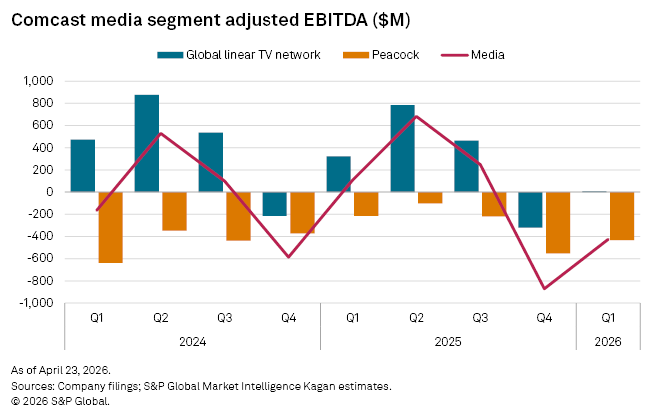
Adjusted EBITDA for the media segment fell to a loss of $426 million, driven by higher operating expenses related to the Winter Olympics, Super Bowl, and NBA rights. The straight-line amortization of NBA rights fees continued to weigh on EBITDA and is expected to impact results in the second quarter of 2026. However, with ongoing subscriber growth and increased revenue, Peacock is positioned to approach profitability in the next quarter.
Comcast's media segment reported total quarterly revenue of $7.28 billion, with Peacock accounting for 28.9% of the total. Domestic distribution revenue rose 37.0% to $2.28 billion, or 21.3% to $2.02 billion when excluding the Olympics. Domestic advertising revenue increased 135.2% to $3.45 billion, driven by the Super Bowl and Olympic coverage, and grew 4.7% to $1.54 billion when excluding these events. NBCUniversal is expected to see further advertising growth in the second quarter of 2026 with the NBA playoffs and FIFA Men's World Cup.
NBC's strong sports roster made it the most-watched network in February, averaging 3.9 million viewers, a 37.8% year-over-year increase. More than 225 million Americans tuned into NBCUniversal's coverage, with the Winter Olympic Games averaging 23.5 million viewers, Super Bowl LX setting records with 125.6 million average viewers, and the NBA All-Star Game drawing its largest audience since 2011.
Peacock
Peacock's results in the first quarter benefited significantly from streaming the Winter Olympic Games, Super Bowl LX and NBA action (including the All-Star Game). The service added about 2 million net new subscribers, bringing total paid subs to 46.0 million, and quarterly revenue of $2.10 billion soared 71.2%. Advertising revenue of $901 million was up 117.6% from $414 million in the first quarter of 2025, with ad sales related to one-time events such as the Olympics and Super Bowl boosting first quarter 2026 results but not present in the prior-year quarter. Subscription revenue growth was strong as well, growing 50.9% on a year-over-year basis to reach $1.15 billion.
Growth came at a cost on the expense side of the ledger, however, as Peacock programming and production costs nearly doubled to $1.95 billion while marketing and promotional costs rose by 26.3%. Access to live sports programming has been a key differentiator and an important customer-acquisition tool for Peacock, but related sports rights and production costs have been a drag on profitability. Peacock reported an adjusted EBITDA loss of $432 million in the first quarter, roughly double the adjusted EBITDA loss of $215 million in the prior year quarter. Company executives noted that the first quarter would represent the peak of NBA coverage-related costs at Peacock (and the Media business overall), with Peacock losses expected to improve as 2026 progresses.
Studios
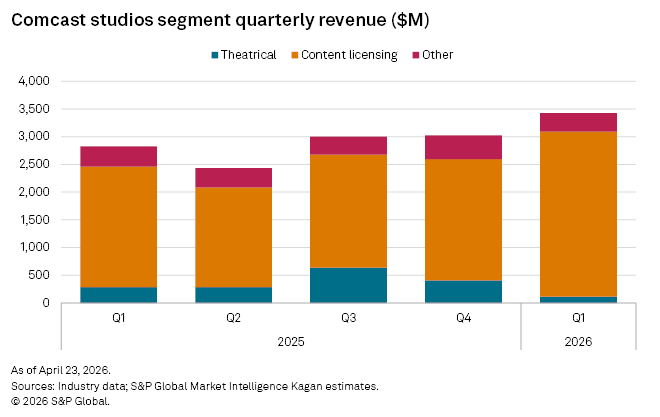
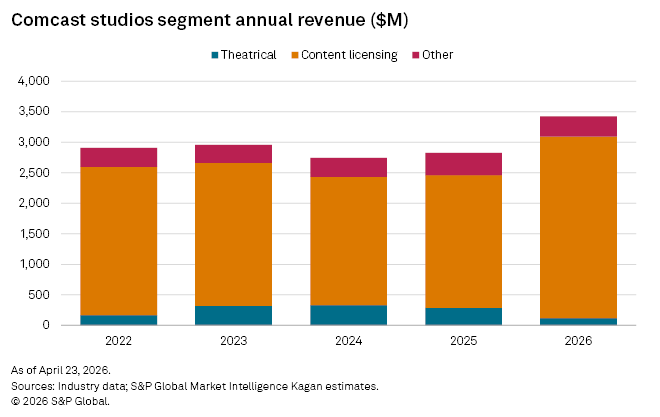
Comcast's studios segment reported a 21.2% increase in 2026 first quarter revenues, recording nearly $3.43 billion in total revenue compared to almost $2.83 billion in the first quarter of 2025. Total first-quarter revenue grew 13.2% from $3.03 billion in the fourth quarter of 2025.
Content licensing revenue was $2.97 billion in the first quarter of 2026, up 36.8% from the first quarter of 2025. "Content licensing revenue increased primarily due to the timing of when content was made available by our television studios, primarily driven by a renewed licensing agreement for content exclusively available for streaming on Peacock," according to Comcast's press release.
Theatrical revenue decreased 59.1% year over year in the first quarter, from $286.0 million in 2025 to $117.0 million in 2026. Other revenue decreased 8.2% to $336.0 million in the first quarter of 2026.
NBCUniversal, the Comcast subsidiary where all the production studios reside, released five films in theaters in the first quarter of the year, two of which were re-releases. The five films have grossed nearly $91.7 million in worldwide box office through April 19. They have grossed $52.2 million domestically and nearly $39.50 million internationally.
"Reminders of Him" is the top-grossing film of the first quarter of 2026 with $48.2 million in domestic gross and $38.7 million in international gross, combining for $86.9 million in worldwide box office. The Focus Features film "Midwinter Break" was a very distant second with almost $1.8 million in worldwide box office.
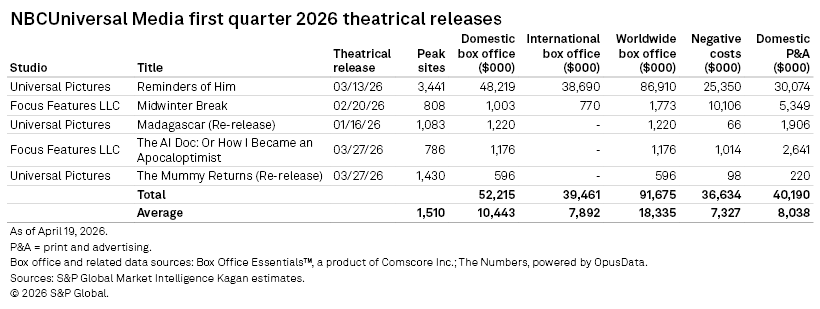
NBCUniversal kicked off the start of the second quarter with a big bang, releasing "The Super Mario Galaxy Movie" on April 1. The film is a huge hit, grossing almost $756.6 million worldwide through April 19. "You, Me & Tuscany" hit theaters on April 10 and has earned just $16.8 million worldwide. Universal's next second quarter release won't be until June 12, when "Disclosure Day," Steven Spielberg's latest alien invasion thriller, hits theaters.
NBCUniversal theme parks
Buoyed by continuing strength from the bow of Epic Universe in Orlando last May, segment profits jumped by a third in the opening quarter of 2026.
First-quarter revenue increased 24.2% year over year to $2.331 billion from $1.876 billion. Operating costs, largely tied to Epic, increased 21.6% to $1.780 billion from $1.463 billion. The higher revenue advance, though, led to a 33.3% rise in adjusted EBITDA to $551 million from $413 in the prior-year period.
Comcast CFO Jason Armstrong said on the earnings call that adjusting for the roughly $100 million of preopening costs at Epic in last year's first quarter, EBITDA would have grown over 7%.
“We are really pleased with Epic's performance since its launch,” he said. “It's expanding the overall guest experience and helping to position Universal Orlando as a true weeklong destination.”
That remark echoed Comcast co-CEO Mike Cavanagh, who said Orlando continues to perform extremely well, with Epic “driving strong resort attendance and higher per-cap spending.”
The performance at international parks was not as strong. Armstrong said there has been some impact on attendance at Universal Studios Osaka from China-related inbound travel trends. At Universal Beijing Resort, the company is “navigating a more challenging macroeconomic environment.”
Cavanagh, who noted the theme parks still have not returned to pre-COVID attendance levels, said the domestic venues have yet to feel any impact from the US-Iran war and resultant higher oil costs, and their effect on gas and jet fuel pricing.
“But I think that does not mean that it may not happen depending on the duration of the effect on price of gas and the like, and airline tickets and so forth,” he said.
US Broadband & Pay TV Trends is a regular feature from S&P Global Market Intelligence Kagan.
This article was published by S&P Global Market Intelligence and not by S&P Global Ratings, which is a separately managed division of S&P Global.
Content Type
Segment
Language