ECONOMICS COMMENTARY — 02 Nov, 2026
US manufacturing PMI holds close to highest since 2022 as price pressures build

US factories continued to report strong growth in October, sustaining the sector’s best growth spell since early 2022. However, growing pains are clearly evident, with factories struggling to meet strong demand, especially for AI-related goods and equipment, amid supply chain disruptions. Delivery delays, often linked to shipping and logistics issues, are more widespread than at any time since 2022.
With demand often exceeding supply, producers have been increasingly able to pass higher costs on to customers, notably for energy-related inputs. October consequently saw another leg-up in terms of manufacturers’ selling price inflation to the steepest since September 2022. Such steep growth in factory gate prices will inevitably feed through to consumers in the coming months, keeping inflation well above the Fed’s target and adding to pressure on policymakers to raise interest rates further.
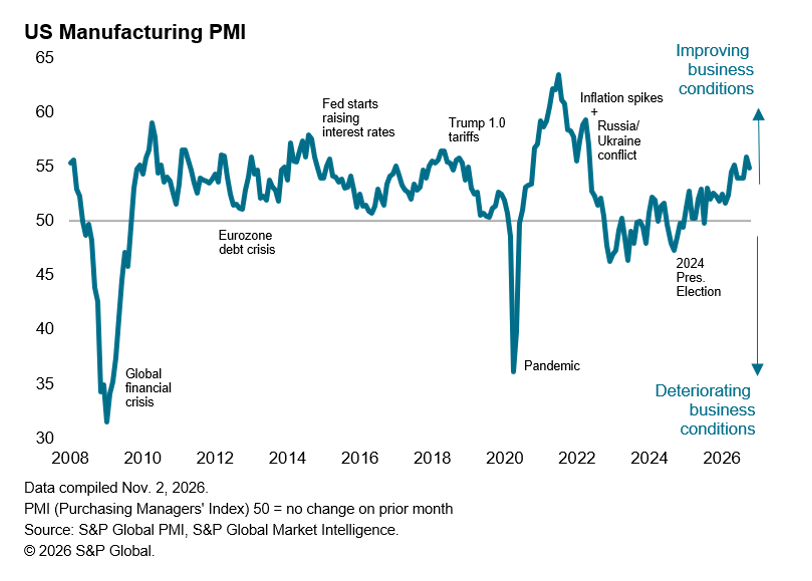
Manufacturing growth remains robust
The headline S&P Global US Manufacturing PMI recorded 54.9 in October. While that is down from 55.9 in September, it is the third-highest since May 2022 and points to a sustained strong expansion of factory activity.
The S&P survey has provided an especially reliable indication of changing manufacturing production in recent years, having a 69% long-term correlation with official production growth (on a three-month-on-three-month basis). That compares, for example, with a 61% correlation for the ISM output index over the same period.
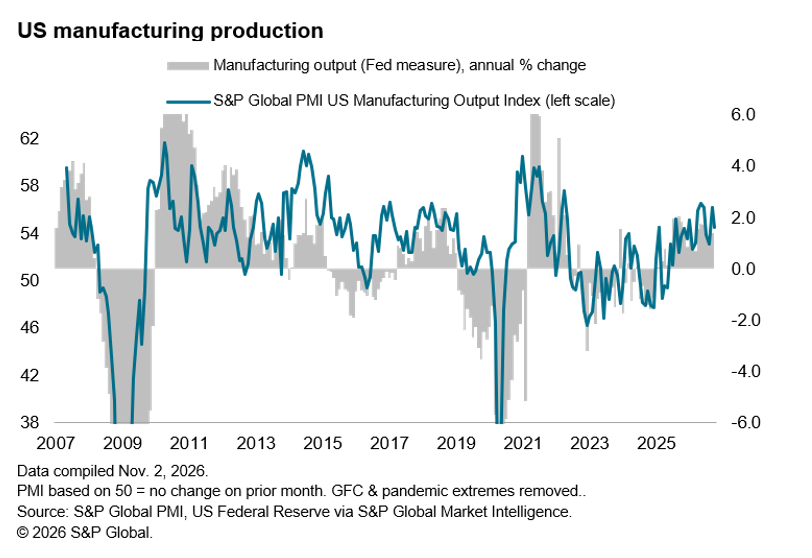
Rising demand buoys order book growth
The survey data indicate that factory output is being buoyed by rising orders, which have grown in volume terms recent months at rates not beaten since 2022. However, growth of both overall new orders and export orders are even more impressive in value terms, as prices charged by US manufacturers have increased sharply in recent months. (PMI volume terms data can be converted to a value-based series by adding the change in the PMI prices charged index over the prior month, as per charts below).
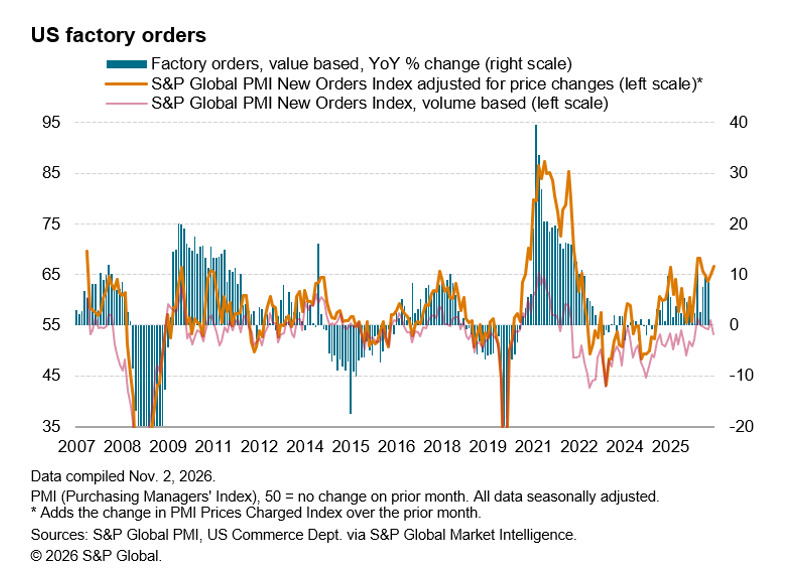
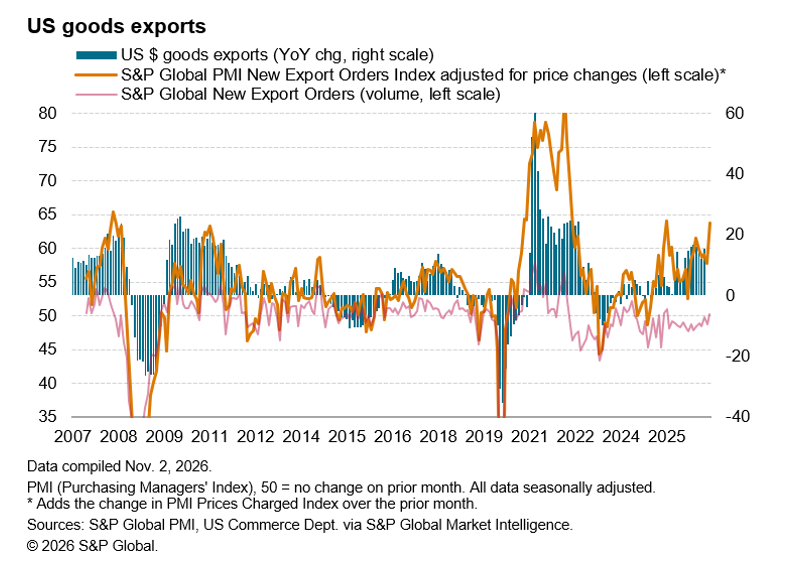
Selling prices rise at fastest rate since 2022
The latest rise in selling prices was notable in being the largest since September 2022, indicating a marked uplift in inflationary pressures at the factory gate.
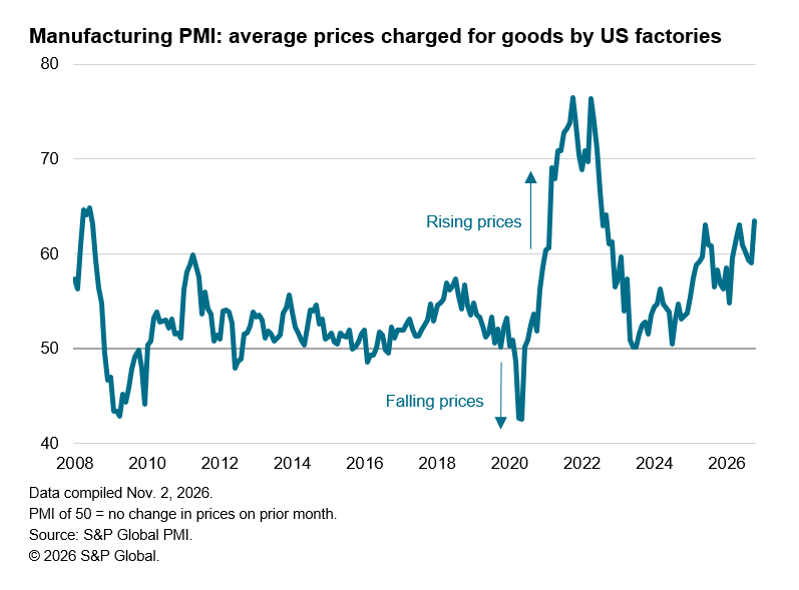
The sustained robust order book growth in the face of high and increasing selling prices reflects solid demand in many markets, often with customers reportedly less price sensitive than usual. This is particularly notable for producers where AI-related investment spending and precautionary stock building is reported as driving sales, often meaning demand is cited as running ahead of supply.
Higher costs linked to energy prices and supply delays
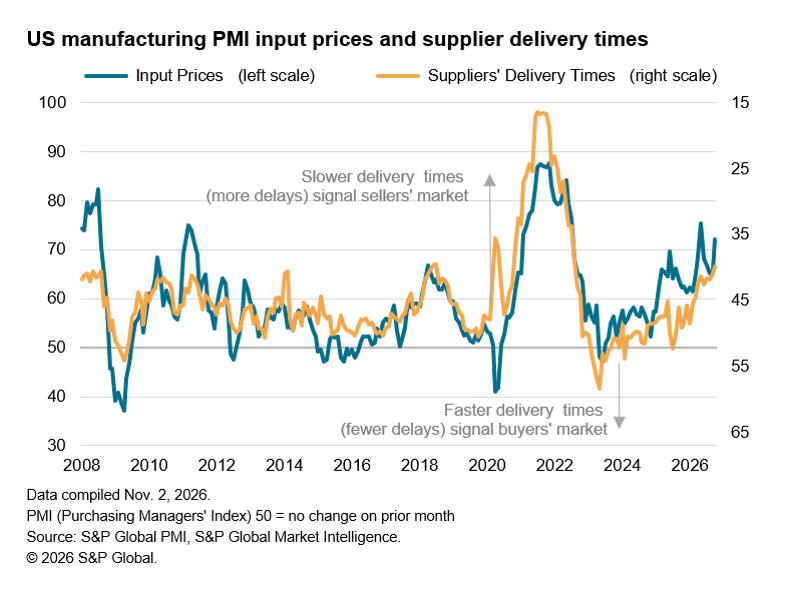
High selling prices reflected high cost growth, with input prices for raw materials into factories also rising at an increased rate in October. The overall rate of input cost inflation hit the second-highest for over four years.
While a key driver of higher cost growth was the further upturn in oil and broader fuel, energy and transportation costs during the month, supply shortages intensified. Supply delays have the effect of handing greater pricing power to suppliers, as buyers struggle to source goods. Average supplier delivery times lengthened to the greatest extent since mid-2022, building on prior lengthening seen in recent months, especially since the onset of the conflict in the Middle East but also reflecting reduce global supply on the back of tariff-related supply chain disruptions.
Outlook
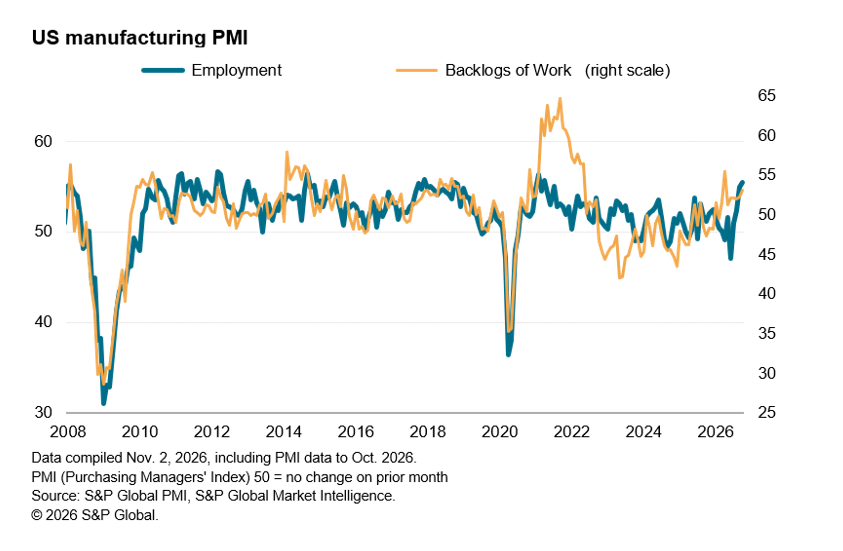
The increasingly widespread difficulties reported in producers servicing high demand resulted in a further improvement in the hiring trend in October, as companies sought to boost productive capacity. Backlogs of uncompleted work nevertheless continued to rise at one of the fastest rates seen for over four years, adding to the sense of additional pricing power developing in the US manufacturing sector.
The sustainability of this pricing power depends on the resilience of demand, however, and the added inflationary pressures signalled in October will likely add to speculation of another rise in the Fed’s fund rate before the end of the year, which should serve to temper demand growth.
Access the latest PMI press release here.
© 2026, S&P Global. All rights reserved. Reproduction in whole or in part without permission is prohibited.
Purchasing Managers' Index™ (PMI®) data are compiled by S&P Global for more than 40 economies worldwide. The monthly data are derived from surveys of senior executives at private sector companies, and are available only via subscription. The PMI dataset features a headline number, which indicates the overall health of an economy, and sub-indices, which provide insights into other key economic drivers such as GDP, inflation, exports, capacity utilization, employment and inventories. The PMI data are used by financial and corporate professionals to better understand where economies and markets are headed, and to uncover opportunities.
Read our latest PMI commentary here.
This article was published by S&P Global Market Intelligence and not by S&P Global Ratings, which is a separately managed division of S&P Global.
Theme
Location
Products & Offerings