Research — Oct 08, 2026
US prediction market trades are predominantly sports-based

By Keith Nissen
While there are many differences, the one thing that prediction market platforms have in common with traditional sportsbooks is users, according to Kagan’s recent online consumer survey.

➤ Ten percent of surveyed internet adults said they have placed prediction market trades over the past year, and 70% of prediction market users traded on sports outcomes.
➤ Twenty-three percent of internet adults placed either sportsbook bets or prediction market trades over the past year, while 21% bet on sports through either a traditional sports book or the prediction market.
➤ Prediction market users are heavily skewed toward being young adult men under 35 years of age.

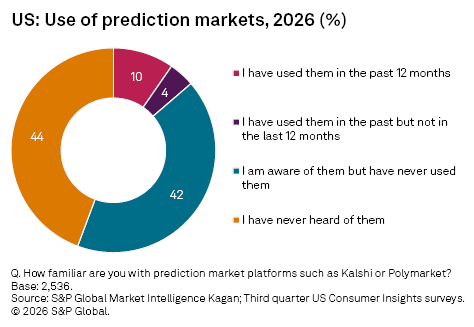
The S&P Global Market Intelligence Kagan US third-quarter 2026 Consumer Insights survey asked respondents about their use of prediction market platforms. Ten percent of total respondents said they had participated in the prediction market over the past year, while another 4% cited using a prediction platform in the past. Due at least in part to widespread advertising during live sporting events, 42% indicated they were aware of prediction market operators but had not used them. The largest percentage, 44%, reported they had never heard of the prediction market.
The two major operators in the prediction market are Kalshi and Polymarket (US). Other prediction market participants include DraftKings Predictions, FanDuel Predictions, and Robinhood Predictions, to name just a few.
Prediction markets differ from sportsbooks in that they are financial exchanges allowing users to trade on "yes/no" outcomes for a wide range of future events, spanning live sports to political elections, financial and world events, weather and entertainment-related events. One unique category of trades is mentions, where individuals predict the frequency of specific words used in public discourse, such as whether the President will use certain words in an upcoming speech. Media analysts are increasingly using prediction market statistics to assess consumer attitudes regarding future outcomes, such as potential election results.
Unlike sportsbooks, where individuals are betting against the house (which sets fixed odds), prediction markets operate as peer-to-peer exchanges, with operators only charging a transaction fee on winning contracts. The contract prices range from 1 cent to 99 cents, with lower-priced contracts perceived to have a low probability of occurring (with a high payout) and, correspondingly, higher-priced contracts are believed to have a high probability and low payout. Contract pricing is set by supply and demand (amount of yes/no money) related to a specific outcome. If the outcome occurs, then "yes" contract holders receive their contract value and "no" contract holders lose their investment. Contracts can be bought and sold prior to an outcome based on the fluctuating price of the contract.
While the types of events that can be traded are nearly limitless, the survey asked prediction market users which category of trades they have participated in. For example, 70% said they had traded on sports-related outcomes, compared to 36% trading on economic or financial outcomes and 33% trading on political outcomes. Approximately one-quarter (26%) indicated they had traded on news and entertainment outcomes, and 11% cited trading on other outcomes, such as word mentions, weather or cryptocurrency.
The survey found that 21% of surveyed internet adults either placed a sportsbook bet or traded on a sports outcome over the past year. Another 2% of internet adults indicated they traded only non-sports outcomes during the past 12 months. Based on this data, Kagan estimates that approximately 23% of US internet adults use either sportsbooks and/or prediction market trading exchanges.
The survey data also shows that the majority of those trading on non-sports outcomes also trade on sporting events. For example, 68% of those placing trades on political outcomes also traded on sports outcomes. Approximately half of those trading on news and entertainment outcomes also traded on elections (49%) or economic outcomes (56%). Four in ten (44%) prediction market users trade in multiple event categories (1.7 event categories, on average).
Prediction market traders are heavily skewed toward being younger adults. For example, the survey found that 61% of those making prediction market trades were adults under 35 years of age. Only 13% were adults 55 years of age or older. Two-thirds (66%) of prediction market traders were men. Prediction market traders tended to be spread across all states, rather than skewed toward states where sportsbook gambling is prohibited. The survey data shows a correlation with crypto, as 55% of prediction market traders reported buying and/or selling cryptocurrency over the past year.
The Kagan Q3 2026 US Consumer Insights survey was conducted in August of this year, consisting of approximately 2,500 internet adults. The margin of error is +/-1.9 ppts at the 95% confidence level. Survey data should only be used to identify general market characteristics and directional trends.
Consumer Insights is a regular feature from S&P Global Market Intelligence Kagan
This article was published by S&P Global Market Intelligence and not by S&P Global Ratings, which is a separately managed division of S&P Global.
Content Type
Theme
Segment
Language