Research — Oct 29, 2026
NBA tips off 2nd year of media deals with surging viewership and expansion plans

The National Basketball Association Inc. (NBA) enters the second year of its landmark media rights agreements with NBC (US), ABC (US)/ESPN (US) and Amazon.com Inc., building on a season of soaring viewership and renewed excitement. This year's tip-off comes on the heels of the New York Knicks capturing their first championship in 53 years, electrifying one of basketball's most storied fan bases. With momentum at an all-time high, the league is pushing forward with ambitious expansion plans, both in the US and internationally through the development of NBA Europe, signaling a new era of growth and global reach for professional basketball.

➤ The NBA is entering the second year of its media rights deals, driving a dramatic increase in viewership and fan engagement.
➤ NBA media coverage is more diversified than ever, with fans needing multiple national and local subscriptions for complete access.
➤ Domestic and international expansion is a top priority, with NBA Europe on track for a 2027 launch and global partnerships extending the league's reach and brand visibility.
➤ Franchise values are surging, as seen in the record-setting Lakers sale, while the NBA continues to lead in technology, betting integration and direct-to-consumer (DTC) strategies.

NBA media deals enter Year 2 after strong start
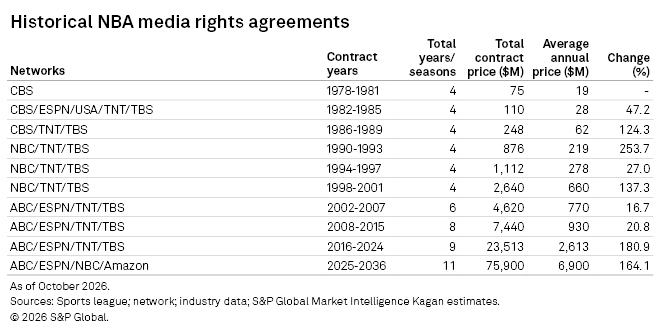
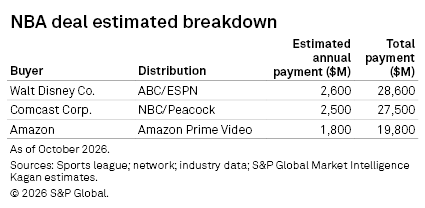
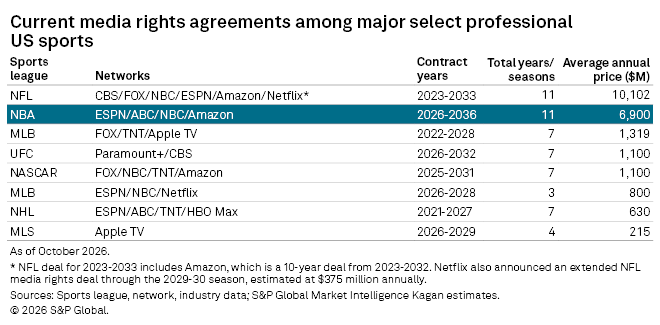
The NBA's 11-year $76 billion media partnership with Walt Disney Co., NBCUniversal Media LLC and Amazon enters its second year, bringing a 164% increase in annual value and solidifying its place as the second-largest US sports media deal after the NFL. The agreements combine streaming, broadcast and cable platforms, requiring fans to subscribe to multiple services for complete game access. With NBC and Amazon now firmly in the mix, the deals brought both innovation and nostalgia during the first season, enhancing the viewing experience for basketball fans.
ABC and ESPN
Disney is investing approximately $2.6 billion annually to broadcast nearly 80 NBA regular season games each year on ESPN and ABC, including exclusive coverage of the NBA Finals and one Conference Final. Disney also began streaming NBA games internationally last season on Disney+ in select markets, expanding ESPN-branded NBA content across Latin America, Africa, Oceania and the Netherlands. Disney extended its reach to 11 European countries this year, spanning the Baltic region (Estonia, Latvia and Lithuania), Bosnia & Herzegovina, Croatia, Czechia, Greece, Hungary, Portugal, Romania and Slovakia.
Meanwhile, "Inside the NBA" will increase its presence in the 2026-27 season, making 25 regular-season appearances across ESPN and ABC, up from 20 last year. The show will kick off during NBA Opening Week with broadcasts on October 21 and 22, and continue throughout the fall, including a special Christmas Day episode. Charles Barkley has hinted this could be his final year as part of the broadcast team.
NBC and Peacock
Now in the second year of its NBA media rights deal, Comcast Corp.'s NBCUniversal is paying $2.5 billion annually for a robust slate that includes Monday and Tuesday night games, Sunday night matchups following the NFL season, and exclusive coverage of NBA All-Star Weekend.
Michael Jordan is not expected to return to NBC Sports' NBA coverage for the upcoming season. Last year, his involvement was limited to a single interview with Mike Tirico, which NBC aired in several segments throughout the season. While Jordan's insights were compelling, his appearances were infrequent and didn't address current NBA events. Meanwhile, Basketball Hall of Famer Doc Rivers is joining NBC's NBA coverage as a game analyst across NBC, Peacock and NBCSN, with the possibility of some studio work.
Amazon Prime Video
Amazon is investing $1.8 billion annually to broadcast games on Prime Video, featuring Thursday, Friday and Saturday night matchups. Prime Video's 2026-27 NBA schedule kicks off October 23 with a doubleheader, reigning champion Knicks vs. Boston Celtics and Houston Rockets vs. San Antonio Spurs. This season also marks Prime Video's first exclusive presentation of the Eastern Conference Finals, a major milestone in its NBA coverage.
Prime Video will spotlight the Emirates NBA Cup In-Season Tournament, including a Black Friday doubleheader and the tournament's championship at Butler University's Hinkle Fieldhouse, as well as host NBA Global Games in Paris and Manchester. The platform's extensive international reach, available in over 240 countries, has reportedly contributed to a nearly 30% year-over-year increase in global NBA viewership on Prime. Amazon's partnership with AWS brings cutting-edge data and analytics to broadcasts, including metrics like Defensive Box Score and Shot Difficulty, enhancing the viewing experience.
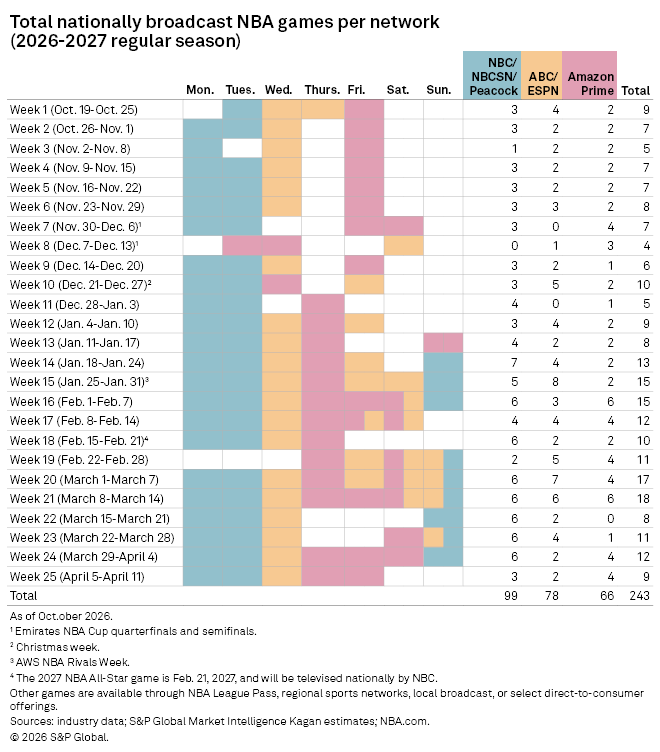
The NBA's 2026-27 schedule features a similar number of national games compared to last season, with the Sixers, Knicks, Lakers and Spurs each receiving the maximum 34 national TV appearances.
NBA international media rights
The NBA's global media strategy now combines regional pay TV with enhanced streaming, highlighted by an 11-year deal with Amazon to broadcast games, including six NBA Finals, and distribute NBA League Pass worldwide. China remains the league's top international market through a $1.5 billion Tencent deal. TNT (US) Sports lost live game US rights prior to last season but kept digital highlights and international rights in Latin America and Europe. In Canada, Sportsnet and Bell Media Inc.'s TSN share national coverage, with Amazon set to begin live-game rights in 2026-27. Other broadcasters like beIN Media Group Sports, DAZN Group ltd. and Sky Sports Limited continue to carry NBA games in key international markets.
NBA Europe aiming for 2027
The NBA is accelerating plans to launch NBA Europe in fall 2027, aiming for a 16-team league in major cities like London, Paris, Munich and Madrid. Interest is high, with over 120 franchise bids ranging from $500 million to $1 billion, and advanced talks ongoing with European soccer powerhouses and US investors.
While EuroLeague's owners rejected the NBA's initial merger proposal as of October 2026, negotiations continue, and the NBA is committed to moving forward with or without EuroLeague's participation, working with FIBA to complement existing basketball structures.
Meanwhile, the NBA is boosting its European brand through high-profile games, such as the sold-out 2027 Manchester debut between the Pelicans and Spurs. The league's vision is to blend top competition with commercial and developmental strengths, supported by new arena projects and global investor interest.
Consumer Insights highlights NBA's global popularity
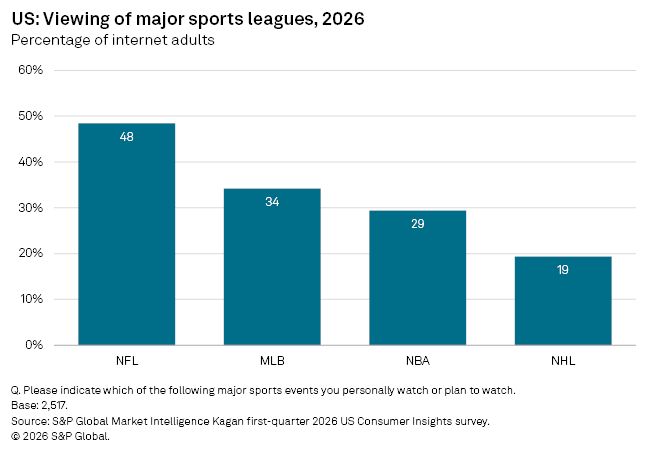
The S&P Global Market Intelligence Kagan first-quarter 2026 Consumer Insights survey highlights the NBA's strong position in the American sports landscape and its growing international appeal. In the US, basketball remains one of the most popular sports, unsurprisingly, with 29% of Americans reporting that they watch NBA games. While this trails the NFL, which is watched by about half of Americans, and MLB at 34%, the NBA still outpaces the NHL, soccer, tennis, golf and motorsports. The league's audience is also notably younger and more engaged among moderate and avid sports fans, with about one-third of these viewers under 35, compared to the more senior-skewing "casual" fan base that dominates football and baseball.
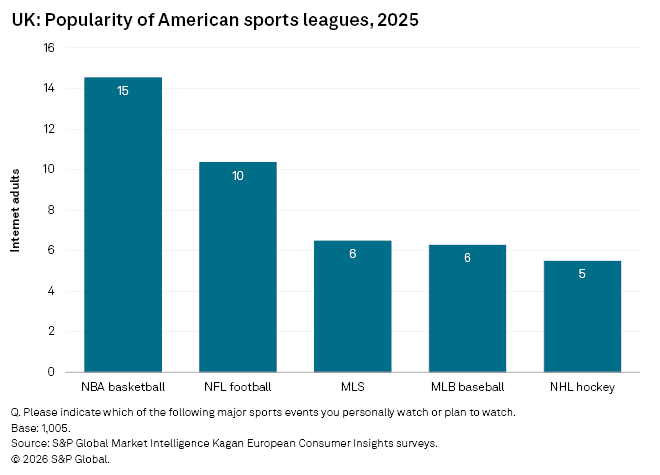
Internationally, the NBA stands out as the most popular American professional sports league in several key European markets. In the UK, 15% of adults watch NBA basketball, making it the leading US sport ahead of the NFL, and basketball's popularity is on the rise, with viewership up six percentage points year over year. Italy also demonstrates the NBA's strength, with 12% of internet adults watching NBA games, four times the number following the NFL. In France, the NBA is the most-watched American league, particularly among avid sports fans, while in Germany, 9% of adults watch NBA basketball, outpacing other American leagues such as the NFL and NHL.
Record setting viewership in first year of media deals
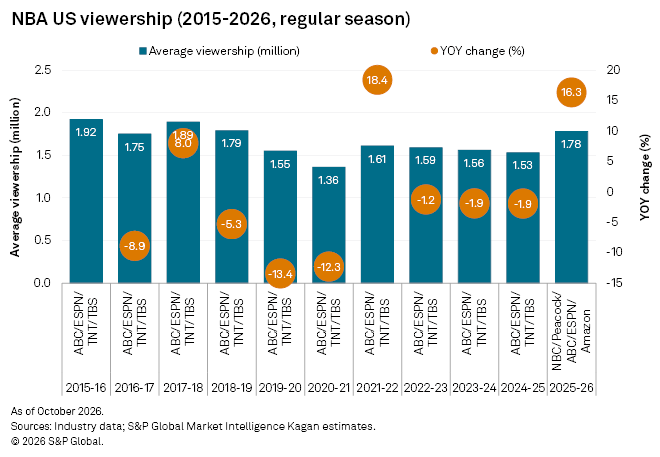
The 2025-26 NBA season set a 24-year high for US viewership, with 170 million Americans tuning in, an 86% increase over the previous year. This surge was fueled by the league's new media rights cycle, which expanded coverage across ABC, ESPN, Amazon Prime Video, NBC/Peacock and NBA TV, ensuring broader access and engagement.
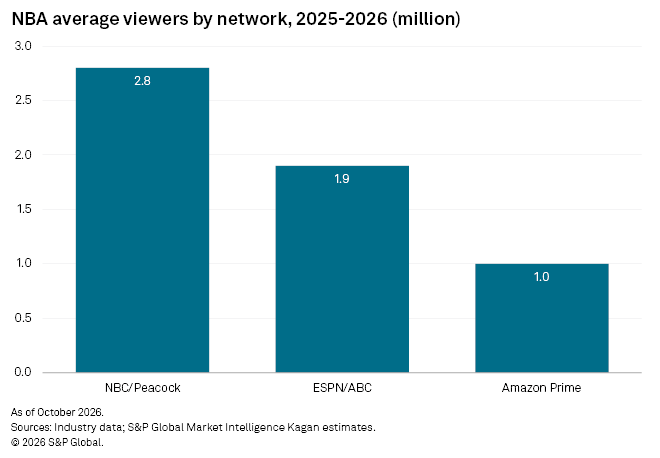
Fans watched over 920 million hours of NBA games, up 25% year over year, and the league averaged 1.78 million viewers per game across its main partners, a 35% jump when including NBA TV. NBC's return to NBA coverage was especially impactful, with game windows averaging 2.8 million viewers and Sunday Night Basketball drawing 3.4 million per broadcast. ESPN and ABC also hit their best combined average since 2018-19.
Marquee telecasts flourished, with 19 games topping 3 million viewers and 57 exceeding 2 million, both multiyear highs. NBC's All-Star Game attracted 8.8 million viewers, its largest since 2011. While part of the increase is due to Nielsen's updated measurement model, the league's reach and frequency of big-audience games have clearly improved.
Streaming also saw strong gains: Prime Video averaged 1 million viewers for its 67-game package and set a new NBA record with 3.15 million viewers for the Warriors-Clippers Play-In game. The NBA's digital and social channels reportedly set a new record of 228 billion views, with LeBron James alone accounting for 2.85 billion.
The 2026 NBA Finals between the Knicks and Spurs averaged 20.6 million viewers per game, the highest since 1998, and peaked at 24.5 million for Game 5. Playoff viewership averaged 6.35 million, up 34% year-over-year, also the league's best since 1998.
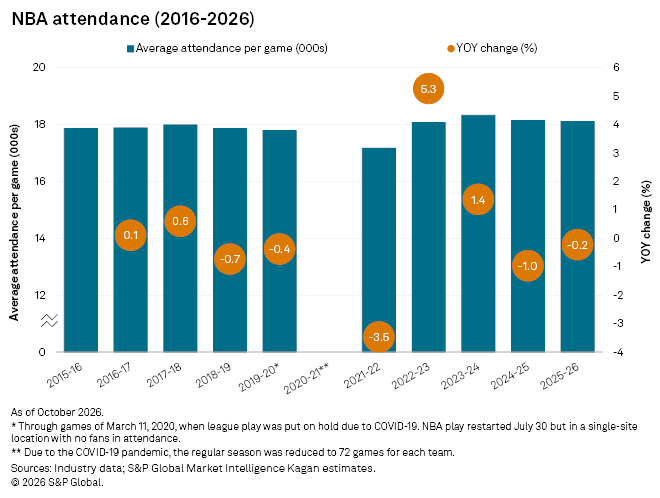
NBA teams attracted over 22 million fans last season, averaging 18,106 attendees per home game, a figure that has surpassed 18,000 for four consecutive years. League-wide, arenas operated at 97% capacity, marking only the fourth time in NBA history that this level of occupancy has been achieved.
Eleven teams sold out every home game, with the Miami Heat currently holding the NBA's longest active sellout streak at 14 straight seasons (excluding pandemic years), while the Celtics have sold out every game since 2021-22.
The Spurs stood out as a major draw, averaging over 18,700 fans at Frost Bank Center, a 15.5% increase from last year, while the Hornets saw a 9% attendance boost following an almost $250 million arena renovation. On the other hand, the Grizzlies had the largest drop (down 7.9%), and the Wizards posted the league's lowest average attendance and seat-fill rate (80.4%) for the second year in a row.
Local media rights evolve following Main Street Sports Group LLC, centralized coverage on the horizon
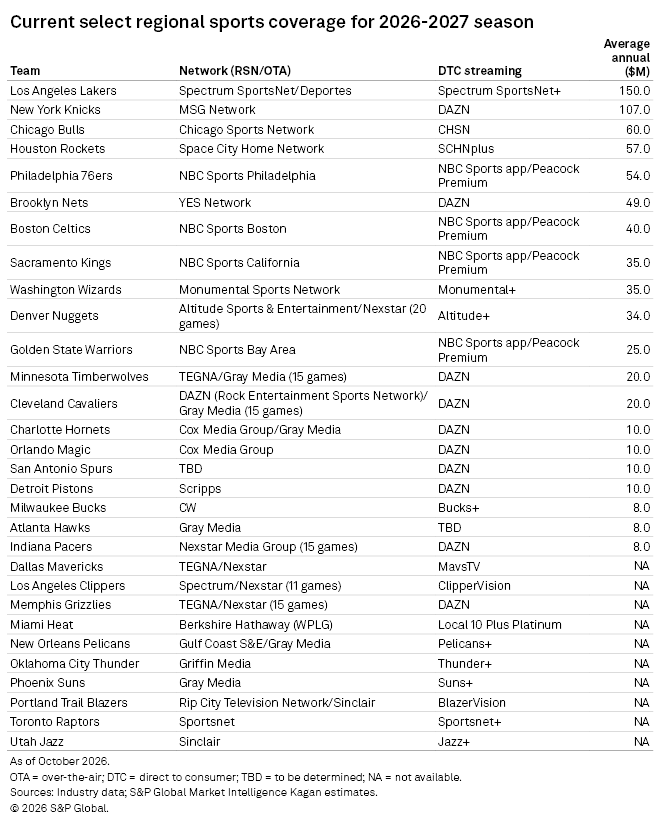
The collapse of Main Street Sports Group has fundamentally reshaped the NBA's local broadcast landscape. With the traditional RSN model no longer viable, teams have quickly adopted a mix of over-the-air (OTA), DTC and hybrid models for the 2026-27 season. DAZN has emerged as a key player, securing exclusive or digital-only streaming rights for at least a third of NBA teams, offering minimum guarantees, revenue sharing and flexible exit clauses ahead of the league's anticipated centralized streaming hub in 2027-28.
Many franchises, including the Hawks, Magic, Hornets, Pistons, Heat and Bucks, have partnered with local broadcasters for OTA deals, often paired with DTC apps. The NBA has built its own production group, while Mobile TV Group and agencies like Playfly Sports support teams with production and advertising solutions.
The abrupt failure of streaming startup Victory+ illustrates the risks of undercapitalized digital ventures, pushing teams to focus on advertising, fan data and direct engagement to offset lost RSN revenue. Teams like the Cavaliers and Timberwolves have signed innovative DAZN deals, while others, such as the Heat and Thunder, use hybrid models combining OTA, cable and streaming. In New York, MSG Network and YES Network will migrate Knicks and Nets streaming to DAZN, maintaining linear access for cable subscribers.
Most NBA teams are now opting for short-term, flexible contracts with mutual out clauses and hybrid distribution, aiming to maximize reach and engagement while keeping options open for the league's future centralized streaming platform.
Expansion fees likely to top $10 billion
NBA expansion is gaining momentum, with Las Vegas and Seattle at the forefront of the league's plans. The Las Vegas bidding war has attracted high-profile groups, with expansion fees projected to reach $12 billion-$13 billion when factoring in new arena construction. The NBA is expected to select a winning Las Vegas bid before Seattle, where One Roof Sports & Entertainment is the main contender.
The NBA's expansion ambitions are fueled by soaring franchise valuations, the influx of private equity, and the desire to tap into new international markets. The Basketball Africa League (BAL) is also transitioning to a permanent franchise model, with bids from Morocco, Nigeria, Senegal, Kenya, Rwanda and South Africa.
Commissioner Adam Silver has stated that the league will decide on expansion by the end of 2026, with at least one new franchise likely to debut by the 2028-29 season. The NBA's expansion strategy is not just about adding teams, but about creating a truly global league infrastructure, with Las Vegas, Seattle and Europe representing the next frontiers for basketball growth
NBA continues to lead innovative advancements
The NBA continues to be a trailblazer in sports technology, piloting innovations that enhance officiating, player performance, and the fan experience. The league is testing a "smart basketball" embedded with a microchip sensor, developed in partnership with Wilson, that can track movement, spin and trajectory. This technology has already been trialed in the G League and Summer League and could soon be used to automate out-of-bounds and shot-altering calls, increasing accuracy and speeding up games.
Wearable technology is also being piloted for officials, enabling real-time communication with the Replay Center. While players routinely use wearables off the court, negotiations with the players' union are ongoing regarding in-game data use and privacy concerns. The NBA's Launchpad startup program is expanding to Asia, sourcing new innovations in player health, AI-driven content and youth basketball development.
On the broadcast side, teams are integrating AI-driven graphics, augmented reality and advanced camera systems to create more immersive viewing experiences. Commissioner Silver has emphasized the importance of technology in deepening fan engagement, personalizing content and creating interactive multi-platform experiences, especially as younger fans consume sports across a variety of devices and channels.
Sports betting and prediction markets are becoming increasingly central to the NBA's fan engagement and revenue, with the league examining partnerships with platforms like Kalshi Inc. and Blockratize Inc.'s Polymarket. While these services boost fan interaction, evidenced by over $245 million in reported trading volume during LeBron James's free agency, the NBA is also pushing for stronger oversight and tighter regulations to ensure integrity and balance commercial growth with a safe, transparent experience.
Lakers sold at record valuation, Timberwolves also change ownership
The Lakers' sale to Josh Kushner and Bob Iger for a record $12.5 billion, just 14 months after Mark Walter's $10 billion purchase, highlights the rapid rise in NBA franchise values and the increasing influence of private equity in team ownership. The swift, high-profile deal has sparked internal Buss family drama and raised questions about the future of the Lakers' lucrative Spectrum Sportsnet Llc TV contract, adding uncertainty to the team's business model and local fan engagement.
Similarly, the Minnesota Timberwolves changed hands quickly, with Marc Stad taking control from Marc Lore and Alex Rodriguez at a $4.5 billion valuation, tripling the franchise's value in just over a year. This trend reflects the NBA's shift toward investor-driven ownership and the view of teams as appreciating assets, rather than family-run enterprises. The new Timberwolves ownership has pledged to keep the team in Minnesota and invest in a new arena, signaling a focus on both stability and growth.
Madison Square Garden Sports Corp. (MSG Sports) spinoff
MSG Sports is spinning off the Knicks and Rangers into separate publicly traded companies to give investors clearer insight and independent valuations for each franchise. This move follows the Knicks' first NBA title in 53 years, as mentioned, which reportedly boosted MSG Sports' quarterly revenue by $67 million and drove strong growth in annual revenue and operating income. The split is expected to unlock additional shareholder value, with analysts projecting the combined market cap could top $15 billion. With the Knicks defending their championship and the Rangers remaining a top NHL attraction, MSG Sports anticipates continued growth in ticket sales, sponsorship, and media rights for both teams.
Economics of Networks is a regular feature from S&P Global Market Intelligence Kagan.
This article was published by S&P Global Market Intelligence and not by S&P Global Ratings, which is a separately managed division of S&P Global.
Content Type
Theme
Segment
Language