ECONOMICS COMMENTARY — 01 Oct, 2026
Global Manufacturing PMI hits highest since February 2022 but price growth also accelerates

Manufacturing business conditions improved worldwide to an extent not seen for four and half years in September, according to PMI® survey data.
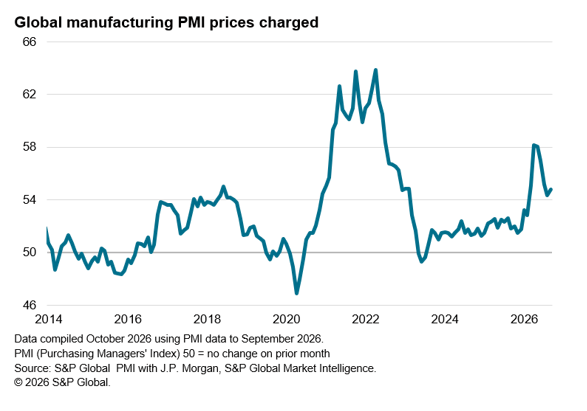
The PMI was buoyed as factories reported the largest global rise in production since July 2021 amid accelerating growth of orders and global trade flows. The headline PMI was also buoyed by employment showing the largest rise for over four years as firms expanded capacity. However, the surveys indicated that demand continued to outpace supply, helping firms pass through rising costs onto customers and driving factory gate selling prices up at one of the steepest rates seen over the past three and a half years.
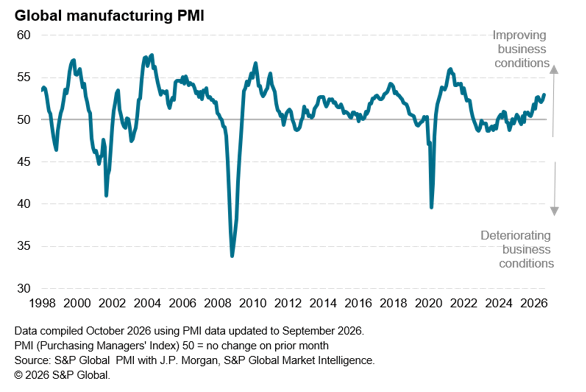
Global PMI at four-and-a-half-year high
The Global Manufacturing Purchasing Managers’ Index™ (PMI) survey, sponsored by J.P. Morgan and compiled by S&P Global Market Intelligence, indicated a further improvement in the health of the factory sector in September.
At 53.0, the headline PMI was the highest since February 2022. If the post-pandemic growth spurt is excluded, September’s reading was the best since May 2018 and indicates that factories are enjoying a much greater business environment in recent months than seen in recent years.
Demand for goods has improved throughout 2026 reflecting the combined increases in spending on AI infrastructure and defence equipment, through inventory building due to price and supply fears resulting from conflicts – notably the war in the Middle East – has also spurred demand.
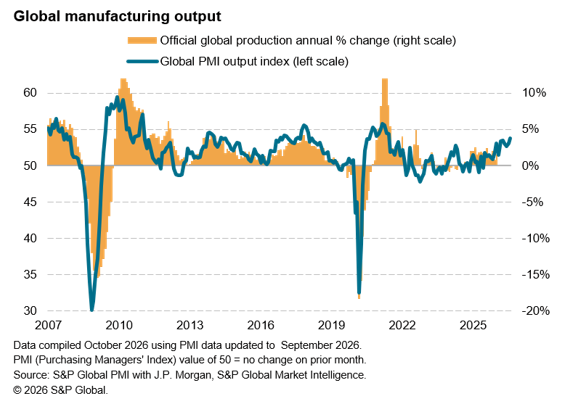
Comparisons with official data suggest that the PMI’s output index, which is highly correlated with official data, is broadly indicative of manufacturing production rising worldwide at an annualized rate of almost 4% in September, its fastest pace since July 2021. That compares with a long-run average of around 2%.
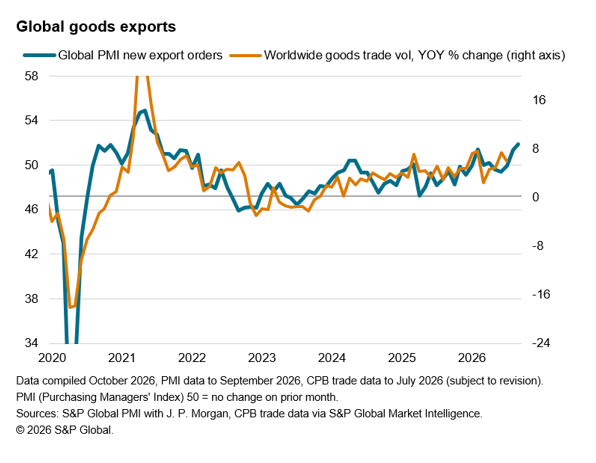
New orders growth meanwhile accelerated to the highest since February 2022, buoyed by a rise in global trade flows. New export orders rose worldwide at a rate not seen since July 2021, indicative of worldwide trade growing at annual rate of approximately 8%.
Pricing power improves as demand exceeds supply
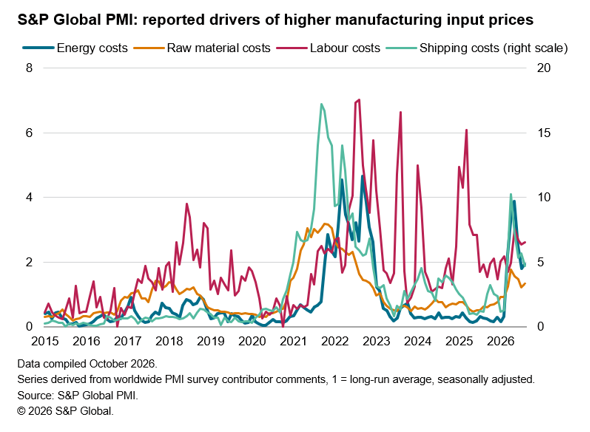
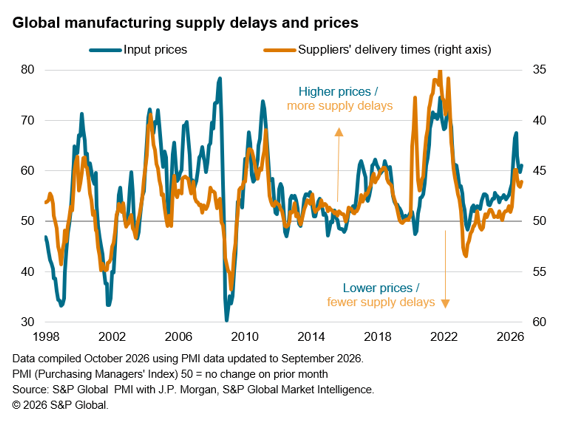
The good news on production and order books is tempered somewhat, however, by signs of sustained inflationary pressures. Factory input costs rose worldwide at a slightly increased rate in September. Although below recent peaks seen in the early months of the war in the Middle East, the rate of inflation remains elevated and the fifth highest seen over the past four years.
Some of the ongoing spike in input prices reflected higher oil prices during the month, feeding through to firms via transportation costs as well as more directly through energy prices. However, the survey data also continue to bring signs that supplier pricing power has improved, allowing cost pressures to be more easily passed through the supply chain and drive factory selling prices higher in September.
Suppliers’ delivery times lengthened in October to one of the greatest extents recorded over the past four years amid supply chain bottlenecks linked to both reduced raw material availability and shipping delays. Longer supply chains typically mean suppliers have greater pricing power.
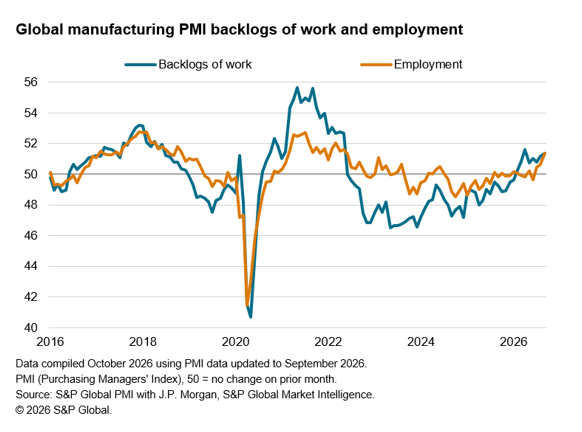
Similarly, manufacturers reported a rise in their own backlogs of orders for an eighth successive month in September, contrasting with falling backlogs of work over the prior 43 months. Like longer supply lead-times, rising backlogs are typically a sign of pricing power being re-established as demand exceeds supply. Hence average prices charged by manufacturers rose worldwide at an increased rate in September. Though not as steep as the spike in prices seen earlier in the year, the PMI data on factory selling prices shows a clear upward trend in the underlying rate of inflation over the past year, with September’s rise the sixth steepest since early 2023.
Factory jobs growth hits highest for over four years
An obvious upside to the stretched capacity being indicated in recent months has been an improvement in hiring, the pace of which stepped up a gear in September. After only marginal employment gains had been recorded worldwide in July and August, September saw the largest rise in factory payrolls since May 2022, as the sustained upturn in demand added conviction to manufacturers’ intentions to expand operating capacity.
Access the latest global PMI press release here.
© 2026, S&P Global. All rights reserved. Reproduction in whole or in part without permission is prohibited.
Purchasing Managers' Index™ (PMI®) data are compiled by S&P Global for more than 40 economies worldwide. The monthly data are derived from surveys of senior executives at private sector companies, and are available only via subscription. The PMI dataset features a headline number, which indicates the overall health of an economy, and sub-indices, which provide insights into other key economic drivers such as GDP, inflation, exports, capacity utilization, employment and inventories. The PMI data are used by financial and corporate professionals to better understand where economies and markets are headed, and to uncover opportunities.
Read our latest PMI commentary here.
This article was published by S&P Global Market Intelligence and not by S&P Global Ratings, which is a separately managed division of S&P Global.
Theme
Location
Products & Offerings